

The same conversation finds me every week. The question is always the same. How do you keep up? My answer has compressed down to four words.
Start with Claude Code.
Not a chat product. Not a copilot in your editor. The CLI. The thing that looks like a terminal and works like a second nervous system. It has been generally available for a year. In that year it has rewired how I work, what I ship, and what I think one person can hold in their head at once.
This post is the long version of those four words. Where Claude Code is right now. Why I keep telling people to start there before anywhere else. What a day and a weekend can look like when you’ve been wearing it for twelve months. I am not going to walk you through installation. The official docs do that fine and they will outlive this post by a wide margin. I am going to tell you what the thing becomes after you live inside it.
Pieces vs. a harness
Most AI tools ship you a piece.
A really good chat window. A really good inline completion. A really good standalone agent. A really good IDE plugin. Each one solves a slice of the problem and ships it well. You assemble the rest yourself and the assembly never quite holds together. Five tabs, three subscriptions, two workflows that overlap by 80%, and a brain still doing all the routing.
Claude Code ships you something different. It ships you a harness around a frontier model.
The harness is the part most people undersell on day one. It is invisible until you have used it for a few weeks and then it is everything. Not one feature. Connective tissue.
Rules that load every session, so the model already knows your voice, your preferences, your machines, and the people you work with.
Skills you build up over time as muscle memory, where every correction you make becomes a reusable capability instead of a one-time fix.
A three-layer memory architecture, so what you learned together yesterday does not evaporate overnight.
Subagents you can fan out to ten at a time when the work is independent.
Hooks that act as guardrails the model cannot bypass when you have made a rule about safety or destructive operations.
Sessions and continuity, so you are not restarting your brain every morning explaining the same context.
Filesystem and tool access, so the thing does things instead of telling you what to do.
And then there is the part Anthropic did not intend to show us. The Claude Code system prompt that leaked earlier this year made the engineering behind the experience visible in a way the docs never quite do. I am not going to dwell on it. The takeaway is small and clean: a serious amount of craft sits inside that harness, doing work for you that you cannot see and probably would not think to ask for.
Hold onto this part.
A great model with no harness is a demo. A harness with a great model is a second nervous system. Pieces are interchangeable. The harness compounds.
The exoskeleton
The metaphor I keep landing on is exoskeleton. I’ve used it before in The Data Paradox: AI isn’t your coworker, it’s your exoskeleton. A copilot sits next to you. An exoskeleton is load-bearing. You move differently because it’s on. You attempt things you would not attempt without it.
Once you’ve worn the rig for a few weeks, working without it feels slow. Not the cute way people say a new tool is slow when they mean novel. The literal way. You sit down at a keyboard with no harness and you can feel the missing carry.
What a day looks like
Let me make this concrete. One Thursday in January, I ran eleven parallel work streams in a single day. I kept a log. Here is what was on it.
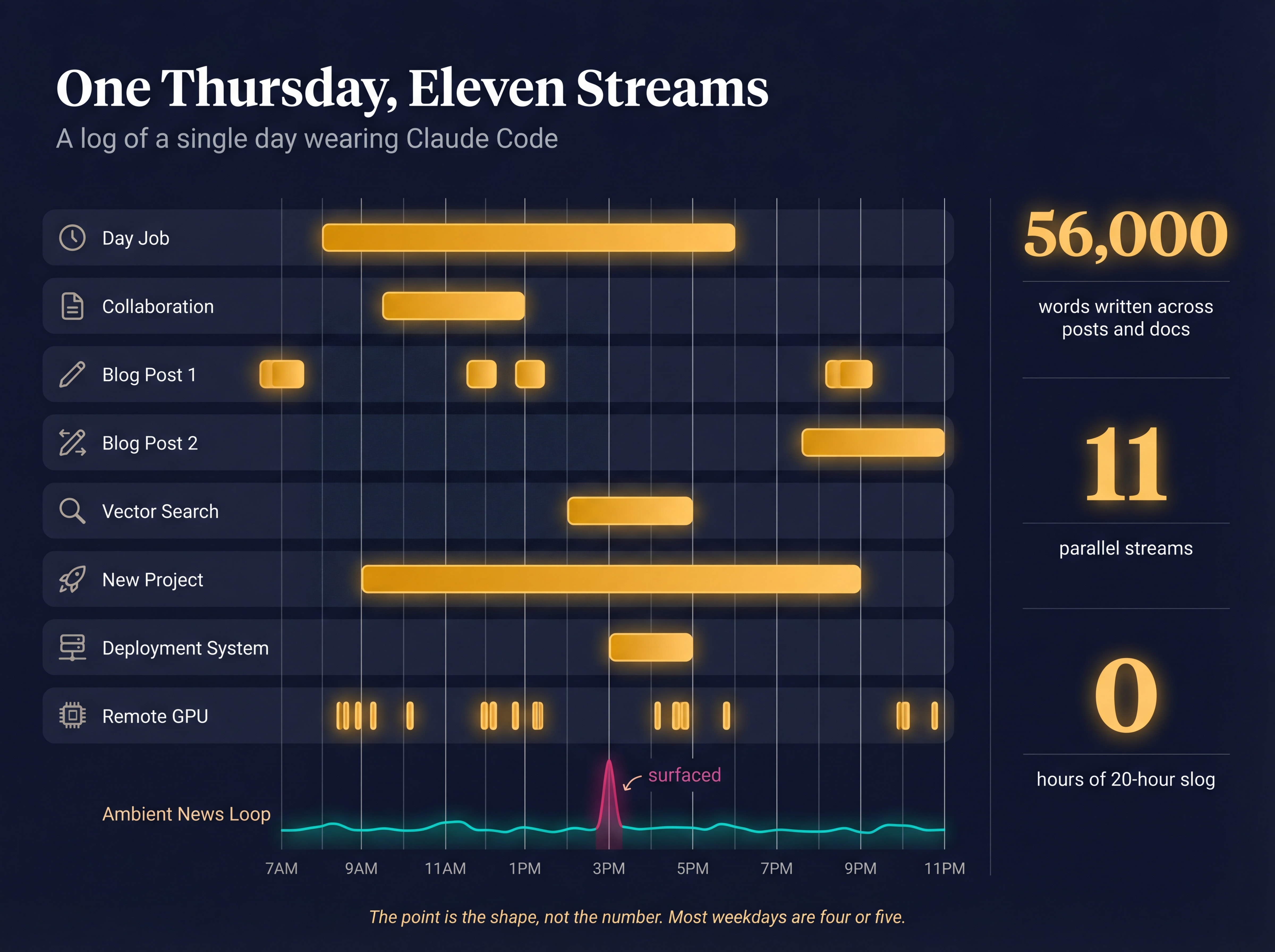
An 8-hour workday at the day job. Meetings starting early, running heavy, ending late. Stakeholder updates that need answers I have to stand behind, not answers a model generated. A team to lead. Decisions no model is going to make for me. That stream ran full intensity from morning through evening and took nothing from what follows.
A collaboration project advancing two or three hours of work in the background. Literature review synthesized. Training code iterated. A progress summary generated as both markdown and PDF. I opened the files that evening and read what the harness had produced while I was in meetings.
Two long-form posts written the same day. One ran 4,700 words. The other ran 2,100 and went live that night. The first was dictated in fragments during a morning workout, filled in between meetings, polished in the evening. The second started as a walk and ended as a published post. I have stared at enough blank pages after 90-minute review meetings to recognize what the harness takes off the table.
A vector search and RAG upgrade to one of my autonomous research systems. It had been accumulating data but had no way to query itself. By end of day it could answer natural-language questions against its own memory. Two to three hours of elapsed wall time. Most of that was me checking in, not me typing.
A new project conceived in the morning, deployed by evening. Frontend scaffolded. Backend stubbed. Fifteen documentation files generated. Vision, architecture, algorithm, roadmap, FAQ, privacy, success metrics. Not a demo. A real POC running on localhost.
A production deployment system built end to end. VM bootstrapping scripts. Configuration management. SSH automation. Monitoring hooks.
A long-running training run being watched on a remote GPU machine, with the harness reporting back when anything interesting happened.
In the background, Claude reading the world for me. I wrote about the mechanics in The Overnight Loop. The short version: loops running on a schedule that stay quiet most of the time and surface the one thing that earns my attention. I have been on the receiving end of enough daily digests to last several lifetimes. I do not want another one. When a loop surfaces something, I either ask for more, or we build.
Total words written that day across posts and docs: just north of 56,000. Total skills added: a few. Total 20-hour slog: zero.
Eleven streams is the high side of a normal day. Most weekdays are four or five. The point is the shape, not the number. Infrastructure that compounds, doing the carry I used to do alone.
What a weekend looks like
If a weekday is parallel streams, a weekend is the upper bound.
Two weekends ago, I scoped, built, and documented a small drug discovery model end to end. 4B parameters. Curriculum training across 600,000 samples from six public sources. A reinforcement learning stage with chemistry-specific rewards. A benchmark harness across five categories. Documentation and a reproducibility setup that did not embarrass me.
The full Pharmakon build is its own post (next week, once the model finishes training and the numbers are real). For now, the part that matters for this essay is the shape.
Normally this is months for a small team. A scoping doc, a kickoff, a midpoint review, a results meeting, a steering committee somebody forgot to invite the data engineer to. I did it across a weekend because the harness carried everything that was not the thinking. Dataset wrangling. Boilerplate. Training scaffolding. Benchmark plumbing. Documentation. The parts that historically eat the weekend before you have made a decision about anything that matters.
The trigger was the news loop. A few related papers crossed it Friday evening. I read them, asked for more, and the asking turned into a conversation about whether a 4B base model with the right curriculum could close the gap to a 27B pharma-specific model. By Saturday morning the conversation had a folder. By Sunday night it had a training pipeline.
The curiosity-to-project friction collapsed. That is what the harness actually buys you.
Full writeup coming.
The weekend does not work without the weekday. The weekday does not work without a year of the harness. Pharmakon is what compound interest looks like when you cash a chip.
How it compounds
A weekend can hold Pharmakon. A weekday can hold three side projects in parallel without anything dropping. Five mechanisms doing the work, most of which I have written about elsewhere. Fast tour, then a pointer for each.
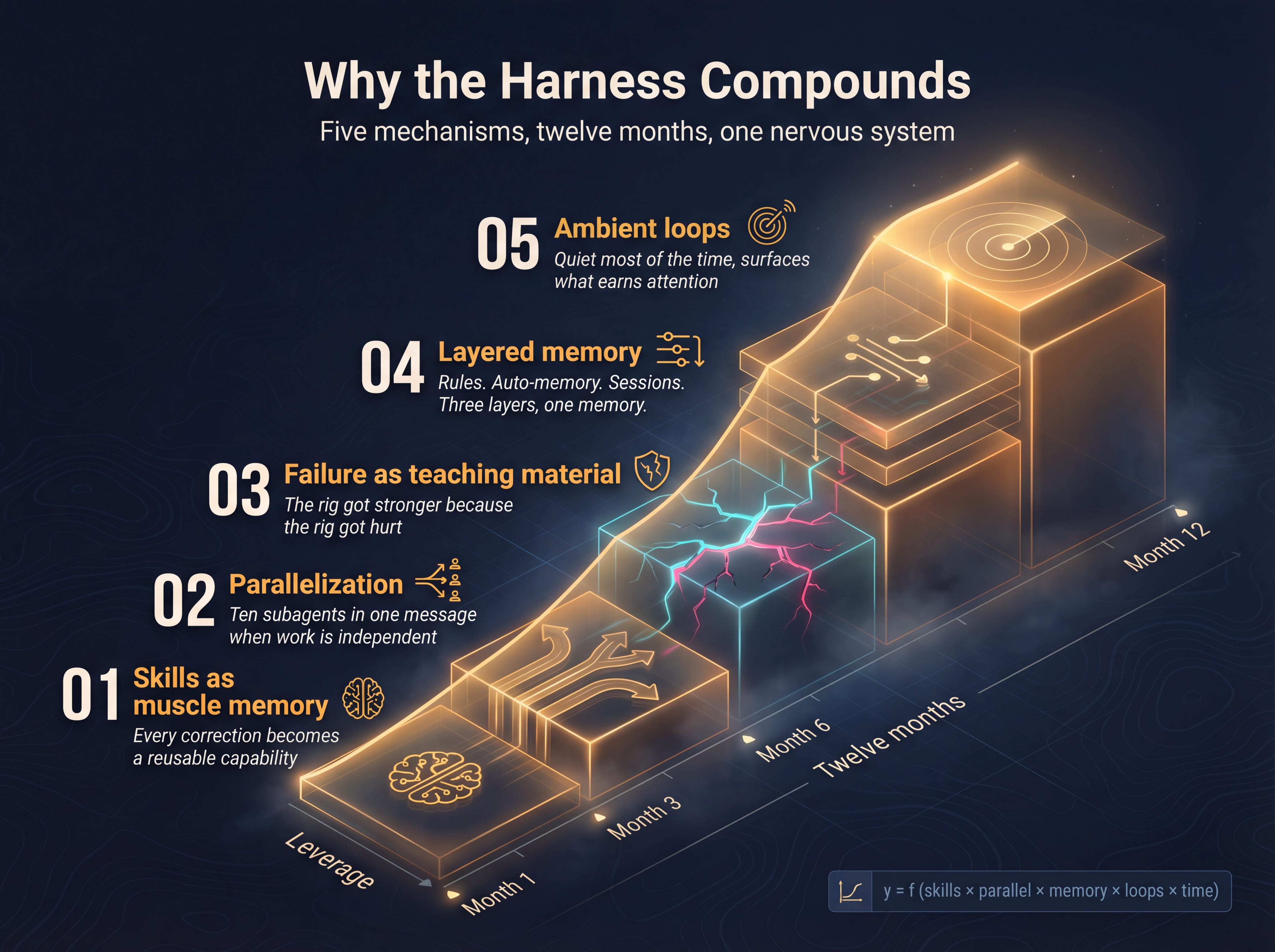
Skills as muscle memory. Every correction becomes a reusable capability. A year of corrections turns into a library that knows how I write, commit, review, draft, deploy. None of them feel like much in isolation. Together they feel like a different person sitting at the keyboard. Full argument in Claude Skills vs. MCP Servers.
Parallelization. Ten subagents in one message when the work is independent. Feels weird week one, obvious by month two, invisible by year one. The same way you stopped noticing you have ten fingers.
Failure is teaching material. A crash loop early on cost me an embarrassing amount of API spend. The lesson was not “be more careful.” The lesson was that guardrails matter more than cleverness and the harness needs hooks the model cannot bypass even when it thinks it is helping. Every meaningful failure since has turned into a hook or a rule. The rig got stronger because the rig got hurt.
Layered memory. Rules at the top, loaded every session. Auto-memory in the middle, loaded on demand. Sessions at the bottom, ephemeral. I do not re-explain myself every morning. This is the difference between a tool that knows you and a tool that asks every time and forgets the answer by Friday.
Ambient loops watching the world. Covered above. See The Overnight Loop for the build.
If you’ve read me before, this thread runs through The Art of the Impossible (what one person can attempt now), Your AI Strategy Should Be 1,000 Small Bets (the arithmetic of compounding bottom-up), The Agentic Tipping Point (why the boundaries between roles are blurring), and Your Data Science Team Is Stuck at Level 2 (why most teams have not crossed the gap yet). This post is about the tool that makes all of them concrete on a Tuesday.
The starter kit
If you want to skip the month where you figure out how to configure your own harness, I made it easy.
A public repo called slopless. github.com/BioInfo/slopless. My CLAUDE.md, my rules, my hooks, my statusline, the whole scaffolding. The part of my setup that is not personal. The part anyone can reuse.
The way you use it is the part most people miss. You do not fork it and read it line by line like a textbook. You open a terminal, run Claude Code in an empty directory, and say something like:
“Look at github.com/BioInfo/slopless and set me up the same way, asking me about anything that should be personalized.”
Then you answer its questions. Name. Machine. Editor. What kinds of projects you work on. Whether you want the agent hooks that block destructive deletes. Whether you want the voice profile or you’ll write your own.
Sixty seconds later you have a working harness that knows who you are and what not to break. That self-configuring move is the magic most people miss on day one. The harness can extend itself. The same capability that lets it build Pharmakon scaffolding over a weekend lets it build your scaffolding over a coffee.
What slopless gives you is scaffolding. What it does not give you is my voice, my projects, or my judgment. Those you build by living inside it. Scaffolding is the head start, not the finish line.
What to do Monday morning
Three starts, depending on which one of these you are.
If you are a non-technical leader, start with Claude Cowork. I wrote about why Cowork is the on-ramp that changes everything in Cowork’s iPhone Moment. The browser and desktop apps are absorbing more CLI territory every month. Start there if a terminal makes you nervous. Value in week one with no setup beyond a login.
But the honest version. If you want to flourish, buy a Mac, install Claude Code, point it at slopless, and figure it out. Spend the weekend feeling stupid. Spend the next weekend feeling slightly less stupid. By the third weekend you will look at the web product the way a guitarist looks at GarageBand: useful, friendly, not where the work happens.
The web product is the on-ramp. The CLI is the highway. You will thank me.
If you are a technical IC, pick the project you have been postponing. The one that has been on your list for three months because you cannot find a clean two-day window for it. Open it on a Saturday morning with the harness on. You will not finish it that morning. You will get further than you thought possible, and the rig will hold the context for you when you come back to it Sunday with coffee and slightly more humility.
If you are a team lead, get your team on Claude Code before you build the platform you have been planning. You probably do not need the platform. You probably need the team using the harness with a shared CLAUDE.md and a few internal skills. The platform people want is usually a worse version of what already exists, shipped six months late, with a Slack channel for support requests nobody answers.
One more thing
A weekend was enough to scope a drug discovery model. A Thursday was enough to run eleven streams without anything falling. A year ago those sentences would have read like a brag. Today they read like a Tuesday.
The gap between the people using Claude Code seriously and the people who have not started yet is wider than most leaders realize, and it is widening fast. Every week I meet someone smart who is waiting for the right moment to dive in. There is no right moment. There is only the moment you start.
Start with Claude Code. The rest gets easier from there.