

The technical capabilities existed. The interface just made them accessible. Here’s what just became possible for everyone.

The day before Anthropic announced Co-work, I listened to Ethan Mollick describe Claude Code’s potential beyond coders. The next day, Anthropic delivered exactly what he was talking about.
This is a pattern I recognize. The technical capabilities existed, like smartphones before the iPhone. Power users had figured out the workflows. The interface and accessibility unlocked mass adoption.
I used to flop around trying to make things happen. Grinding through tasks, working hard, results coming slow. Now I have work running constantly in the background. I check different windows throughout the day. Guide when needed. Absorb what I need. Go into a meeting. Come back to completed analysis. The difference between then and now isn’t talent. It’s delegation mindset.
Co-work isn’t competing with Claude Code for developers. It’s the iPhone moment that makes autonomous multi-step work accessible to everyone. And that changes everything.
What Just Happened
Anthropic just launched Co-work, a new way to work with Claude that’s currently available to Claude Max subscribers on macOS. It’s different from everything else they’ve built.
You grant Claude access to specific folders on your computer. Not your entire system, just the folders you choose. Then you describe what you want. “Organize my downloads by sorting and renaming each file.” “Create a spreadsheet from these scattered notes.” “Draft a report from my research folder.”
Claude makes a plan and works through it. Autonomously. You can queue multiple tasks and let them run in parallel without waiting between requests. The experience feels less like prompting and more like delegating to a colleague. Asynchronous communication. You set the task, Claude executes, you loop back in when it needs guidance or when you’re ready to review.
This isn’t new capability. It’s the same Claude Code file system access developers have had for months. Same autonomous multi-step execution. Same ability to read, edit, and create files. The difference is packaging.
No terminal. No configuration files. No learning bash commands or MCP servers. Co-work brings these capabilities to everyone through a sidebar interface that feels natural. You describe outcomes. Claude figures out the process.
This is convergence, not competition. Terminal versus sidebar misses the point. The unlock is the same: autonomous multi-step work where you set tasks running and come back to completed work.
Here’s what matters. Tools and models aren’t the barrier anymore. Access isn’t the barrier. These capabilities have existed. The barrier is mindset.
Can you let go? Can you delegate? Can you describe outcomes without prescribing process?
That’s what determines whether Co-work becomes your superpower or just another tool you tried once.
The gap between early adopters and everyone else just collapsed. The question is: can you learn to delegate?
Three Things That Change Your Tuesday
Let me show you what unlocks when you can delegate multi-step tasks and check back later.
Automated Research at Scale
I run automated research constantly. The system I call ARIA aggregates signals from newsletters, arXiv papers, Hacker News, Reddit, company blogs, Twitter bookmarks. Multi-layer deduplication ensures I never see the same story twice. Throughout the day: new developments since last check, zero repetition.
This isn’t just convenience. It’s compound velocity.
I check in throughout the day. See what ARIA found in AI research since my last check. Patterns across dozens of sources that no human could track manually. That informs the questions I ask. Better questions lead to better research. Better research leads to better articles. Better articles lead to more interesting conversations. Those conversations lead to new questions worth researching.
The velocity compounds. Each layer builds on the last.
Before I had this, I’d spend weekends trying to catch up. Scanning newsletters. Checking forums. Missing things. Always behind. Now I’m ahead. Not because I work harder. Because work continues in the background while I’m in meetings, writing, thinking.
What used to take a week of scattered research now happens automatically. The time I save isn’t the point. The point is I’m always informed. I make better decisions faster. Those decisions compound into capabilities that look impossible to people still doing this manually.
Competitive Intelligence at Scale
Point Claude at competitor filings, press releases, job postings, conference talks. Get strategic synthesis, not just aggregation.
“What’s Palantir doing in healthcare based on public signals from the last six months? Not just what they say they’re doing. What the pattern of hires, partnerships, and product releases reveals.”
Humans miss patterns across hundreds of signals. We see individual data points. We don’t naturally aggregate signals into insight at scale. Claude does. And when you wake up to that analysis, you see things your competitors don’t.
This is intelligence work. The kind that used to require teams. Now it requires clarity on what questions matter and trust that the synthesis will be good enough to act on.
Your Computer as Organized Extension of Mind
I live in Claude windows. It’s become almost the OS for my Mac.
“Organize these 400 meeting recordings by project. Extract key decisions. Flag action items. Create a summary document for each project showing what we decided and what’s still open.”
This used to be weekend work. Catching up on what happened while I was in back-to-back meetings. Reconstructing context. Now it’s Tuesday night delegation, Wednesday morning review.
The more you trust it, the more it handles. File organization. Download folder cleanup. Document structuring. Research aggregation. The stuff that matters but doesn’t require you.
What changes is your relationship with your computer. It stops being a tool you operate and starts being an extension of how you think. The files are organized. The research is synthesized. The context is maintained. You focus on decisions, not housekeeping.
Set it running Tuesday night. Review Wednesday morning. Ship Wednesday afternoon. This is compound velocity.
The Delegation Mindset
I’ve watched people try and fail with powerful AI tools. The difference isn’t the tool. It’s whether they can delegate.
Anthropic published a getting started guide. Read it. But mindset comes first. Tools follow mindset. Not the other way around.
Here’s what makes delegation work:
1. Trust the Results, Not the Process
The first time you hand Claude a real task and walk away, it feels uncomfortable. You want to watch. You want to guide every step. Resist that.
Describe what you want. Let Claude figure out how. Come back when it’s done. Check the result. If it’s wrong, refine and try again. If it’s right, expand what you delegate.
Start small if you need to. Organize your downloads folder. That’s low risk. Build confidence. Then scale up.
2. Different Doesn’t Mean Wrong
Claude will do things differently than you would. It will organize files in ways you didn’t expect. Structure research with different headers. Solve problems using approaches you wouldn’t have tried.
That’s fine. Judge outcomes, not methods.
If the files are findable, the organization works. If the research is accurate, the structure doesn’t matter. If the code runs, the implementation details are secondary.
Getting comfortable in the uncomfortable is learnable. It just takes repetition.
3. Describe Outcomes, Not Process
This is the hardest shift for people who’ve been doing knowledge work for years.
Bad delegation: “Use the Read tool to open files in the research folder. Parse each PDF for mentions of clinical trials. Extract the trial IDs. Query ClinicalTrials.gov for each ID. Aggregate the results.”
Good delegation: “Analyze our research folder and identify which clinical trials our team has been tracking. Get current status for each from ClinicalTrials.gov. Summarize what’s changed in the last month.”
Same outcome. One tells Claude what to do. The other tells Claude what you need. The second one works better because Claude can adapt when it hits something unexpected. The first one fails when your prescribed process doesn’t match reality.
4. Think Asynchronously
This is the unlock most people miss.
Delegation isn’t about finding tasks to hand off during your workday. It’s about work continuing in the background while you focus on something else.
I have multiple Claude windows running throughout the day. Research in one. Analysis in another. Organization in a third. I check in. Guide when needed. Absorb results. Move to the next thing. Come back later to completed work.
The pattern:
Set research running → go to meeting → come back to synthesis
Set competitive intel gathering → write for an hour → check back to strategic analysis
Set file organization → think about a problem → return to organized structure
This is how you multiply capability without multiplying hours. Work continues while you’re doing other work.
5. Iterate and Refine
First result is rarely final. That’s fine.
The research synthesis comes back too broad? Refine it. “This is good but too general. Focus specifically on trials in oncology that failed in Phase 2. I want to understand why.”
The file organization makes sense to Claude but not to you? Adjust it. “Reorganize these by date instead of project. I need chronological, not categorical.”
This is collaboration. You bring domain knowledge and judgment. Claude brings execution speed and pattern recognition across data you couldn’t process manually. Together you get to answers neither of you would reach alone.
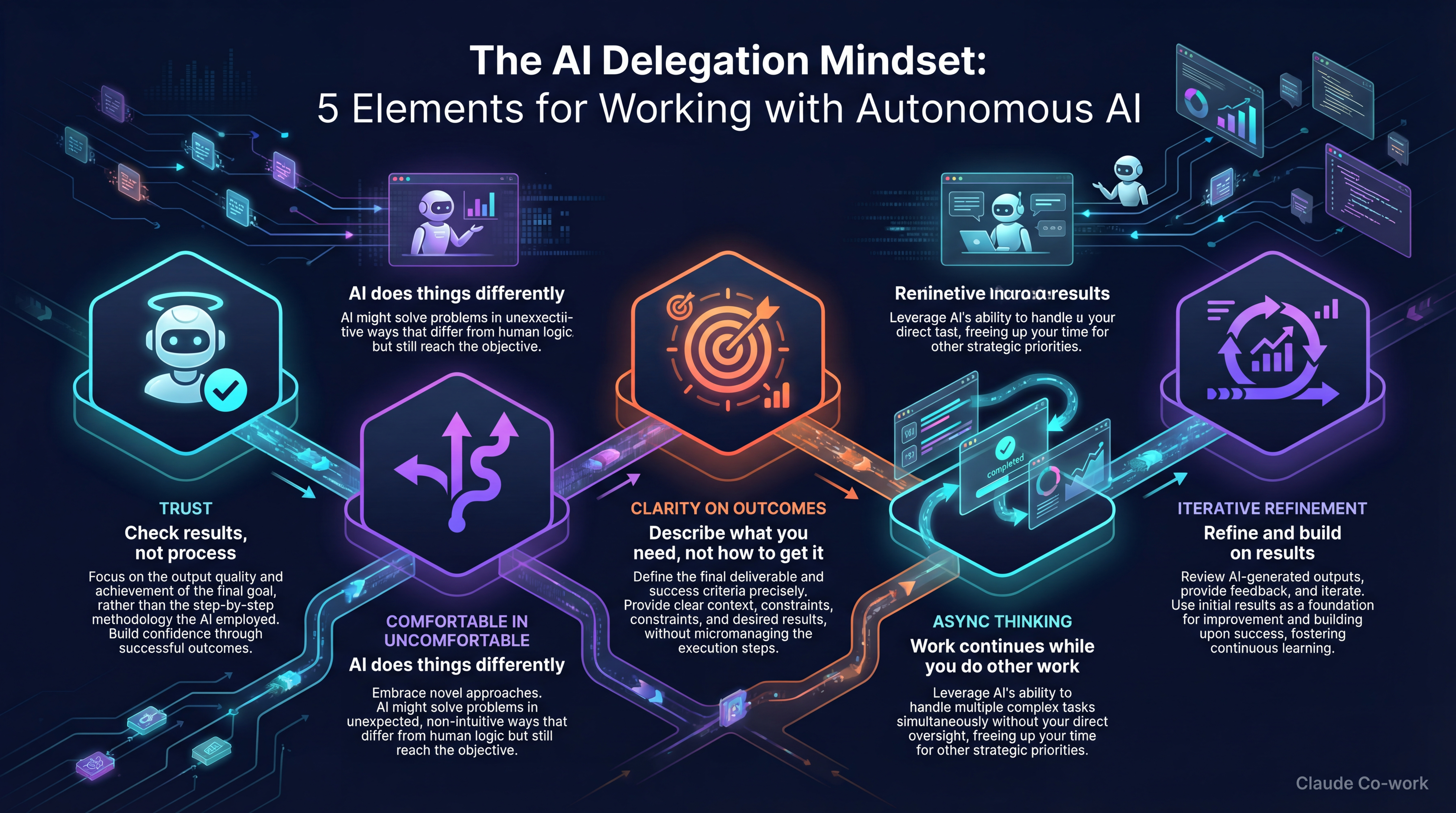
Delegation isn’t about finding tasks to hand off. It’s about reimagining what you’re capable of when work continues while you’re doing other work.
Why Velocity Compounds
I’ve written about compound velocity before. The 20-hour AI research lab I built. The fine-tuning experiments that went from idea to published model in days. The pattern is the same.
Delegate overnight research. Wake up informed. Make better decisions faster. Better decisions lead to more ambitious projects. More ambitious projects give you more to delegate. More delegation teaches you what works. You get better at delegating. Velocity builds on velocity.
This is why early adopters pull ahead. Not because they have better tools. Everyone has access to the same models, the same APIs, the same capabilities. The moat isn’t access anymore.
The moat is mindset. Who learned to delegate? Who’s comfortable in the uncomfortable? Who can describe outcomes without prescribing process? Who thinks asynchronously?
Those are the skills that matter now. And they’re learnable.
The future of human-AI collaboration isn’t copilot prompting. It’s not automation replacing you. It’s async delegation where you multiply your capability without multiplying your hours.
You describe what success looks like. Claude figures out how to get there. You review, refine, and build on the results. Repeat.
That pattern, applied consistently, creates compound velocity. Small improvements compound into capabilities that look like magic from the outside.
Early adopters don’t have better tools anymore. They have better delegation patterns. And patterns are learnable.
The Gap Just Closed
Here’s what just happened. The technical capabilities that power users figured out are now packaged for everyone. Co-work is the iPhone moment.
For the past year, the gap between early adopters and everyone else has been widening. People who learned to delegate to AI have been building faster, researching deeper, operating at a scale that looks impossible to people still doing everything manually. Multiple streams of work running in parallel. Constant background progress. Checking in across windows, guiding when needed, absorbing results, moving forward.
That gap just collapsed.
You have access to the same tools I have. Same file system access. Same autonomous multi-step execution. Same ability to set tasks running and come back to completed work.
The question isn’t about access anymore. The question is mindset.
I wasn’t good at delegation two years ago. I micromanaged. I prescribed every step. I checked progress constantly. I didn’t trust the results. I learned. You can too.
Start small. Organize your downloads folder. Build trust through repetition. Ask for competitive intel on one competitor. Practice setting tasks and walking away. Set research running on a question that matters. Do something else. Check back later.
Get comfortable in the uncomfortable. Learn to describe outcomes instead of prescribing process. Iterate and refine.
The only barrier left is you.
Because velocity compounds. And the gap between those who learn this and those who don’t? That’s about to widen faster than ever.
The iPhone moment just happened. The question is: will you learn to use it?