

Yesterday, Meta paid somewhere between $2 and $3 billion for Manus. The same day, I launched justinhjohnson.com.
Not a coincidence. Or rather, the timing is coincidental, but the convergence isn’t. The world is waking up to what I’ve been building toward for the past 18 months: AI that does things, not just answers questions.
“Manus went viral earlier this year after it released what it claimed was the world’s first general AI agent, capable of making decisions and executing tasks autonomously, with much less prompting required than AI chatbots.”
That quote from Reuters captures the shift perfectly. Less prompting. More autonomy. Completed work, not suggestions.
The Answer Problem
For the past two years, enterprise AI has mostly been a glorified search engine. Ask a question, get an answer. Maybe a good answer. Maybe hallucinated nonsense. But either way, the work wasn’t done. You still had to do something with that answer.
I watched scientists spend 80% of their time on implementation, not analysis. They’d get an insight from an AI tool, then spend hours or days translating that insight into action. Write the code. Query the database. Format the report. Schedule the meeting. Run the experiment.
The gap between “here’s what you should do” and “it’s done” was enormous.
And that gap is where value lives. Anyone can have an insight. Execution is everything.
What Manus figured out, and what I’ve been building toward, is that the future isn’t better answers. It’s completed work.
The Trilogy
Enterprise AI isn’t one thing. It’s three things working in concert.
I’ve spent the past year driving this into production. What I’ve learned: you need all three pieces, and you need them to interoperate.
Data
Before anything else, your data has to be in order. AI-ready. Clean, structured, accessible, compliant. This isn’t glamorous work. It’s essential work. Without it, you’re feeding garbage into your models and wondering why the outputs smell.
Models
Not one model. The right models for the right tasks.
Small language models trained on domain-specific data. I helped build OncoVLLM, a specialized model for oncology research that outperforms generic models on our benchmarks. Frontier models like Claude for reasoning and complex analysis. Diffusion models for generating and manipulating images in scientific contexts.
The insight: model selection is a portfolio decision, not a single choice. Different problems need different tools.
Agents
And now we’re here. The third piece. The most hyped, and for good reason.
Agents tie it all together. They orchestrate the data and the models to complete actual work. This is where Manus lives. This is where the $2-3B valuation comes from.
Data provides the fuel. Models provide the intelligence. Agents provide the action.
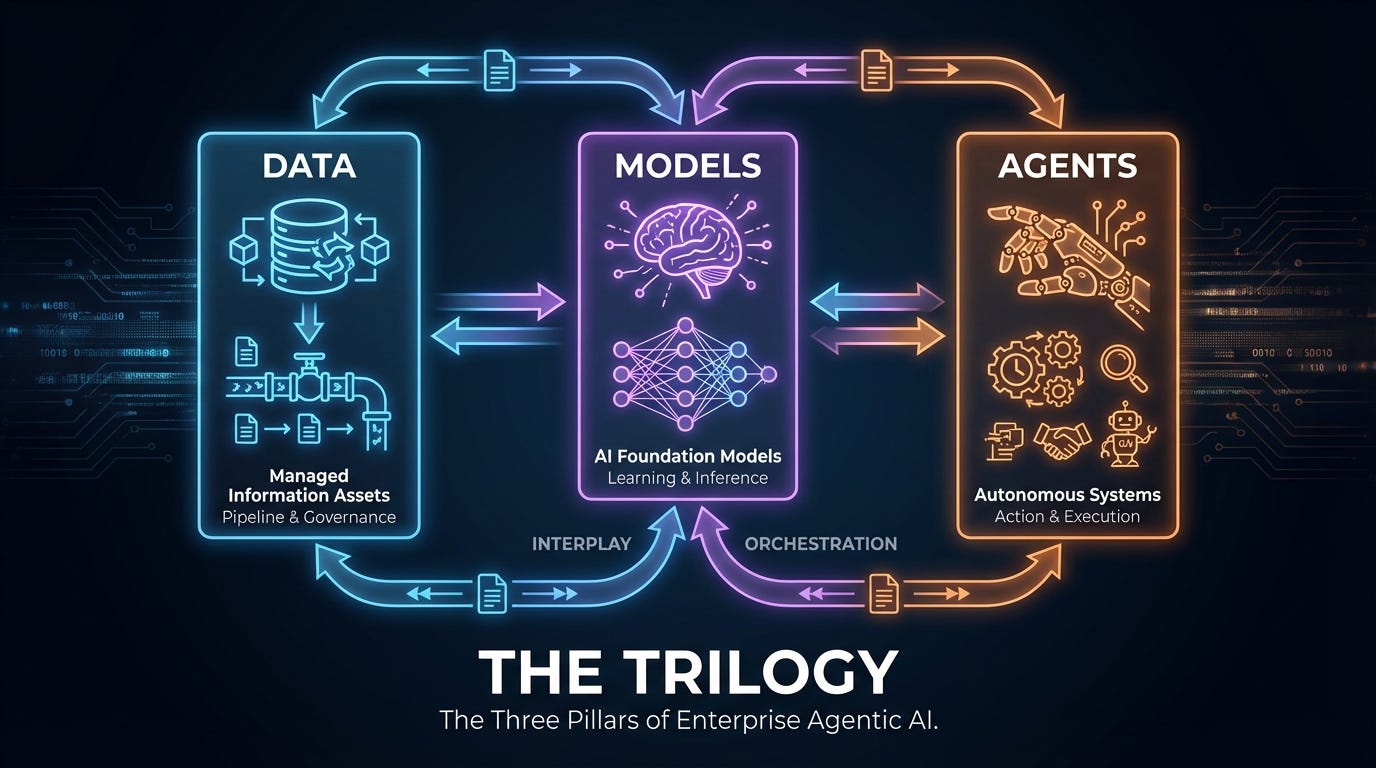
I’ve been working on this interplay for over a year. It’s validating to see the industry arrive at the same conclusion.
Why Now?
Three technical shifts enabled the agentic moment:
Context windows expanded. When models could only hold a few thousand tokens, agents were impossible. Every task required starting from scratch. No memory. No context. No continuity. Now, with 100k+ token windows, agents can hold complex state across multi-step workflows. They can remember what they were doing and why.
Tool use matured. Function calling went from experimental to production-ready. The Model Context Protocol (MCP) created a standard for connecting models to external tools. Structured outputs made it possible for AI to drive software reliably, not just generate text that might work.
Reasoning improved. Chain-of-thought prompting, o1-style reasoning models, and self-correction mechanisms made agents smarter about when to take action and when to pause. They stopped being overconfident pattern matchers and started being careful executors.
The result: AI stopped being a search engine and started being a colleague.
Manus claims performance surpassing OpenAI’s DeepResearch. Not better at answering. Better at doing.
Proof in Production
I don’t just write about this. I build it.
Earlier this year, I helped create an enterprise agentic platform that embodies exactly what Manus represents. The numbers tell the story:
500+ active users
25x growth rate
Days → Minutes time savings
7 MCP servers deployed
But the numbers are less interesting than the behavior change. Scientists stopped asking “how do I...” and started asking “do this.”
The platform responds with completed work, not instructions.
One researcher told me, “I used to spend three days preparing data for analysis. Now I describe what I need and go get coffee. When I come back, it’s ready.” That’s the shift. Not faster answers. Faster work.
The key insight: every manual step in a workflow is a place where humans make errors, lose context, or simply run out of time. Agents compress those steps. They don’t forget. They don’t get tired. They don’t make transcription mistakes. I wrote about this when Manus first launched back in March.
The Personal Frontier
I wanted to push further. What if your research never stops?
So I built ARIA. Autonomous Research & Ideation Agent.
It runs 24/7 on a DGX Spark in my home lab. 14 distinct actions: generate, refine, combine, mature, sketch, validate, implement, critique, incorporate, promote, explore, consolidate, debug. Up to 48 sessions per day. Adaptive thresholds that learn what works and double down.
Think of it as a living research organism. While I sleep, ARIA explores the space of possible ideas. When I wake up, there are novel hypotheses I didn’t have to think of. Connections I wouldn’t have made. Directions worth investigating.
Most of them are garbage. That’s fine. The good ones are worth it.
This is where research is going. Not AI that helps you think. AI that thinks on your behalf, at scale, around the clock.
What Meta’s Move Signals
When a company pays $2-3 billion for a startup that went viral on X with a demo video, they’re not buying current revenue. They’re buying a bet on the future.
Three implications:
Validation. The big players see what I see. Agentic AI is the next platform shift. Not a feature. Not an upgrade. A new way work gets done. Meta, OpenAI, Google, Anthropic are all racing toward the same destination.
Acceleration. This will move fast. Manus had a strategic partnership with Alibaba’s Qwen team. Beijing showed interest in supporting them. Now Meta’s bringing those capabilities to consumer and business products. The competitive pressure just intensified dramatically.
Enterprise opportunity. Early adopters will pull ahead. Not marginally. Dramatically. The organizations that figure out agentic AI in 2026 will operate at a fundamentally different level than those still wrestling with chatbots in 2027.
I call this the 1:N thesis. One person with agentic AI tools can produce team-level output. The multiplier is real.
The Invitation
I didn’t plan for Meta’s Manus acquisition to coincide with launching justinhjohnson.com. But I’m glad it did.
The portfolio represents 18 months of work: 34 projects, 8 models trained, a trilogy of platforms serving over 500 users. It’s proof that the agentic future isn’t theoretical. It’s already in production.
If you’re curious, explore:
The portfolio: justinhjohnson.com
The writing: Run Data Run
The conversation: @BioInfo on X or LinkedIn
The agentic moment has arrived. The question isn’t whether to adopt this approach. It’s how fast you can get there.
I know my answer. What’s yours?