

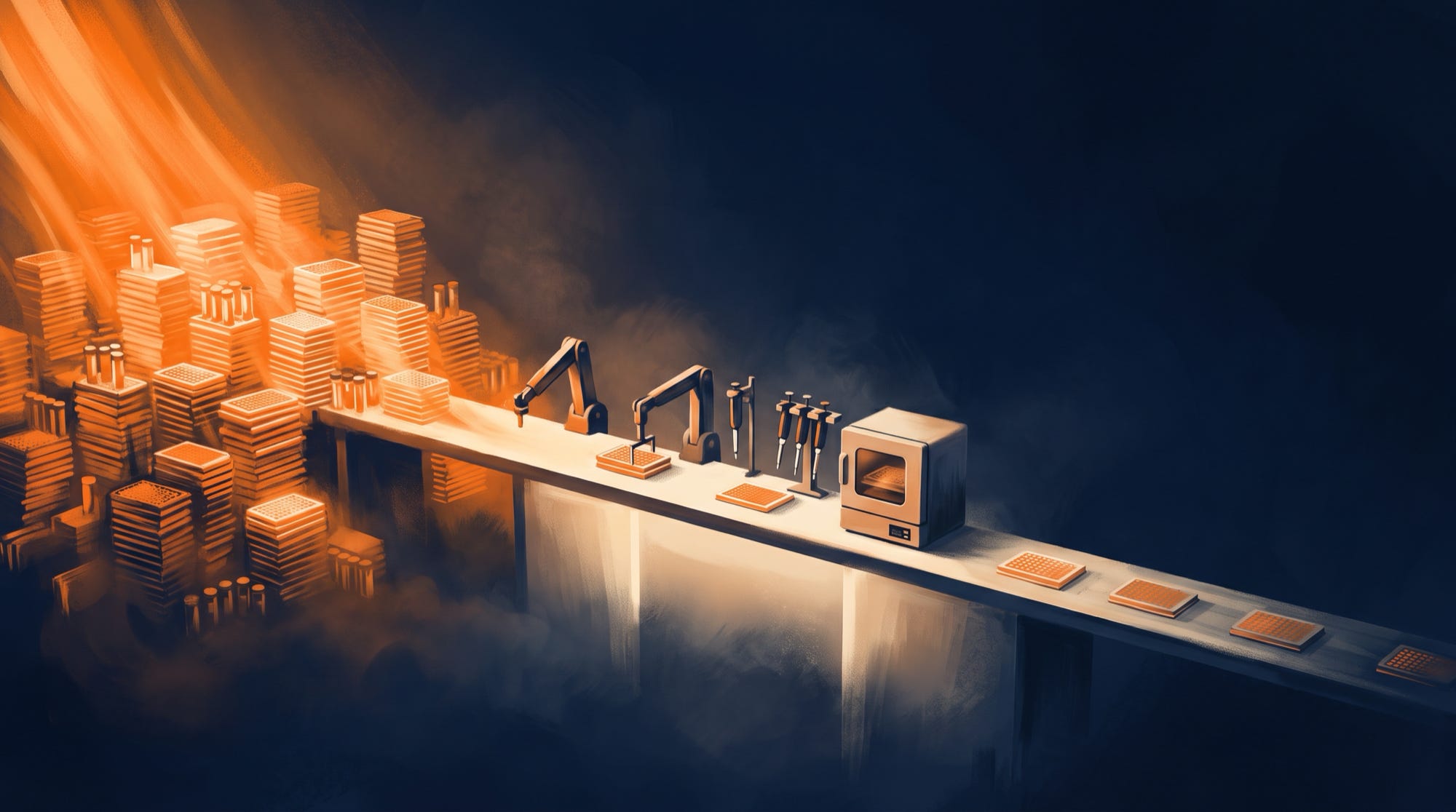
Most Sundays I take something new in AI and science, read the whole thing, and tell you what I make of it. This week it's three of the big AI labs, which went and studied how scientists use their models and came back with an answer I've been giving for a year.
I've spent most of this year writing the same post in different clothes. In September Anthropic built a lab and I wrote that reading got cheap and the bench didn't. In October I argued that comprehension is the new line item. A week later Claude designed 318,000 proteins in 64 hours, and making and measuring 211 of them took two months and three times the money.
AI made the easy part of science cheap and left the slow part slow. I'd built that case one lab result at a time. Today I read Anthropic's report on how researchers use Claude, and it sent me back to a paper Google published in September, which says the same thing with a survey behind it. Google asked 637 scientists in the US and UK, and 44% said their main bottleneck had moved downstream in the past two years, into lab work and writing up, three times as many as said it moved the other way.
The labs' own data points at the slow part of science. So does their spending.
Scientists use AI where it's easy to check
Use piles up where the work is text and code, and where you can tell at your desk whether the answer is right. Both labs ran a usage study, which means counting what people ask a model and sorting it by field and task. Anthropic sorted the research sessions on its consumer plans from August and September. Computer scientists are about 4% of the world's researchers and a third of Claude Code's research sessions, which is either a finding about science or a finding about who already had a terminal open.
Data analysis and writing make up about two thirds of the sessions on Claude. Google's Gemini logs lean the same way, with computer science far ahead of its share of working scientists. Life and health sciences lag, and in Anthropic's data so does chemistry.
Anthropic then scored each research task for how well AI can do it, and that score tracks closely with how well the task suits reinforcement learning, which rewards work where you can check the result quickly. Anthropic's own gloss is that scientists use AI where it works best. Use goes where the work is easy to check. The capability score comes from a model judging tasks in pairs, though, so it's a model grading a model.
Each lab also sees only the people using its model, and both surveys skew toward enthusiasts. So the numbers rhyme without adding up, and I wouldn't put Anthropic's shares and Google's in the same table.
OpenAI is the missing third. It studies how people use ChatGPT at scale, but for science it's only put out a headline number, about 1.3 million people a week.
The bench hasn't moved
Once the desk work speeds up, everything waits on the wet lab, the room with the pipettes, cells and reagents where an idea meets biology. In biology and chemistry, checking a result usually means running the experiment. There's no faster way to find out whether a molecule binds.
Google's scientists name physical experiments and data collection as their top bottleneck, ahead of analysis and writing. And 41% say their pile of hypotheses nobody has tested yet got bigger, against 25% who say it shrank. That's what a queue forming at the bench would look like.
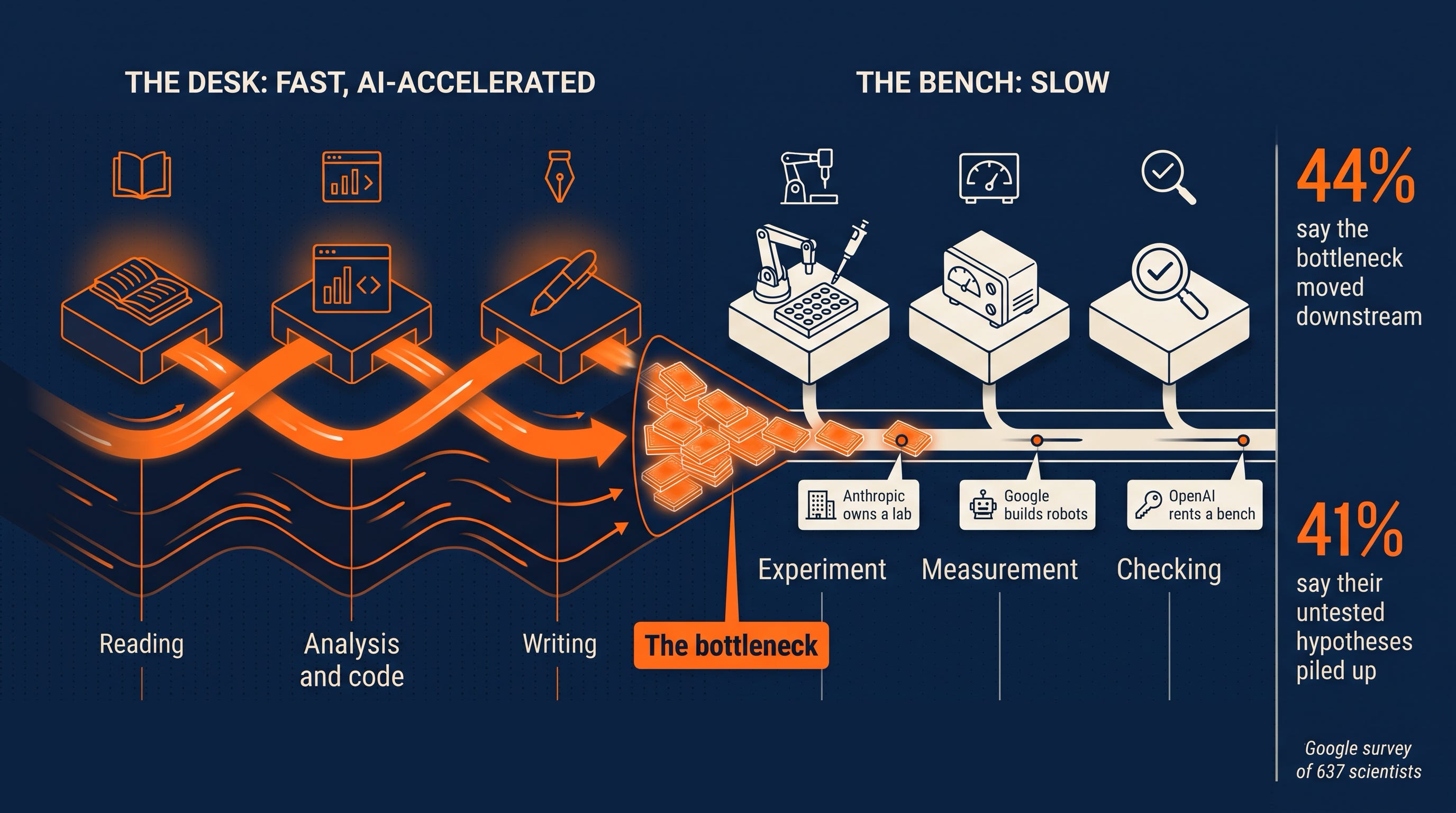
Anthropic gets to the same place from the other side. It built a model of how much faster research could go if AI took over more of the work. Even with every non-physical step automated, biology and chemistry top out at 3 to 4 times faster, while desk fields go far higher, because the physical work stays put. Those multiples come out of a simple economic model, so I'd trust the direction and hold the numbers loosely.
Mihai Codreanu, one of the Google study's leads, said in an interview about the paper that what surprised him most was "the sheer size of the verification tax." I read that tax and the bench bottleneck as one bill.
In a lab science, checking the model's output is the experiment.
The bottleneck shift and the growing backlog both show up more among scientists who say they use AI heavily. That's the pattern you'd expect if AI is filling the queue faster than the bench can empty it. It's also what you'd see if the heavy users mostly work in fields that were already waiting on the bench, and a survey can't separate the two.
It's the same law I wrote about in July: compress one layer and the next one becomes the bottleneck. The labs now have the receipts.
All three labs are moving toward the bench
Each lab is moving toward the slow part in a different way, and most of it started before the usage data came in.
Anthropic is buying the whole loop. It runs a wet lab, it bought the computational biology startup Coefficient Bio in April, and in July it bought Mithril Medicine, a one-person company working on treatments for two rare forms of muscular dystrophy. Then in late October it wrote, in a post on its drug-development work, "We've also begun drug discovery efforts of our own." The same post says the work is mostly preclinical, meaning it hasn't reached people yet, and that a drug could be ready for human trials as soon as late 2028. Mithril's technical report says its mouse study assigned treatment by litter, with no randomization, and it still needs a blinded repeat.
Google is building agent software that runs real lab robots. In October Google Research showed AI agents planning and running experiments on liquid-handling robots, with a scientist authorizing each designed sequence before it touched a reagent. It also has Isomorphic, its drug-discovery company, which had no trial on ClinicalTrials.gov as of this week. The part of Google's work I like most is a separate DNA-binder experiment, where the agents noticed their best-looking binders were sticking to the beads, and rewrote their design rules for the next round. That's what a good postdoc does.
OpenAI is buying coordination and renting the bench. It acquired Orchestra Bio, software that helps drug teams track studies and keep programs moving. Its closed-loop lab work in February ran on Ginkgo's cloud lab, which is how pharma has handled a busy bench for decades: contract the work out. I couldn't find a lab it owns.
I think this is good for science. More of the AI world's attention is going to instruments and measurement, the parts of research that have always been short of it.
They'll also hit what pharma has known for decades. Biology doesn't scale like code. A cell line doesn't care how fast you wrote the protocol, and a trial takes years whatever the model does. Late 2028 for a first human trial is a normal drug timeline, and a fast one for a program that started with one person.
The scientists and drug hunters quoted in coverage mostly took the tools and pushed back on the discovery claims and the cure talk. The AI and tech crowd online was much warmer. I didn't find anyone qualified arguing the labs should stay out of biology.
China is building benches at scale, and talking faster
China's bench-building is a working build with the claims running ahead of it. It's strongest at putting things into production.
In Nature this month, Shanghai Jiao Tong's AutoDNA lab has a team of AI agents designing and running DNA experiments from a simple prompt, across more than 20 types of instrument, which is awesome. Robotic arms move the samples, and people refill reagents and fix hardware. It's peer-reviewed, too.
Beijing's city government has a 2026 to 2028 plan that names autonomous labs as the core platforms for how research gets done, and says it will develop funding policies for them.
XtalPi says it has more than 300 robotic workstations. Its post on X this week says AI now designs molecules faster than a lab can test them, which is my argument with a marketing budget. Its headline claim of 40 times more efficient data is a capacity figure from the company website, and nobody outside has measured it.
The revenue is easier to check. XtalPi's interim results say its AI-for-science business, robot labs plus services, grew 136% while group revenue fell, mostly because the year before included a large licensing payment.
No source I found ranks China first in lab automation, so I won't either. I'd still bet on the build, because the labs already exist and Beijing's plan names them as core. One of them just got into Nature.
A workbench, for now
In June I called Claude Science a workbench and not a miracle. That's mostly held up, and I expect it to age worse than I'd like. I called the product right. The company went further than the product, into drug programs it runs itself.
The tools still speed up operations: the analysis, the writing, the code, the logistics. They don't yet produce the new idea.
The labs' data shows the gap. Ideation and hypothesis generation are about 4% of Claude research sessions, against about 7% of a researcher's time. Anthropic says ideation is hard to spot in the logs, so the real share may be higher. Yet the scientists Anthropic surveyed rank that work first for producing important results, ahead of data gathering and analysis. Anthropic's authors suggest scientists may want to keep that part for themselves, or that AI may be weaker at choosing which question to pursue.
Google found a mixed pull. About half its scientists say AI nudges them toward safer, more incremental questions, against just over a quarter who say it pushes them toward riskier ones. Yet most of the same scientists say their questions have got more ambitious.
The scientists' own answers don't settle it, so whether these models can come up with new ideas at all is the next post.
AI speeds up the operations of science. Picking the next question is still on us.
Checking is the product, and judging is the job
If making things is cheap and checking them is slow, whoever owns the checking holds a lot of the value. That means the bench, the evals and the controls. The labs' behaviour says they've worked this out too.
When three labs can all generate a plausible molecule, a protocol or an analysis in minutes, nobody pays for the generating. A buyer pays for a result they can trust, and trust comes from whoever ran the assay, kept the controls and can show the failures. A molecule claim is only as good as the experiment behind it.
The Google paper, written with MIT FutureTech, ends by arguing for investment in physical experiments, validation capacity and verification tools, plus the data and benchmarks that would let AI take on riskier questions. That's a company that sells models telling you the scarce thing is the stuff that checks models.
XtalPi's best asset may be its data. It says it holds more than 500,000 experiment records, and about 80% of them are failed experiments. That's checking data that rarely makes it into published science, and it's most useful when each record says why the experiment failed.
OpenAI built a benchmark this month, BioBasicsBench, for everyday wet-lab work, and one thing it tests is whether an agent can tell when the evidence can't support a conclusion. It's a benchmark for judgment, from a company that sells generation.
Checking slipped at Mithril too. Claude caught five of the six errors its technical report looked at, though not always before they went out. Human review was in the loop, and some still reached outside labs in emails that people had edited and then sent.
Earlier this year I wrote that the ability to tell right work from confident wrong work got more expensive, and that evals are the new bottleneck, so you should treat the thing that judges your models like a regulated instrument. The labs' science data is the same argument, with pipettes.
Making things got cheap. Checking them didn't, and the checking is where the value went.
So the scientist's job is moving from doing the work to judging it.
In OpenAI's field report on eight scientific-software projects built with agents, written by the teams themselves, all but one project had the people involved spending their effort on the framework for checking the agent's output. Software is where agents have the easiest time in science. The agents handled well-scoped requests and often sounded confident about work with clear errors in it. The authors describe the researcher's role shifting from building to verifying and directing.
Google's survey shows the same thing from the scientist's side. Among the people saving time with AI, 46% spend more than a quarter of that saved time checking what it produced. It's the weakest result in the paper, only marginally significant, and it still points where everything else does: the time AI saves goes back into checking.
Judging is hands-on work. It's choosing which 211 of 318,000 designs are worth making. It's reading an assay and deciding whether the signal came from the target or from sticky beads. It's killing a campaign that looks good on a dashboard. Those calls used to be a slice of a scientist's week, and for some teams they're becoming most of it.
DeepMind argues in an essay on AI in science that if AI takes over junior-level lab work, it could hollow out the training that teaches scientists to judge new work. You learn to judge an assay by running a lot of bad ones. A field that automates the bad runs away has to find another way to train the judges.
A team that gets this right pays for checking the way it pays for generation, as capacity: assay throughput, a validation budget, reviewers with time on their calendars. Agent campaigns get run like screens, with many runs and a reported hit rate. Every ruler gets a positive and a negative control before anyone trusts a score. What counts as a pass is written down before the run, so a good-looking number can't redefine success afterwards. And junior scientists stay at the bench long enough to learn what a failed experiment feels like.
Drug discovery learned long ago that one hit means little until you know how many wells you ran to find it. Agent work hasn't learned that yet. If you only see the run that worked, you haven't seen a result. You've seen a demo.
The same goes for whatever grades the agents. An eval that has never failed a known-bad answer can't tell you anything about a new one, so it needs its own controls, the way an assay does. It's easy to test the model hard and the grader not at all.
None of that is new to anyone who's run a screening group. The new part is the AI labs measuring it.
The labs went looking for where AI speeds up science, and their logs point at the slow part. They were already paying for it, like everyone in drug development eventually does. Welcome to the industry.
The bench was never the cheap part.
Sunday Deep Dive is a weekly series on Run Data Run, which is true most weeks. Each one takes something in AI and science and says what I think it changes. Found it useful? Forward it to someone on your team who'll argue with it. If it missed, hit reply.