


On Tuesday, Anthropic and an investment research firm called Citrini published a drug-design run in which Claude produced 318,484 candidate proteins in 64 hours. The same day, OpenAI said it had bought Orchestra Bio, a four-year-old startup whose agents trace what a slipped date drags with it. I'd file both under the same heading: the design step just got cheap, and nothing after it did.
Which half of drug development does AI actually speed up, and who pays for the other half? I've been asked that in every R&D conversation for two years. This week answered it twice, from opposite ends.
Five messages, 318,484 designs
Citrini is an investment newsletter, and I like how they went about this. They wanted to know whether AI in biology had moved far enough to bet money on, and rather than poll a dozen experts, they ran the experiment. Three of the five people involved had no science background at all.
They picked antivenom, which is a good choice for reasons that have nothing to do with AI. Scorpion stings injure more than 1.2 million people a year and kill more than 3,250, mostly children in places where treatment is scarce or unaffordable. The product is made roughly the way it was a century ago, by immunizing horses and purifying antibodies out of their blood. It works. Nobody is getting rich making it, and that economics, rather than any lack of effort, is why it still looks the way it does.
The goal was small proteins that latch onto venom toxins and hold on, so it never reaches the nerve cells it would otherwise disrupt. A Baker lab team did the same for snake venom last year and protected mice with it, so the shape of the idea was already proven.
Citrini wrote the brief with Claude's help, about 35 pages of it. From there an internal Anthropic research model, running inside Claude Science, did most of the work. It picked its own starting structures out of public databases, set its own thresholds for what counted as a design worth keeping, decided how much to lean on each of a dozen specialist design tools, ran more than 300 sub-agents across more than 300 GPUs, and screened 553,052 predicted pairings to rank what it had made. When it needed to know what a manufacturing vendor could physically build, it drafted an email to the scientist who runs procurement there, the team sent it, and the model parked that branch until the reply landed that evening.
The first 180 designs came out of five human messages. The compute bill was $49,997, three dollars under the $50,000 they'd allotted. That's an awesome run. Read the footnotes, though, because Anthropic's own account says a stripped-down version of the same prompt, one agent on one GPU for 24 hours, reaches comparable scores on the computational measures. The 300 GPUs bought breadth, not the result.
The part of this I like most is that Claude told them their moonshot would probably fail. They'd asked for one molecule that handles all five targets at once, which would make a universal product far cheaper to build and ship. Ninety-one designs went after it. One qualified, and only against a single target. The warning was correct.
The first 180 designs came out of five human messages. Then they had to become actual proteins.
Then the lab took two months
Citrini hit enter in August. The data came back as the Halloween stores were going up.
Two contract labs built and tested 211 designs: the 180 Claude picked, plus 31 the team added. Genes synthesized, proteins expressed and purified, materials sourced, controls set up. That bill came to just under $150,000, about three times what the compute cost.
Seventeen designs passed, against a deliberately strict bar: binding at both labs, in every replicate, above a stated strength, and nothing against an unrelated control protein. Among designs aimed at a single target, 18% cleared it, which is a normal rate for protein design. An agent steered by five messages hit the number a specialist team would expect to hit.
Then the caveats, which mostly got lost in the headlines. The two strongest designs bound in the single-digit nanomolar range, and a follow-up suggests they grab the toxin where an antibody already shown to protect mice grabs it. That's a real result. It is also about an order of magnitude looser than the hand-engineered antibodies they'll be measured against, which come in below one nanomolar. Nothing has been tested for whether any of these actually neutralize the toxin rather than merely stick to it, in cells or in animals. The binding was measured against lab-grown copies of the toxins rather than the real thing out of venom, and for some designs the selectivity is still unconfirmed.
So I don't think the 17 is the achievement here, and I'd go further: designing a binder is close to a solved problem in 2026. Conventional high-throughput screening turns up plenty of them at manageable cost with no AI anywhere in the room. The antivenom researchers were blunter about this than either write-up was, and The Verge went with a headline Anthropic presumably did not enjoy, "Claude did not invent scorpion antivenom". Andreas Hougaard Laustsen-Kiel, who works on antibody technologies at the Technical University of Denmark, put the rest in one line:
"The hard part is to translate it into a medicine."
The achievement is the price and the staffing. Five messages, three non-scientists, $50,000, and you land where a specialist group lands. That is a genuine change in who gets to try.
The incentives are sitting right there, too. Anthropic covered the compute and is a few weeks out from an IPO, and the model Citrini used isn't one you can buy: it ran under supervision on Anthropic's machines, because the published models decline this category of work. Citrini sells investment research, and the stock picks sit behind its paywall. Framing and product are the same object here, so every number above comes from the technical report and the lab data rather than from either narrative.
Which leaves the slow half unfunded. Anthropic is the only one visibly writing cheques here, and I've written before about what its biology lab is for: discovery-stage science, where a harness runs hundreds of attempts and one of them notices something. That money isn't aimed at carrying a scorpion binder through neutralization work, animal studies and a trial. For a disease with no commercial market, that stretch still has nobody.
Design compressed to 64 hours. Making and measuring 211 proteins took two months and three times the money.
What OpenAI bought
Orchestra Bio sells software for the part of drug development that looks like project management with scientific consequences. A medicine runs on thousands of decisions and dependencies from discovery to the clinic, and the example OpenAI reaches for in its own announcement is the one everybody recognizes: a manufacturing batch fails, which delays a trial, which moves a dozen other things nobody has traced yet. Orchestra's agents trace what's affected and lay out the options.
The team and the technology go into Rosalind, OpenAI's life-sciences line. Terms weren't disclosed, but Orchestra is four years old and had raised around $20 million from a16z, 8VC and others, which is a size where the people are most of what you're buying.
So the two companies are walking in opposite directions. OpenAI's line now reaches past the science into the schedule. Anthropic has gone the other way, deeper into the science, buying Coefficient Bio for a figure reported at around $400 million and running wet-lab work in house.
Nobody has shown yet that schedule agents survive contact with a live program, where dates are negotiated rather than calculated. All I've seen of Orchestra is a press release and one worked example, so this half is my read on intent.
Two bets on the same funnel
Ideas haven't been the bottleneck in drug development for a long time. These two companies are betting on different answers to what is.
Anthropic's bet is that the agent keeps pushing further down the pipeline on its own. Look at what it already did: drafted a vendor email, waited for a human to send it, used the answer. In a regulated company that email goes through contracts and quality first, and the thresholds the agent set for itself need a named person to sign them. Right now it's a demo; making it a workflow takes a quality team. I made a version of this argument when they shipped a driver standard for lab instruments last month: the limits on the machine were prose in an agent prompt, and somebody still has to own them.
OpenAI's bet is that the slow part is coordination between people, vendors and dependencies, that this is a different problem, and that it needs a team who has lived in it. So they bought one.
In twenty-five years around R&D, the meeting I've sat in most often is the one where a single late input moves six other dates and nobody in the room can name which six without three days of email. The funnel has always been top-heavy. This week widened the top and left the middle exactly where it was: 318,484 designs for the price of a mid-size consulting engagement, and then two months and $150,000 for 211 proteins. The on-site reporting on this found something I keep thinking about. Making the binders was routine. Getting hold of the scorpion toxins and the reagents to test them against was not.
Making the binders was routine. Getting hold of the toxins to test them against was not.
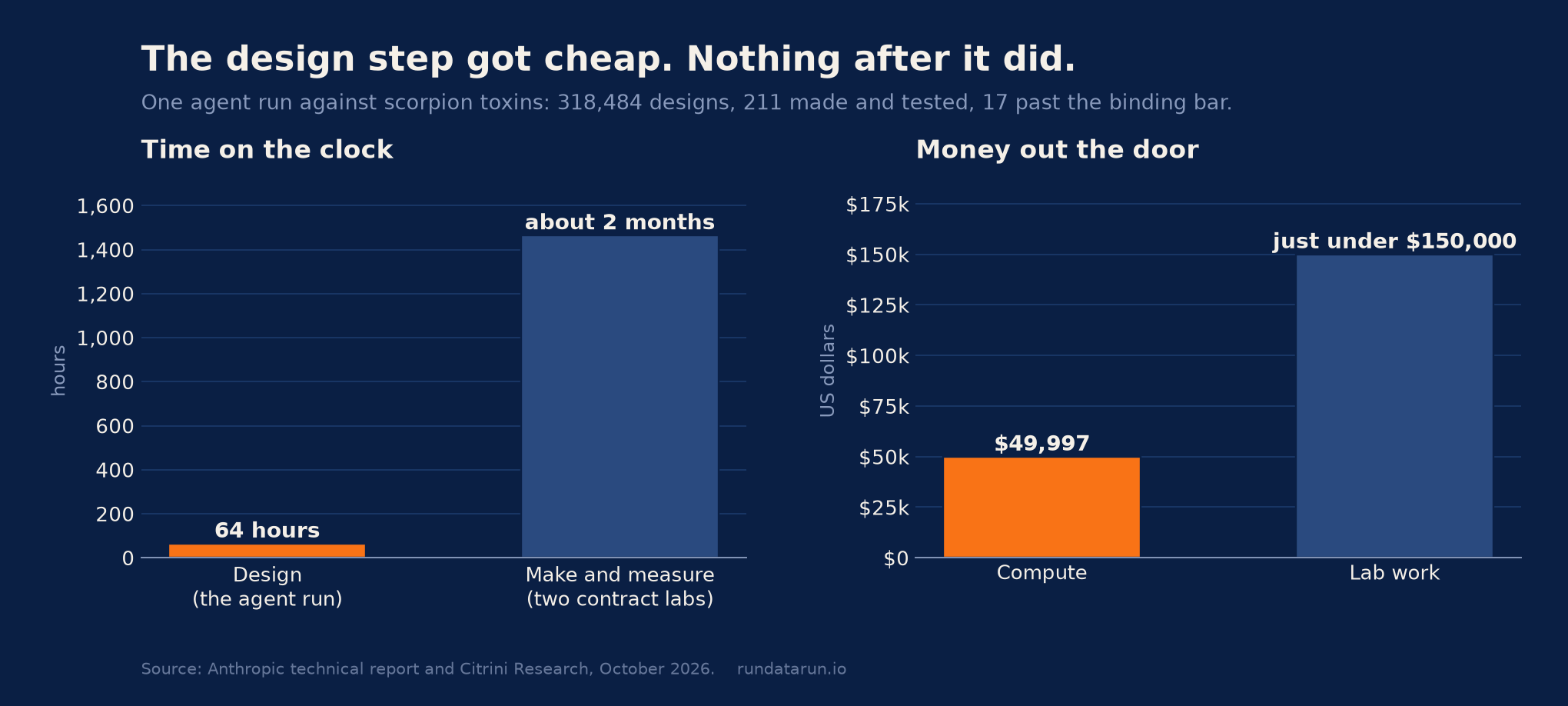
That distinction matters more than the 318,484 does, because a queue you can schedule around and a supply chain you can't are different animals. Compute took a quarter of the money and three days of the clock. The rest went to contracts, shipping, assays and material that had to physically exist before anyone could measure anything. And $200,000 is a rounding error against a clinical program, so the cost that decided this was never money. It was weeks.
Which is where I have to be careful with my own argument, because the thing that was slow here is not the thing OpenAI just bought. Orchestra works the coordination layer: what slipped, what it drags with it, who needs telling. That's a real and expensive problem in a program running hundreds of dependencies, and it is not the problem that cost Citrini two months. No agent reconciling a timeline sources a scorpion toxin any faster.
So the Orchestra deal is the quieter of the two stories by a distance, and I still think it's the more consequential one, because coordination is where big programs lose whole quarters and nobody is ever going to make a film about agents reconciling batch records against a trial calendar. But this week's experiment is evidence for something narrower and harder: widen the top of the funnel and you run straight into the physical world, which does not have an API.
What I'd watch
Whether the strongest designs do anything. The next experiment measures neutralization rather than binding, and that result turns 64 hours into either a real starting point or a fast binding curve. Anthropic released all 211 designs and their data, so other labs can answer it too, and I think that release is the most useful thing to come out of the whole exercise.
Then the first feature in Rosalind that visibly came from Orchestra. That tells you whether OpenAI bought a product or a team, and whether it thinks the agents belong next to the science or next to the schedule.
I argued back in June, when Claude Science first shipped, that the workbench mattered more than the model. Neither company has bought the two months in the middle.
Numbers in this piece come from Anthropic's technical report and released dataset, Citrini Research's own account of the campaign and its costs, The Verge's reporting on the outside reaction, and Hunterbrook Media's on-site investigation. Hunterbrook collaborated with Citrini and discloses market positions.