


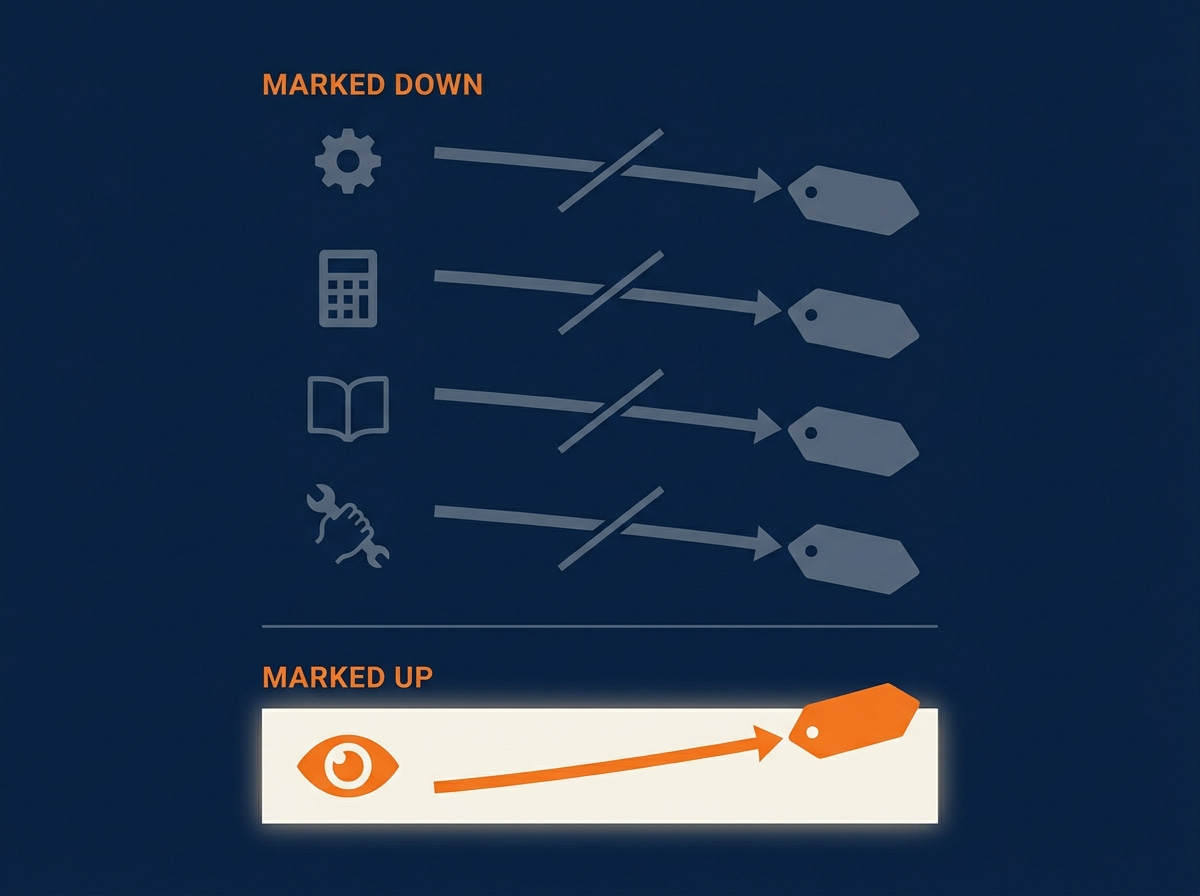
Think of the last two years of AI as one long, indiscriminate markdown sale. Skill after skill that used to be scarce got cheap, fast. Writing a clean function. Drafting a competent memo. Summarizing a dense report. Producing a first-pass analysis. A year ago each of those was something you hired for, waited on, or did yourself at the cost of an afternoon. Now they are a prompt and a few seconds.
The sale hit almost everything. It missed one thing, and the thing it missed didn't just hold its price. It went up.
Last week I put four hundred thousand sessions behind that claim: Anthropic's analysis of real coding work found that what predicted success wasn't your job title or your syntax, it was whether you understood the problem. That was the evidence. The implication: a few things got more valuable this year, not less, while everything around them got cheaper.
Almost everything got cheaper this year. The ability to tell right work from confident-looking wrong work got more expensive.
The half that got cheap was the doing
Start with what fell in price.
What AI commoditized is the execution of a known task. Give a model a well-specified job inside a domain it has seen a million examples of, and it will do it about as well as a competent junior, for free, instantly, at three in the morning. That is most of what people mean when they say AI is changing knowledge work, and they are right about it.
I've made this argument from a few angles already. When the model stopped being the frontier, the interesting problems all moved to the layer around it. When Apple rented its brain, it conceded that the model itself is now the rentable, swappable part of the stack, even for the most vertically integrated company on earth. The engine is a commodity. You can buy it, switch it, and so can your competitor.
So if the doing got cheap, the question is what didn't, and why it climbed while everything around it fell.
The half that got expensive was the judging
"AI does the work" treats the work as if it were one thing. It isn't. Every task has a doing half and a judging half, and AI only ate the first one.
The doing is producing the output. The judging is knowing whether the output is right. Not right in general, not right on a benchmark, but right here, for this patient, this contract, this market, this dataset with its ten-year-old quirk that everyone who has worked it knows about and no document anywhere records.
That second half is domain expertise, and it resists the markdown for a structural reason: it isn't in the training data. A model learns from what people wrote down. The deepest domain knowledge was never written down. It lives in the head of the person who has run the assay four thousand times, sat across from the regulator, watched the trade go wrong in 2019, and can look at a fluent, plausible, beautifully formatted answer and say, with a flat certainty, "no, that's not how this behaves." You cannot prompt your way to that, because the corpus the model trained on doesn't contain it.
This follows a basic rule about complements. When you flood a market with cheap supply of one thing, the price of its complement goes up. Cheap output makes the scarce ability to judge that output worth more, not less, because now there is a hundred times more output to judge and the same small number of people who can tell which of it is wrong. AI didn't just spare domain expertise. It bid the price up.
Cheap output doesn't lower the value of judgment. It raises it. There's a hundred times more to judge and the same few people who can.
Two voices, different worlds, one conclusion
What turned this from a hunch into a post was watching it land from people who don't share a desk, a discipline, or a reason to agree.
In March, the Berkeley California Management Review, about as institutional as business thinking gets, told executives their next competitive moat is tacit knowledge: not the data, not the models, but the judgment embedded in their people, and the systems that capture it before it walks out the door. Two months later, a working software engineer named Aaron Brethorst, with no reason to read a business-school journal, wrote that domain expertise has always been the real moat. His point: the framework knowledge, the syntax, the boilerplate, the part everyone used to grind years to acquire, was never the durable thing. AI making it free didn't destroy the moat. It drained the water and showed you where the moat actually was the whole time.
One came at it from the top of the org chart, thinking about strategy and knowledge graphs. The other came at it from the keyboard, watching a model write code he then had to check line by line. Different altitude, different vocabulary, different month. Same conclusion. Put their two arguments next to the four hundred thousand sessions from last week and you have a management journal, a working engineer, and a population-scale measurement all pointing at the same line through the work. When the same claim arrives from corners that don't read each other, the content is almost secondary. The convergence is the signal.
The one asset that appreciated
Domain expertise is the one appreciating asset on the books. Everything else in your AI strategy is depreciating. The model you standardized on this quarter will be cheaper and roughly matched by your competitor's within months; you'll remake that decision four times before it matters.
Which changes what the work actually is. The advantage isn't holding the expertise. It's how fast you're turning it into something the machine can use before the person carrying it retires, quits, or simply forgets the quirk from 2019: into context, into the checks that catch a wrong answer before it ships, into the loop that lets one expert's judgment steer a hundred agents instead of one. That capture is an investment with a return, and most organizations aren't making it because they still have expertise filed under cost.
There's a second thing AI didn't reprice, and it pairs with this one: the system you build around the model, the harness that turns a forgetful chat box into something that compounds on your work. I put the flag down on that one in Start With Claude Code, and it's the subject of this Sunday's deep dive. A great harness pointed by someone who doesn't know the field just produces wrong answers faster. The judgment is what tells the system what good looks like. The two are a pair, and neither is on the model menu.
Everything in your AI strategy is depreciating except two things: the judgment of the people who know your field, and the system you build to put it to work.
The decision that compounds
The decision that compounds isn't which model to pick. You remake that one on a schedule, and so does everyone else.
The companies that win the next few years won't be the ones with the best model. Everyone has roughly the same model. They'll be the ones who looked at the markdown sale, noticed the single thing whose price went the other way, and spent like they understood why.
Sources
You Don't Have to Write the Code (Run Data Run). Anthropic's 400,000-session study: domain understanding, not job title or coding skill, predicted success. The evidence under this post's argument.
Berkeley California Management Review, Tacit Knowledge Is Your Next Competitive Moat (March 2026). The institutional framing: the differentiator that lasts is the judgment embedded in your people, and the systems that capture it.
Aaron Brethorst, Domain Expertise Has Always Been the Real Moat (May 2026). The builder's framing: framework knowledge going free made the real moat visible.
Start With Claude Code (Run Data Run). The other thing AI didn't reprice: the harness you build around the model.