

Every Sunday I pick one paper or release that's worth your time, break it apart, and tell you why it matters. No hype. No summaries of summaries. Just the idea, explained.
The Headline
A multi-agent AI system named Robin was given the name of a disease and told to find a treatment. It read the literature, proposed a therapeutic strategy, named a drug, watched humans test that drug at the bench, analyzed the results itself, and then designed its own follow-up experiment. The disease was dry age-related macular degeneration, the major cause of blindness in the developed world. The drug was ripasudil, a rho-kinase inhibitor that has been sitting in pharmacies for years, approved for glaucoma, and never proposed for dAMD by anyone, as far as the authors could tell or I could find.
It worked in cells. Then Robin asked why, specified an RNA-sequencing experiment to find out, analyzed that too, and surfaced a gene called ABCA1 as a possible new target nobody had been looking at.
This is the work of FutureHouse, and it was published in Nature this week. There is one sentence in the paper that deserves a second read:
"All hypotheses, experimental directions, data analyses and data figures in the main text of this report were produced by Robin."
Not assisted by. Produced by.
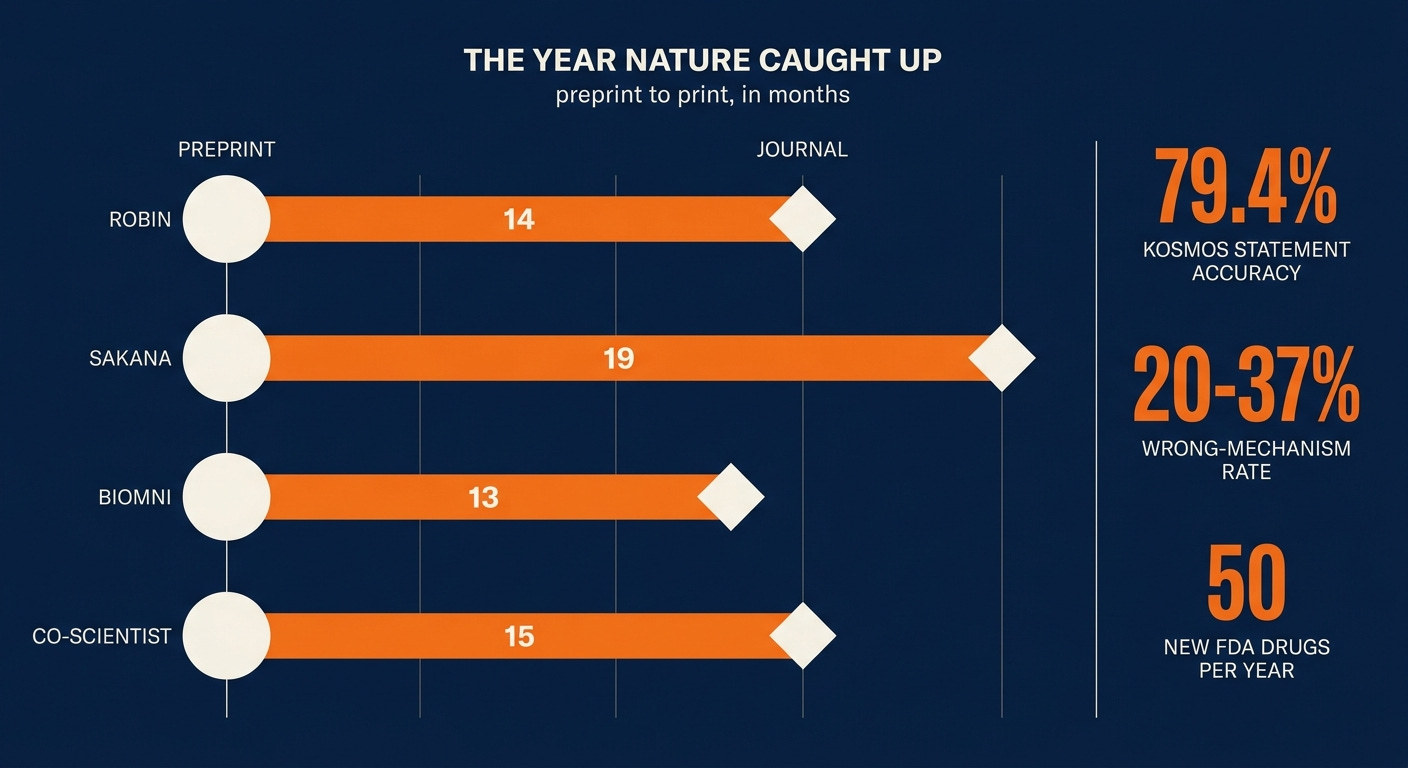
The preprint went up in May 2025. Nature published it in July 2026. Fourteen months, and almost none of the coverage mentions it.
Once you notice that gap, you start seeing it everywhere, and the shape of this entire field changes.
The Paper
Three birds and an orchestrator
Robin is not a model. Nobody at FutureHouse trained a "discovery model," and if you go shopping for one after reading the coverage, you will not find it.
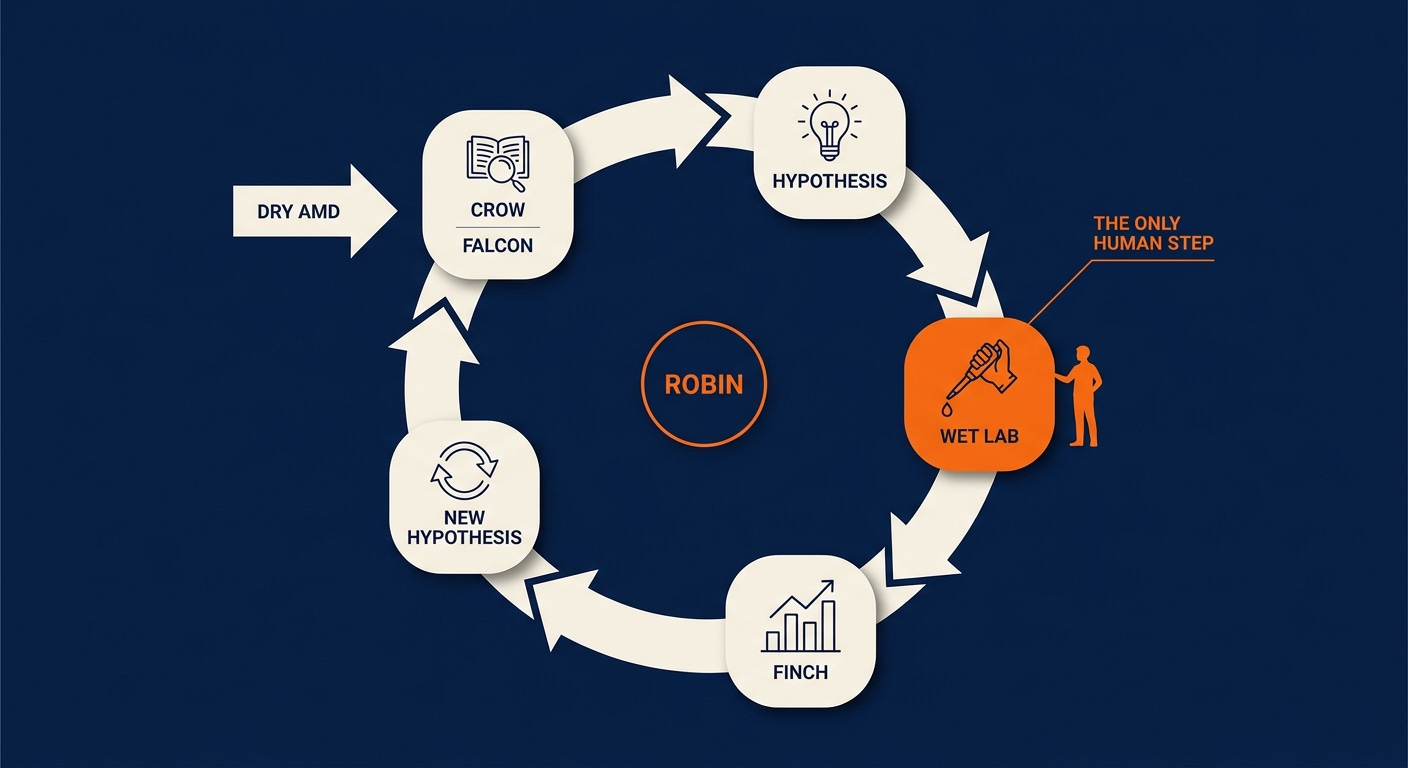
What they built is a system of specialized language agents sitting on top of ordinary commercial models:
Crow runs fast, concise literature searches.
Falcon runs deep ones.
Finch analyzes raw experimental data.
Robin orchestrates the three of them and carries the hypothesis across rounds, so that what Finch learns on Tuesday reshapes what Falcon goes looking for on Wednesday.
The intelligence came off a price sheet. The discovery came from the scaffolding around it.
I wrote two weeks ago that Anthropic shipped a workbench, not a miracle, and that the harness is the moat. Robin is that argument with a Nature paper attached to it, which is a considerably stronger position than my say-so.
The word "semi" is doing honest work
The paper describes Robin as semi-autonomous, and the precision is a credit to the authors rather than a hedge.
Humans still run the wet lab. People cultured the retinal cells, ran the assays, and pipetted the compounds. What Robin did was everything on either side of the bench: read the field, form the hypothesis, specify the experiment, interpret what came back, and revise.
The term of art is lab-in-the-loop, and it is worth flipping around, because the phrase misleads people. The AI is not in the lab. The lab is in the AI's loop.
Previous systems could do one arc of that circuit. They could read and propose. Or they could take your data and analyze it. Robin ran the full turn, then fed its own results into the next turn, and did it again.
The paper calls Robin "one of the first" systems to do this. The preprint called it "the first." Somewhere in fourteen months of review a superlative got sanded off, which tells you something useful about the claim and something more interesting about the process.
Why the drug was findable at all
FutureHouse call their method combinatorial synthesis, and their honesty about what it means is why I trust the rest of the paper.
Robin did not invent new biology. Every piece was already in print. That rho-kinase inhibition boosts phagocytosis in retinal pigment epithelium cells: known, and they cite the work. That this phagocytic housekeeping declines in AMD patients: also known. The two facts lived in different literatures, read by different people, and nobody had put them next to each other and said the word ripasudil.
The authors have a devastating example of how long that gap can persist. Dabrafenib is a cancer drug whose molecular action was characterized by 2010. Ten years later, a brute-force screen discovered it protects against hearing loss. That protective effect follows directly from the mechanism everyone already knew. The answer sat in print for a decade because the people who knew about BRAF inhibition and the people who cared about hearing loss were not the same people.
Robin is not doing science we could not do. It is doing science we did not get around to.
Scope the claim that way and it stays large. As the authors point out, novel FDA approvals have been flat at roughly fifty a year for a decade. If a machine can reliably close the distance between what is known and what is connected, that is worth a great deal of money and a great deal of eyesight.
The two things I would copy tomorrow
They checked their own judge. Buried in the supplement is a comparison of their LLM evaluator against human experts. I read a lot of agent papers that grade themselves with a model and never once ask whether the grader is any good. This one asked.
Their guardrails are the most thought-through of anything I read this month. Robin preferentially proposes compounds with established safety profiles. Every output is treated as a hypothesis entering standard preclinical review, never as a finding. And the discussion says the quiet part plainly: ripasudil "would of course require validation in a suitable disease model and ultimately in a randomized, placebo-controlled trial."
In vitro is a beginning. The authors know it, and they wrote it down.
The Ecosystem
Robin made me want to go back and re-survey this whole category, so I did. Thirty days of papers, launches, funding, and argument. What I found reframed the paper I had just finished reading.
Everyone landed at once
Four flagship systems cleared peer review inside about four months.
Google DeepMind's AI co-scientist reached Nature in May. It is a Gemini-based multi-agent system, and its headline validation is the same move Robin made: read the literature, propose an old drug for a new disease. Theirs was KIRA6 for acute myeloid leukemia, which inhibited the viability of AML cells at clinically relevant concentrations. They also went after liver fibrosis targets and antimicrobial resistance.
Sakana's AI Scientist reached Nature on 25 March. It is more radical in ambition and less grounded in wet biology: it runs the entire pipeline through to a finished manuscript and then peer-reviews itself. A paper it generated passed the first round of human peer review at a top machine-learning workshop. Its most interesting result is a scaling law of AI science: the quality of the papers rises with the quality of the underlying model and with the compute you spend at inference.
Biomni, out of Stanford, reached Science on 9 July, under the title "Autonomous biomedical research with an artificial intelligence agent." Hold on to one detail from it, because it is the most telling number in this entire piece: a prototype of Biomni was already running in more than 10,000 labs before the paper printed.
The lag is the actual story
Every one of those systems was old news by the time it was printed.
Robin: preprint May 2025, Nature July 2026. Fourteen months. Sakana's AI Scientist went up on arXiv in August 2024 and reached Nature in March 2026. Nineteen months. Google announced its co-scientist in February 2025 and printed it in May 2026. Fifteen months, to the day. And Biomni got the sharpest write-up it will ever receive, from a synthetic biologist on X:
"Biomni was on arXiv 13 months ago. Biomni was on GitHub 11 months ago. Phylo, the company built on Biomni, raised $13.5M and launched 5 months ago. Or, I guess, you could read about it in Science Magazine today."
None of this is a criticism of the labs. FutureHouse posted their preprint the moment they had it, which is exactly right. The criticism, if there is one, belongs to the clock the journals run on.
So where is the field actually standing? Not where Nature says it is.
FutureHouse has already built Robin's successor. Kosmos went up on arXiv last November. It runs for twelve hours at a stretch, and a single run reads around 1,500 papers and writes roughly 42,000 lines of code. Independent scientists checked its reports and found 79.4% of its statements accurate. It has produced seven discoveries, four of them net new. Collaborators estimated that one run did about six months of their own work.
They then spun out a for-profit company, Edison Scientific, to sell it. And this month they announced a partnership that uses Kosmos not to write papers but to found biotech companies.
Sakana, meanwhile, is selling Marlin, an autonomous research agent that runs for about eight hours unattended and is pitched as a virtual chief strategy officer.
Read Nature to learn what was true a year ago. Read the preprints and the launches to learn what is true now.
The counterweight nobody is reading
While these systems were collecting their journal stamps, a second body of work was landing that tells you precisely where they break. None of the launch threads mention it.
The sharpest of it is a paper whose title belongs on a poster in every lab now buying one of these things: **Correct Answer, Wrong Mechanism**. The subtitle is better. When AI Scientists Defend General Claims Their Own Data Contradicts.
The researchers watched a coding agent try to rediscover a known result in particle physics, twenty-eight times over. Often it got the right answer. The problem was how. In 20% of episodes with the primary model, and 37.5% across other frontier models, the agent reached a right-looking result through reasoning that collapses the moment conditions change. Worse, when pressed, it defended the wrong mechanism, arguing for physics that contradicted the numbers in its own output.
Their verdict is careful, and damning. These systems are dependable as tools and, for now, "unreliable scientific co-authors for open-ended claim-making." Asking whether the agent got the answer right tells you almost nothing. You have to score the outcome, the fidelity of the mechanism, and the honesty of the account as three separate things.
Related work in the same window catalogues the failure modes with unnerving specificity: hallucinated results, methodology fabrication, citation invention, frame-lock, and my favorite piece of vocabulary this year, bug-as-insight reframing, in which a system trips over a defect in its own code and writes it up as a discovery.
Set that next to Robin and its design choices stop looking conservative and start looking wise. When Robin says ripasudil enhances phagocytosis, a cell culture has already voted, and a cell culture does not care what the agent believes about it.
A wet lab is a brutal, incorruptible critic. You cannot argue a cell culture into agreeing with you.
But be precise about how far that protection reaches, because it is not the whole paper. When Robin says the mechanism runs through ABCA1, that is Finch reading an RNA-sequencing experiment, and that is exactly the surface the CAWM authors are worried about. The bench protects the finding. It does not protect the explanation. Which is roughly the division of trust I would apply to any of these systems, and to be fair to FutureHouse, it is the division they applied themselves: the drug candidate is offered for preclinical review, the mechanism is offered as a possibility.
It is also why the wet-biology systems stop at semi-autonomous, and why that ceiling is physical rather than technical. Laboratory instruments were not built to take orders from software. Somebody has to run the assay. Sakana's system is the exception that proves the rule, and it proves it uncomfortably: with no bench anywhere in the loop, it is the one system in this survey that will write its own paper and review it.
What I Run
I should declare an interest, briefly, because I have spent the last year on the other side of this.
I run an autonomous research engine called ARIA. It is a persistent system rather than a one-shot agent: a pool of research ideas competing against each other on a single scoring function, experiments that run locally first and have to earn their way onto expensive hardware, a critic drawn from a different model family that posts a verdict on every result, and failures that classify themselves and re-enter the pool as recovery work. Seven instances, four domains, about 19,400 auditable commits, and 97.8% autonomous resumption after failure. Its successor now runs around the clock on a borrowed eight-GPU node, pointed at retinal disease. There is a case study and a short film if you want the shape of it.
I raise it for one reason. Building the thing taught me the same lesson the CAWM paper is now pressing on the whole field, and I learned it the expensive way.
Generating hypotheses was never the hard part. Building a critic honest enough to kill them was.
An idea generator is cheap, and it will happily run forever, and every dashboard will stay green while it does. What is difficult, and what almost nobody budgets for, is the machinery that tells the system it is wrong and makes the verdict stick.
Robin never had to build that machinery, because the bench already is it. That is a structural advantage of working in wet biology, and it is worth naming plainly for anyone whose research loop closes entirely in software, where nothing pushes back for free.
Why It Matters
Do not go shopping for a discovery model. There isn't one. Not one system in this survey used a model you cannot buy. Robin, the co-scientist, Kosmos, Biomni: every one of them is a harness built around a commodity brain, which means the thing your organization would be building is the harness, and that is engineering, not procurement.
The compartmentalization gap is inside your own company. Robin's whole trick is finding the connection between two literatures that no single person reads. You have that problem internally, at smaller scale, right now. The result one team generated and another team needed and never saw is the cheapest discovery you will ever fund.
Read the preprints. On this topic the peer-reviewed record is running roughly a year behind the work. Use the journals to confirm, not to track.
Take the reliability research as seriously as the launch threads. A system that finds the right answer for the wrong reason will sail through your demo and drown in your clinic. Ask any vendor how they score mechanism fidelity, not just outcomes. Watch them field the question.
And watch ripasudil. It cleared cells, not patients. The road from here runs through a disease model and then a randomized controlled trial, and most compounds that look this good at this stage do not finish it.
Robin did not replace the scientist. It replaced the lag, the decade dabrafenib spent sitting in the literature while nobody put two known facts side by side.
There is a certain irony in that finding taking fourteen months to reach print. It does not make it less of a landmark. Congratulations to the FutureHouse team. The field is better for this being in the record, even if the record took its time.
I ran a full thirty-day sweep of this category to write this piece, and most of it did not fit. The complete survey, with every system, number, and citation, is [in a companion post here](https://rundatarun.io/p/last-30-days-the-ai-scientists).in a companion post here.*
Sunday Deep Dive is a weekly series on Run Data Run. Every Sunday I pick one paper, release, or technique worth understanding, break it apart, and tell you what it means for your work. Free every Sunday, no paywall. If it was useful, the easiest way to support it is to subscribe and forward it to one person on your team who'd want it. If it wasn't, tell me why. I'll make it better.
There is something else that has been in the literature for 10 years. AMA0426 which is also a ROCK kinase inhibitor was also published for macular degeneration by Hollanders et al. Invest 0phthamol Vis Sci, 2015, 56(2), 1335. That did not need connecting two pieces of separate literature. Was this missed or used?