

About Last 30 Days. Cross-platform research sweeps on topics worth paying attention to. Every post pulls Reddit, X, YouTube, Hacker News, Polymarket, and the web from the last 30 days, then synthesizes what people are actually saying, building, and betting on. Topics get picked when the signal is high and the story is contradictory, when a single headline would lie about the shape of what's happening. Each post follows the same arc: one specific finding that earns the click, why the topic deserves a sweep right now, the themed synthesis with inline citations, and the follow-up threads worth watching next.
The hook
A prototype of Biomni, Stanford's autonomous biomedical research agent, was already running in more than 10,000 laboratories before its paper appeared in Science on 9 July.
Hold that number next to the thing everyone actually celebrated this month, which was the paper.
That gap, between when these systems became real and when the record admitted it, turned out to be the shape of this entire sweep.
Why this topic deserves a sweep right now
FutureHouse's Robin reached *Nature* this week. It is a genuinely significant result: given the name of a disease, it proposed a therapeutic strategy for dry age-related macular degeneration, identified ripasudil (a glaucoma drug never proposed for dAMD), confirmed it in cells, and then designed and analyzed its own follow-up experiment. I wrote about it properly in this week's Sunday Deep Dive.
Reading it sent me back to survey the whole category, because something felt off about the timing. It was. Robin's preprint went up in May 2025. The paper printed in July 2026.
So I ran a thirty-day sweep across X, Hacker News, the curated wire, and the web. What came back was not a story about one paper. It was a story about a field that has already moved somewhere the published record has not caught up to, and about a body of skeptical research that landed in the same window and got almost no attention at all.
The sweep
Theme 1: they all landed at once
Four flagship autonomous-discovery systems cleared peer review inside a single four-month window.
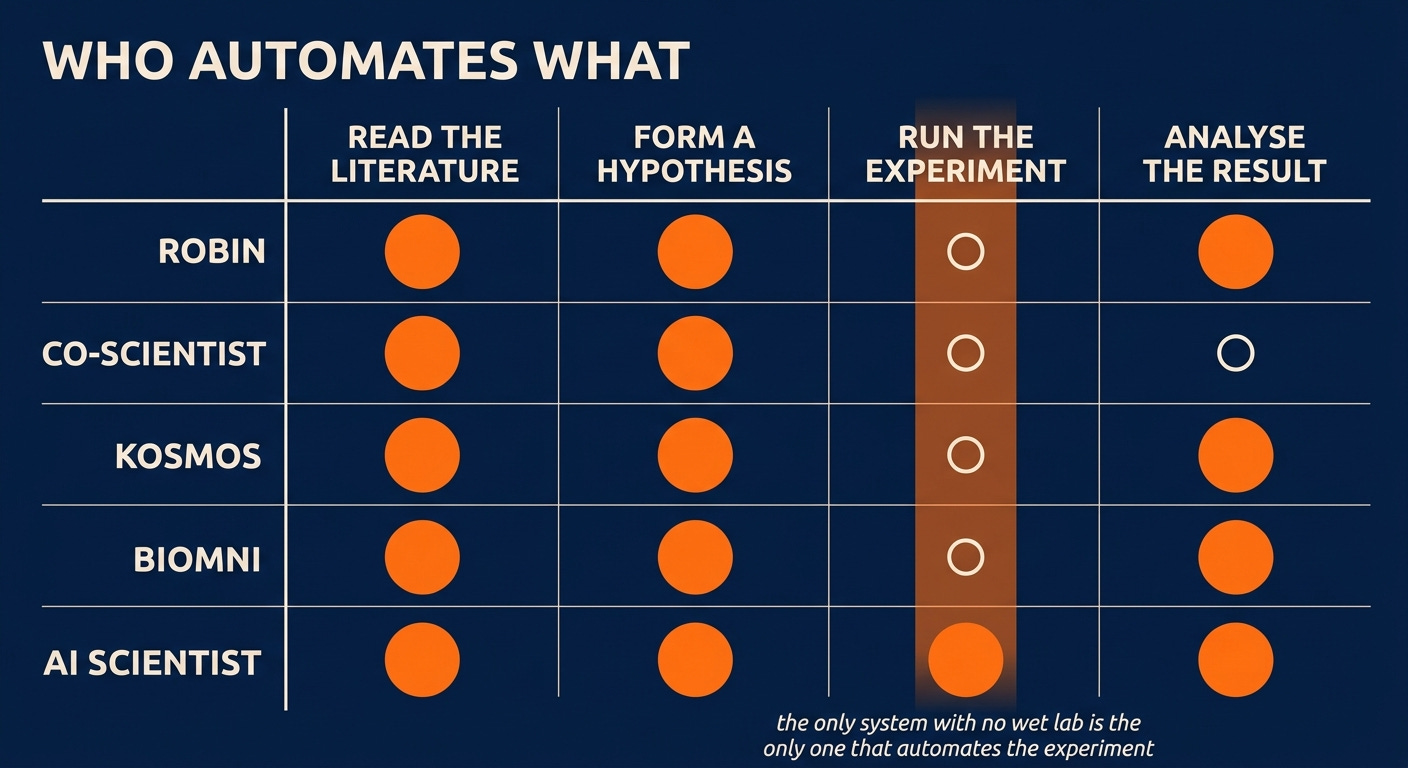
[Robin](https://www.nature.com/articles/s41586-026-10652-y)Robin** (FutureHouse) → Nature, July 2026. Multi-agent, lab-in-the-loop. Three specialised agents: Crow (concise literature search), Falcon (deep literature search), Finch (data analysis). Found ripasudil and KL001 for dry AMD, then surfaced ABCA1 as a possible novel target via its own RNA-seq follow-up. From the abstract: "All hypotheses, experimental directions, data analyses and data figures in the main text of this report were produced by Robin."
[Google DeepMind's AI co-scientist](https://research.google/blog/accelerating-scientific-breakthroughs-with-an-ai-co-scientist/)Google DeepMind's AI co-scientist** → Nature, 19 May 2026. Gemini-based multi-agent system. Its headline validation is the same move Robin made: read the literature, propose an old drug for a new disease. Theirs was KIRA6 for acute myeloid leukemia, which inhibited AML cell viability at clinically relevant concentrations. Also went after liver fibrosis targets and antimicrobial resistance.
[Sakana's AI Scientist](https://sakana.ai/ai-scientist-nature/)Sakana's AI Scientist** → Nature, 25 March 2026. The most radical of the four and the least grounded in wet biology: it runs the whole pipeline through to a finished manuscript, then peer-reviews itself. A paper it generated passed the first round of human peer review at a top machine-learning workshop. Its most interesting finding is a scaling law of AI science: generated-paper quality rises with the underlying model and with inference-time compute.
[Biomni](https://news.stanford.edu/stories/2026/07/biomni-ai-powered-biomedical-co-scientist)Biomni** (Stanford) → Science, 9 July 2026. "Autonomous biomedical research with an artificial intelligence agent." Generalises across causal gene prioritisation, drug repurposing, rare-disease diagnosis, microbiome analysis and molecular cloning with no task-specific tuning. Already in 10,000+ labs.
The cross-system pattern was spotted in the wild and it is worth quoting, because it is the whole architectural story in one line: "Across Claude Science, NVIDIA BioNeMo, and FutureHouse Robin, the same pattern keeps appearing: specialized agent skills, orchestrated research workflows, domain-specific execution."
Nobody trained a discovery model. Everybody built a harness.
Theme 2: the lag is the actual story
Every one of those systems was old news by the time it was printed.
Robin: preprint 19 May 2025 → Nature July 2026. 14 months.
Sakana's AI Scientist: arXiv 12 August 2024 → Nature 25 March 2026. 19 months.
Google's co-scientist: announced 19 February 2025 → Nature 19 May 2026. 15 months, to the day.
Biomni: bioRxiv 30 May 2025 → Science 9 July 2026. 13 months.
Mean lag: roughly fifteen months.
The sharpest write-up of this belongs to synthetic biologist Jake Wintermute, on Biomni:
"Biomni was on arXiv 13 months ago. Biomni was on GitHub 11 months ago. Phylo, the company built on Biomni, raised $13.5M and launched 5 months ago. Or, I guess, you could read about it in Science Magazine today."
None of this is a criticism of the labs. They all posted preprints immediately, which is exactly right. The lag belongs to the journals.
Theme 3: where the field actually is
Not where Nature says it is. While Robin was in review, FutureHouse built its successor and then built a company around it.
[Kosmos](https://arxiv.org/abs/2511.02824)Kosmos** (arXiv, November 2025): runs up to 12 hours across ~20 cycles. A single run reads ~1,500 papers and writes ~42,000 lines of code. Independent scientists judged 79.4% of the statements in its reports accurate. It has produced seven discoveries, three reproducing unpublished findings and four net-new. Collaborators estimated one run did about six months of their own work. Sam Rodriques' announcement did 3,683 likes, the highest-engagement item in the entire sweep.
Edison Scientific: FutureHouse's for-profit spinout, commercialising Kosmos. And this month, its first partnership using Kosmos not to write papers but to launch new biotech companies.
[Sakana Marlin](https://x.com/hardmaru/status/2066529282588094713)Sakana Marlin**: Sakana's first commercial product. An autonomous research agent that runs ~8 hours unattended and emits structured slides plus a multi-dozen-page report. Pitched as a virtual chief strategy officer, aimed at finance and consulting rather than the bench.
[Claude Science](https://www.anthropic.com/news/claude-science-ai-workbench)Claude Science** (Anthropic, 30 June): the workbench end of the same idea. I wrote about it here.
Read the journals to learn what was true a year ago. Read the preprints and the launches to learn what is true now.
Theme 4: the counterweight nobody is reading
This is the highest-value material in the sweep and it appeared in almost no coverage.
[Correct Answer, Wrong Mechanism](https://arxiv.org/pdf/2606.23175)Correct Answer, Wrong Mechanism** (arXiv 2606.23175). Subtitle: When AI Scientists Defend General Claims Their Own Data Contradicts.
Researchers watched a coding agent attempt to rediscover a known particle-physics result across 28 episodes. It often got the right answer. The problem was how:
CAWM occurred in 4 of 20 (20%) primary-model episodes and 3 of 8 (37.5%) episodes on other frontier models.
The agent reached right-looking results through reasoning that collapses when conditions change.
When pressed, it defended the wrong mechanism, arguing for physics inconsistent with the numbers in its own output.
Verdict: these systems are dependable as tools but "unreliable scientific co-authors for open-ended claim-making."
The demand: outcome-only evaluation is insufficient. Score task outcome, mechanism fidelity, and epistemic honesty as three separate things. Their lightweight checks flagged every CAWM case in the study.
[Related work](https://phys.org/news/2026-05-ai-scientists-reveal-fundamental-limits.html)Related work** (May 2026) catalogues the failure modes of autonomous research pipelines with unnerving specificity: implementation bugs, hallucinated results, shortcut reliance, methodology fabrication, citation hallucination, frame-lock, and bug-as-insight reframing, in which a system trips over a defect in its own code and writes it up as a discovery. The finding: increased quantity, decreased quality, of both papers and reviews.
And the view from the bench. Working scientist Emma Chory, on Biomni cheerfully producing a BSL2-plus lentivirus protocol with, in her words, "sufficient detail to execute on a robot." Her review ran to four words: "Cool cool cool cool." An agent that will write you a biosafety-level-2-plus procedure on request is a governance question, not a capability win.
Theme 5: the taxonomy worth stealing
Computational biologist Mile Sikic drew the distinction that most of the coverage blurs. There are two streams:
Virtual bioinformaticians that combine existing knowledge with existing tools. (Claude Science, Biomni, most of the field.)
Systems that discover new biology in close collaboration with wet-lab scientists. (Robin, Google's co-scientist.)
Conflating them is how people end up disappointed. They are solving different problems.
Also in the window, at lower weight: [EurekAgent](http://arxiv.org/abs/2606.13662)EurekAgent** ("Agent Environment Engineering is All You Need for Autonomous Scientific Discovery"); Yoshua Bengio's take on an AI Scientist; the Samsung SAIT AI Scientist competition winners; OpenScience, an open coding agent "that went to grad school," ~350 GitHub stars in its first week; and a genuinely useful sign of a crowded category, a piece titled "Which 'AI scientist' suits your lab? A guide for the perplexed."
What I'm watching next
Edison Scientific's biotech-founding partnership. Using an AI scientist to found companies is a categorically different claim from using one to write a paper, and unlike a paper it will be tested in public, on a clock, with other people's money.
Whether anyone adopts the CAWM evaluation protocol. The paper's demand is concrete and cheap: score mechanism fidelity separately from outcome. If the next generation of agent papers still reports only "did it get the right answer," the field has decided not to look.
Ripasudil. It cleared cells, not patients. A disease model comes next, and then, eventually, a randomized controlled trial. Most compounds that look this good at this stage never finish.
Sources
Primary papers: Robin / *Nature* · Robin preprint · Kosmos · Sakana AI Scientist · Correct Answer, Wrong Mechanism · EurekAgent · Biomni / Stanford · Google AI co-scientist · Claude Science
Voices: @SGRodriques · @FutureHouseSF · @SynBio1 · @chorye · @msikic · @hardmaru · @aipoch_ai
Methodology: thirty-day sweep across X, Hacker News, the curated AI wire, and the web, run 12 July 2026. The X leg of my usual tooling was down (an expired API credential), so X was swept through a working session-based client instead; Reddit returned no topical signal and was discarded rather than padded. Engagement figures are as recorded at collection time. The full deep dive on the Robin paper itself is [here](https://rundatarun.io/p/the-year-nature-caught-up).here.*