

Earlier this month I wrote that two things held their price while AI made almost everything else cheap. Anthropic had just measured one of them across four hundred thousand coding sessions: what the human brings to the work, the command of a domain that lets you direct the machine and catch it when it is confidently wrong. That number was the closest thing we have to proof of an argument I have been making for a while now.
But there were two things, not one. The second one Anthropic could not measure, because it does not live in their data. It lives in yours. It is the system you build around the model, and it is the part of your AI strategy that no competitor can copy.
Recently I made mine public so you can look at it. It is a project called Claudelicious, and before I open it up, I want to convince you why the category it belongs to is where your real advantage hides.
The model is the part of your AI strategy you can order off a price sheet. The part that compounds is the part you build around it.
The part everyone shops for is the cheap part
Most of the AI strategy conversations I sit in still open with the same question. Which model. Which one is smartest this month, which one is cheapest, which one to standardize on. It is a reasonable question to ask once, and a strange one to keep losing sleep over. The models keep getting cheaper and they keep converging; the gap between the best one and the third-best one is a few weeks, not a few years, and the price of yesterday's best falls by half on a schedule you could set a watch to. Picking a model is a decision you will remake four times before this sentence feels dated. It is the commodity layer: you can buy it, you can switch it, and so can the company across the street.
Last month I wrote that the model is no longer the frontier. The first academic conference on agentic systems had just convened, and almost none of its papers touched the model itself. The interesting problems had all moved to the layer around the model: how it improves itself, whether you can tell when it is wrong, what it is allowed to do. That was the research community's verdict. If the frontier moved to the system around the model, then the durable advantage moved there too.
I have been circling this since last fall, when I started writing about Claude as a colleague rather than a chatbot. I put the explicit flag down this spring, in a piece called Start With Claude Code: a year into running this setup, the harness is the moat. This is the full case for it.
What a harness actually is
A raw model, even a very good one, is a brilliant contractor with no memory. It shows up sharp, does excellent work for an hour, and then forgets everything the moment the session ends. It does not know your conventions. It does not remember the mistake it made last Tuesday. It cannot reach for the right tool unless you hand it over, every single time.
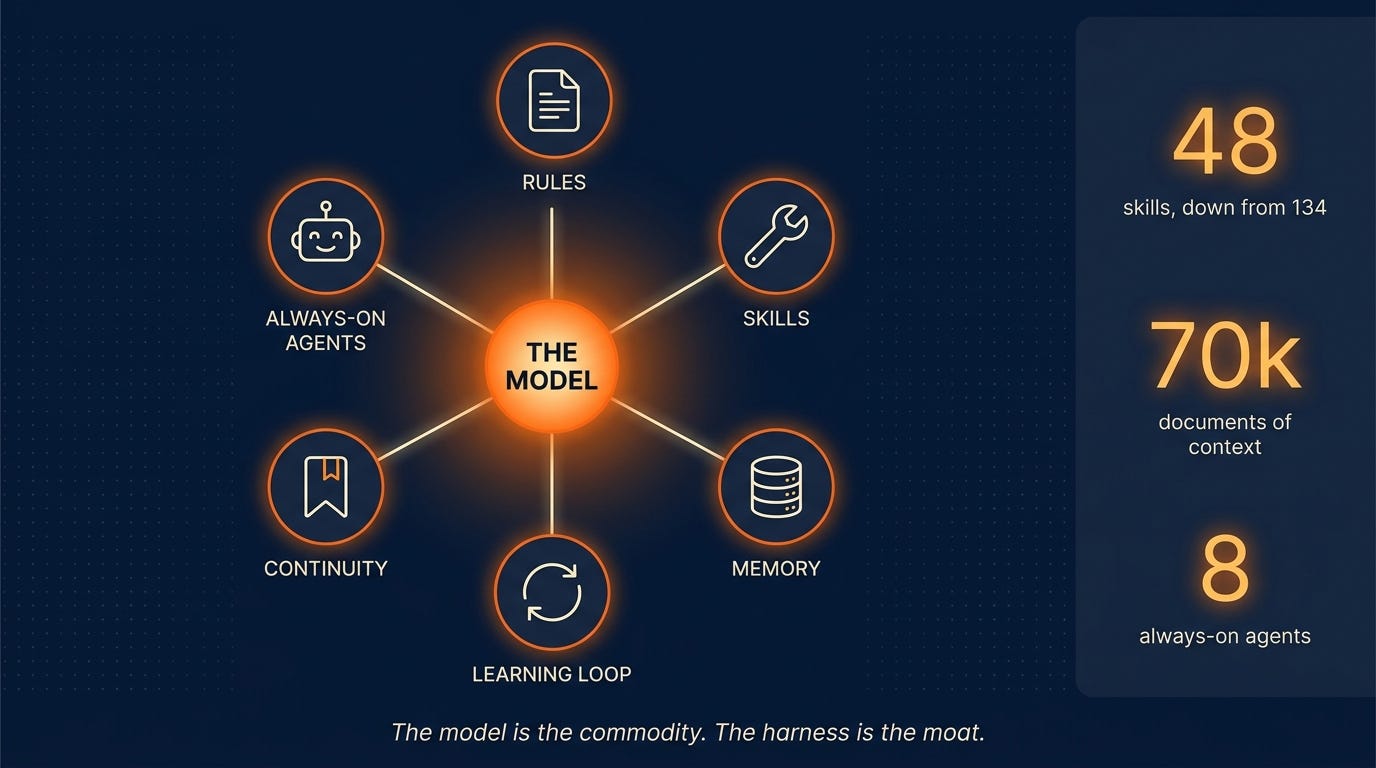
The harness is everything you build to fix that. It is the layer that turns a forgetful genius into a system that gets better at your work over time. You can hold all of mine in your head without an engineering degree:
Rules the model reads at the start of every session, so it already knows how I work before I ask for anything.
Skills it can reach for, small packaged procedures for recurring jobs, so I describe the outcome and it picks the right one. I keep 48 of them.
Memory it carries between sessions, in four tiers, so a lesson learned today is still there next week. Behind it sits roughly seventy thousand documents of accumulated context about my work.
A learning loop that catches its own mistakes and writes them down, so the same error does not happen twice.
Continuity that lets me close the laptop mid-thought and have the next session pick up exactly where this one stopped.
Always-on agents, eight of them spread across a small mesh of machines, that keep working long-horizon jobs while I sleep.
None of that is the model. All of it is the thing that decides whether the model is useful to me specifically. A model is a thing you rent for an hour. A harness is a thing you live inside.
A raw model is a brilliant contractor with no memory. The harness is everything that turns it into a colleague who remembers.
This is also why the choice of harness has a character to it, which is the argument I made in Three Harnesses, Three Characters: the same underlying model behaves like a different colleague depending on the rig you wrap it in. You are not picking an engine. You are picking who shows up to work.
What makes a harness great
Not every harness is worth building. A bad one is a pile of half-used scripts that slows you down and a maintenance burden you resent. A great one has three properties, and none of them is about how smart the model is.
It is shaped to you. Every rule encodes a preference I formed by getting something wrong. Every skill is a procedure I refined over dozens of runs. Every memory is a piece of context about my work, my data, my judgment calls that took months to accumulate. A competitor can license the identical model tomorrow. They cannot license eighteen months of my context, because it does not exist anywhere to license.
It learns. Because the harness has a learning loop, it does not sit still. It gets a little better every time it catches a mistake, and it does that whether I am watching or not. So the distance between a tuned harness and a fresh one does not hold steady. It grows. The organization that started building this a year ago is not a year ahead. It is a year ahead and pulling away.
It stays small. This is the property people get wrong, and getting it wrong is how they waste a year. More scaffolding is not better. Every rule the model reads, every skill in its reach, is something it holds in its attention on every single turn, and attention is finite. My own skill library peaked at 134 packaged procedures. I cut it to 48, and the cut was the work, not the cleanup. Compounding does not mean accumulating. It means keeping the ones that work and ruthlessly cutting the ones that don't.
Put those three together and you have something a competitor cannot buy, because it is personal, and cannot catch, because it keeps moving. That is the moat, and it is the reverse of the model question. The model is the layer where every company is equal.
The model is where everyone is equal. The harness is where the distance opens up.
How the harness crosses the gap
Now widen the lens, because this is where the harness stops being a productivity story and becomes a strategy one.
There is a real divide in how people see AI right now, and it is not skeptics against believers. Andrej Karpathy named it this spring: two groups talking past each other. The split that matters is between the people who have built something with these systems and the people who have only read about them, used the free tier, or sat through a demo. Almost every boardroom argument about what AI can and cannot do is a symptom of that divide, not a real debate. The two sides are calibrated to different machines, different use cases, different tiers of the thing.
You cannot read your way across that gap. You cannot procure your way across it either. You cross it by building, and building does not mean writing code. It means directing a harness to produce real work inside a domain you already command. The harness is the thing you wear to do it. My book calls it the exoskeleton, which is the whole title: Builder-Leader: The AI Exoskeleton That Crosses the Gap. The skills to operate one are not new. They are the same instincts that got you to senior in the first place: setting intent and the boundaries around it, designing the handoffs, judging the output against what good actually looks like. Pointed now at a system of agents instead of a team of people.
This is where those pieces and this one are the same argument seen from different sides. You don't have to write the code was the human half measured: domain command, not coding, is what predicts whether you get working results out of an agent, across four hundred thousand sessions. What AI didn't reprice was the human half priced: when output gets cheap, the judgment that knows which output is right gets dearer, and it is the one asset on your books that went up in value this year. The harness is the other half, the system that judgment directs. The two are useless apart. A great harness pointed by someone who does not know the field just produces wrong answers faster. Deep expertise with no harness leaves most of its own capability sitting on the table.
A leader who commands the domain and has built the harness holds a position the company across the street cannot copy. Not the model. The pairing.
That pairing is the whole point. One half is what you carry in your head. The other half is what you build around the model to put that head to work at machine speed. Together they are the thing no price sheet sells.
Why I made it public
So I wrote mine down. Not as a tutorial, and not as a flex. As a cookbook of why: why each piece exists, what problem it solves, how the parts fit together, and where I drew the line. It is called Claudelicious, and it lives on GitHub.
It is built around one idea: run the model as a system, not a chat box. And it is deliberately not a catalog. The community already maintains a good directory for finding a skill, a hook, a connector. Claudelicious is the other half, the part you cannot reverse-engineer from a screenshot: how those pieces fit together into a harness that remembers across sessions, corrects itself when you catch it, and keeps working while you sleep.
So it walks the six pieces I named earlier and shows the wiring under each. The rules that make the model know how you work before you ask. The skill library, and the discipline of keeping it small. The memory and the second brain behind it. The learning loop that makes a correction stick instead of recurring. The continuity that survives a closed laptop. The always-on agents and the small fleet they run on. Every chapter is principle first, then a worked example, then plain notes on what to copy and what to leave behind. There is a quickstart for getting the spine in place in your first week, and a longer version for reading the whole thing as one story.
It is also the working companion to the book. The book makes the case that the people who win with AI are not the ones who pick the best model, but the ones who build the system around it and lead from inside it. Claudelicious is that case made concrete: one such system, with the reasoning shown, that you can open and read.
I made it public for a specific reason. You cannot buy a harness. There is no SKU for the thing I have described, and there never will be, because the whole point is that it is yours. But you can look at the shape of someone else's, see which parts map to your work, and decide what is worth building and maintaining in your own organization. A worked example beats an abstract argument. So here is mine, with the reasoning shown.
Do not walk away with a shopping list. Walk away with the question underneath it.
Your AI edge is not on the model menu. It is the answer to a question no vendor will answer for you.
The question is this. A year from now, the model everyone runs will be cheaper and smarter than today's and roughly the same as your competitor's. So what will be different about how your organization uses it? What did you build around it that the next org did not, that learned from your work while theirs sat still, that no one can license because it is made of your own accumulated judgment?
If the answer is nothing, that is the gap to close this quarter. Not which model. What is the harness, who owns it, and is it learning.
Where this goes next
The harness is one of the two things AI did not make cheaper. The other is the thing you point it with, and that one did not just survive the markdown. It got more expensive. I made that case earlier this week: when output gets cheap, the scarce ability to judge it gets dearer, and the judgment of someone who knows your field is the one line on the books that AI repriced upward. The harness is the system. That judgment is what tells the system where to aim. Most teams are still budgeting for neither.
For now, sit with the pair. A leader with a domain in their head and a harness around the model is not waiting for a better model to arrive. They are already pulling away from the ones who are.
Sources
You Don't Have to Write the Code. Anthropic's 400,000-session study, the population-scale measurement of the human half: domain command, not coding, predicts success.
What AI Didn't Reprice. The pricing of that same human half: judgment is the one asset AI marked up while it marked almost everything else down.
The Model Is No Longer the Frontier. The first agentic-systems conference, where the research frontier moved off the model and onto the layer around it.
The Quiet Week Claude Became Your Coworker. Last fall, where the colleague-not-chatbot version of this argument started.
Start With Claude Code. This spring, where I put the explicit flag down: the harness is the moat.
Three Harnesses, Three Characters, One Working Week. The same model behaves like a different colleague depending on the rig around it.
Claudelicious. The public cookbook: the why and the wiring behind a full harness.
Builder-Leader: The AI Exoskeleton That Crosses the Gap. The book the harness is the working companion to.
Run Data Run is free, no paywall. If this was useful, the easiest way to support it is to subscribe and forward it to one person on your team who'd want it. If it wasn't, tell me why. I'll make it better.