

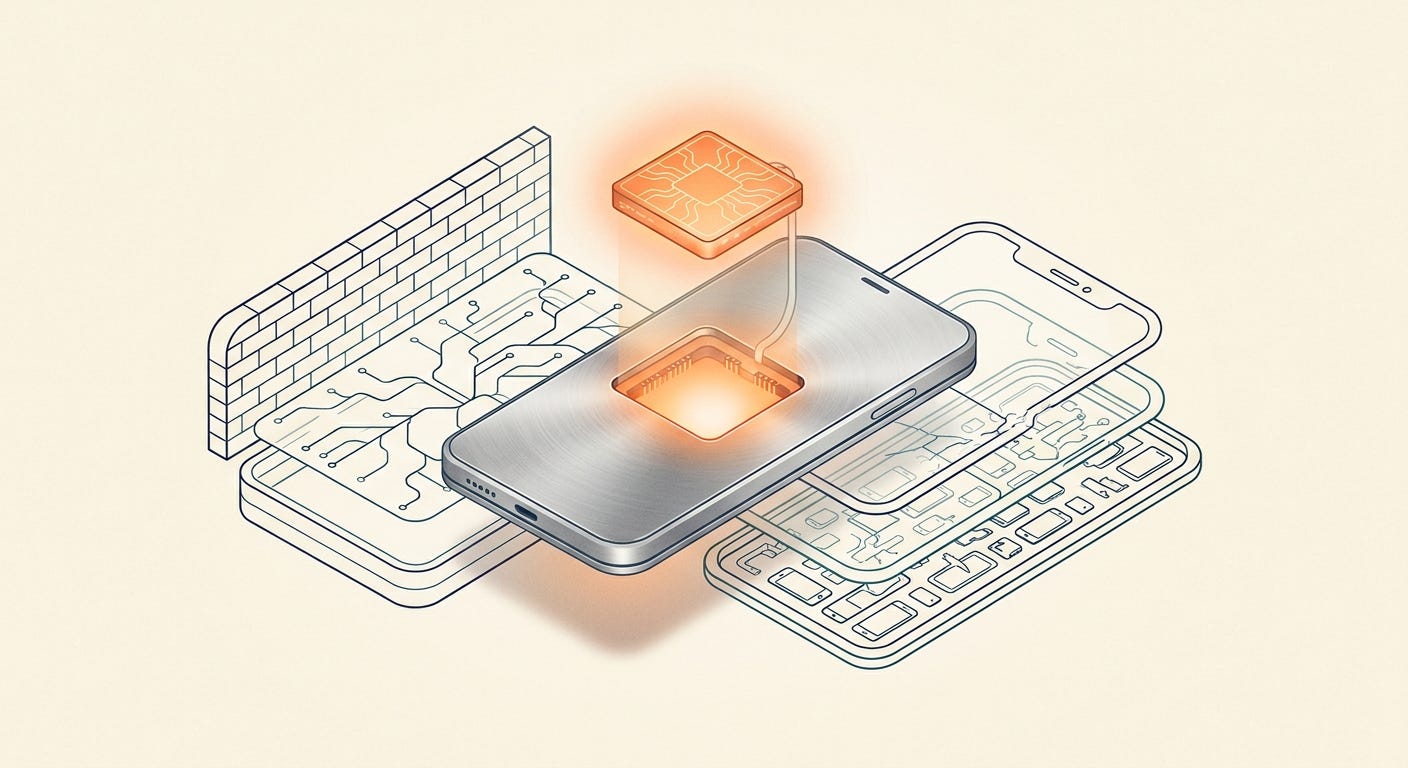
Apple is the company that owns everything. The chip in your phone, the operating system on top of it, the store that sells you apps, the cable, the charger, the retail floor you buy it on. The whole pitch for thirty years has been that owning the stack end to end is why the thing feels good in your hand. So the decision to watch at this year's WWDC is the one part Apple chose not to own.
It rented the brain.
The new Apple Intelligence runs on a family of models Apple calls its Foundation Models. Apple built them, Apple ships them, Apple runs them on its own silicon and its own servers. But the way it built them is the tell. Apple borrowed Google's Gemini, used it to train its own smaller models, and then sent Gemini home. The intelligence at the center of the most privacy-obsessed product on earth started life as someone else's model.
If you have heard me say "the model is the commodity, the thing around it is the moat," this is that argument arriving at the scale of a billion phones.
The company that built its identity on owning the stack just outsourced the brain. That is not a slip. That is the strategy.
What Apple actually shipped
Start with what's settled, because the marketing and the reporting are already fighting about the rest.
Apple shipped its own models. There's a small one that lives on your phone, with nothing leaving the device, and a larger one that runs in Apple's cloud for the heavier requests. Apple's executives, by AppleInsider's account, were blunt about the line with Google: "We use none of the models that Google deploys to their customers." A user, they say, never touches a drop of Google's code or Gemini or Google Search.
Both things are true at once, Apple used Gemini and there's no Gemini in the product, because of a technique worth understanding. It's becoming how a lot of AI gets built.
It's called distillation. Picture a senior expert and a junior. The senior knows an enormous amount but is expensive and slow to keep on staff. So you sit the junior down next to the senior for a long stretch, have the senior answer thousands of questions, and have the junior learn to give the same answers. When it's done, you ship the junior. The junior is cheaper, faster, small enough to run on a phone, and it carries a lot of what the senior taught it. The senior goes home and never meets the customer.
Distillation is hiring a junior, training them on a senior's answers, then shipping the junior and sending the senior home.
That's what Apple did. Gemini was the senior. Apple's Foundation Models are the juniors. By the time your iPhone is answering you, Google's model is not in the room. Which is exactly why an Apple exec can say "none of the models Google deploys" and a headline can say there isn't "a drop of Gemini" in the thing, and neither is lying.
The thing Apple is actually selling
This is where the running theme of this blog lands.
The model was the easy part to rent. What Apple kept for itself is everything wrapped around the model. I've been calling that wrapper the harness: all the machinery that turns a raw model into something a normal person can actually use, safely, without thinking about it. The model is the engine. The harness is the car.
Apple's harness has three pieces, and each one is a thing Google can't easily copy.
The first is the privacy wall. When a request is too big for your phone, it goes to Apple's cloud, and Apple has built that cloud so that even Apple can't see your data. They call it Private Cloud Compute, and the part that matters is that outside researchers can verify the claim rather than take Apple's word for it. There's a twist here that I'll come back to, because some of that cloud reportedly runs on Google's own servers. But the privacy boundary is Apple's, and it's the kind of thing a company builds over years, not months.
The second is the orchestrator. Every time you ask your phone something, a decision gets made in a fraction of a second: can the small model on this device handle it, or does this need to go to the cloud? That traffic cop is the orchestrator, and it's a harder problem than it sounds. Route too much to the cloud and you've broken the privacy promise and run up a server bill. Route too little and the answers get dumb. Apple's whole experience rides on getting that routing right, and Google never touches it.
The third is the one nobody else has. Distribution. Apple is about to put this on a billion devices that people already own, already trust, and already carry everywhere. No download, no signup, no learning curve. It's just in the phone. And those billion devices sit on top of the most personal pile of data anywhere: where you go, who you text, what you spend, how you sleep. No AI lab has that, and no amount of model training buys it.
Here's the beat that should settle the argument. The same week Apple announced this, the largest prediction market on which company has the best AI model gave Google an eight percent chance. Anthropic sat at ninety. Apple did not rent the best brain on the market. It rented one that was good enough, available, and willing to sign. That is not a knock on the deal. It is the whole reason to call the model a commodity: when the engine is interchangeable, you stop paying for the best one and start paying for the one you can build the best car around.
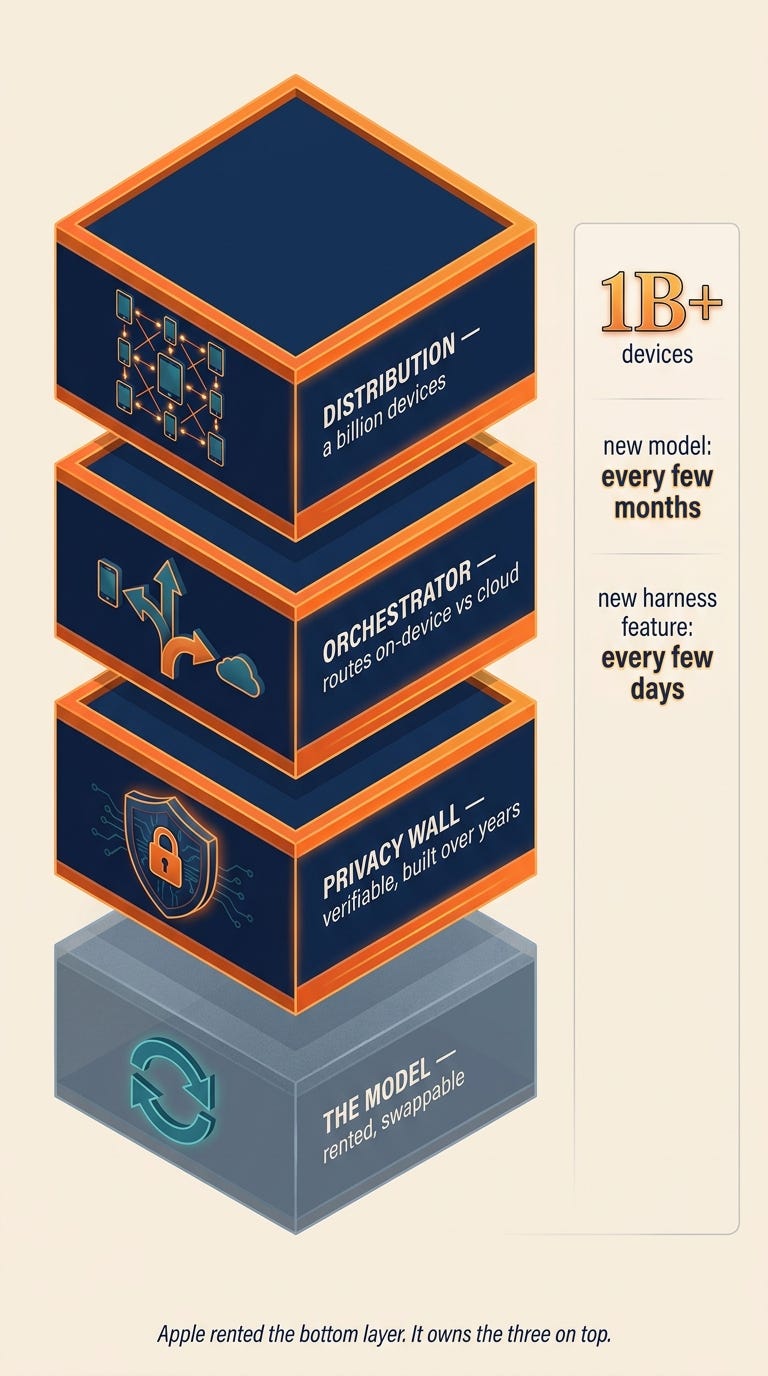
Apple rented the engine and built the car, the safety cage, and the road. Then it parked one in a billion driveways.
Why this is the moment most people meet AI
There's a divide running through every conversation about this technology right now. On one side are the people who have spent real time with AI agents, who have felt a system plan a task, use a tool, come back with something done. On the other side is almost everyone else, the people who have read the headlines, tried a chatbot once, and suspect the whole thing is overhyped.
Apple is about to drag a very large number of people across that divide without their noticing it happened.
For most normal people, this iPhone is the first time agentic AI will just work in their hand, on the device they were already holding, doing something they actually wanted done. Not a demo. Not a separate app they had to go find. The assistant on the phone, doing the thing.
And the model underneath it is rented. That's the part I keep turning over. The thing that finally makes AI feel ordinary and useful to a billion people will be sold to them as Apple, will be wrapped in Apple's privacy story and Apple's design, and will have at its core a model Apple trained off Google's. The harness is what they'll experience. The brain is a commodity they'll never see.
The part I can't resolve
Read three accounts of what Apple announced and you get three different stories. Apple's own newsroom doesn't say the word Gemini once. AppleInsider ran a piece arguing there isn't "a drop of Gemini" in the shipping product. MacRumors split the difference, calling the architecture "co-developed with Google." Those are three different answers to the question I care about: how much of Apple Intelligence is Apple, and how much is Google wearing an Apple case?
On day one, the people closest to the story can't agree on whose product this is. That disagreement is the whole question.
The twist I promised earlier cuts both ways: part of Apple's private cloud reportedly runs on Google's own servers, certified so Google never sees the data. Read it as Apple's harness being strong enough to run safely on a rival's hardware, or as Apple leaning on Google harder than the keynote let on. Both readings come from the same fact. If the harness is the real moat, the rented model is a swappable part and the privacy wall and the billion devices do the heavy lifting. If it isn't, this is a distilled rental with a beautiful interface, and it wobbles the moment Google ships something Apple can't distill its way around. The line between Apple's model and Apple's harness is where the answer lives, and on day one that line is blurry on purpose.
What to take from it
Strip away the Apple specifics and there's a decision sitting underneath, and it's the same one facing anyone deciding how to build with this technology.
You can rent the model. The frontier models are getting cheaper and more interchangeable by the month, a new one drops every few months, and chasing the best one is a race you finish in last place. What you can't rent, and what actually decides whether your version is any good, is everything you build around it: the way you keep data safe, the logic that decides what runs where, the place you put it so people will actually use it. Rent the brain. Own the car.
The catch is that this only works if the harness is something a competitor can't reproduce. A privacy wall outsiders can verify, routing logic you built and own, distribution nobody can take from you, those make a moat. A thin wrapper over someone else's model with a nice logo on it does not, no matter how good the keynote was.
So the test isn't whether Apple rented its brain. Renting the brain is the smart move. The test is whether the car Apple built around it is one only Apple could have built. Watch the privacy wall, watch the routing, watch what happens the first time Google ships something Apple's juniors can't keep up with. That's when we'll find out whether the harness was the moat or the makeup.
I don't know the answer. But I know it's the right question, and I know a billion people are about to live inside whatever the answer turns out to be.
The argument under this post, that the model is the commodity and the thing you build around it is the moat, is the spine of my book, [Builder Leader](https://builder-leader.com). The book names that thing the harness, and it makes a claim that read as abstract when I wrote it: the ceiling on what you get from AI is set by what you build around the model, not by which model you can reach. Apple just ran that play at the scale of a billion phones. It rented the model and bet the company on the harness. Whether the bet pays off is the part this post leaves open. The shape of the bet is the whole book. Builder Leader.