


I’m sitting in a hotel lobby in China, watching a woman at the next table dictate tasks to her phone in Mandarin. She’s not using Siri. She’s not using ChatGPT. She’s talking to an OpenClaw agent running on a Mac Mini back in her apartment. It orders groceries, summarizes her team’s WeChat messages, drafts a report. All before she’s finished her coffee.
This isn’t a tech demo. This is Tuesday.
And it tells you more about the future of AI than any GTC keynote or product launch.
I’ve Seen This Before
Walking around China this week, OpenClaw is everywhere. Not just among developers. Business owners running inventory agents. Students with research assistants. A restaurant manager whose agent handles reservations, supplier emails, and daily P&L summaries through a single Telegram thread.
SecurityScorecard reported this month that China-based OpenClaw usage has already surpassed the United States. Tencent, Alibaba, and Baidu are hosting public meetups to help everyday users get set up. There’s a buying frenzy for used Macs because OpenClaw works best on Apple hardware.
This is a pattern I recognize. We’ve seen it before.
Landlines to mobile (1990s-2000s). China never built out extensive landline infrastructure. When mobile arrived, there was nothing to skip from. Mobile penetration went from 7% to 90% in thirteen years. The West spent decades building copper networks. China went straight to wireless.
Cash to mobile payments (2010s). No entrenched credit card infrastructure to protect. No Visa and Mastercard lobbying to slow things down. QR codes, WeChat Pay, and Alipay now handle 340 trillion yuan annually. Roughly 80% of daily transactions happen on phones. I watched a street vendor selling dumplings who hasn’t touched cash in years.
Traditional SaaS to AI agents (now). No deep Salesforce, ServiceNow, or Microsoft 365 entrenchment in the everyday economy. So when OpenClaw showed up as a free, open-source agent that lives in the messaging apps people already use, there was no incumbent to defend. Just adoption.
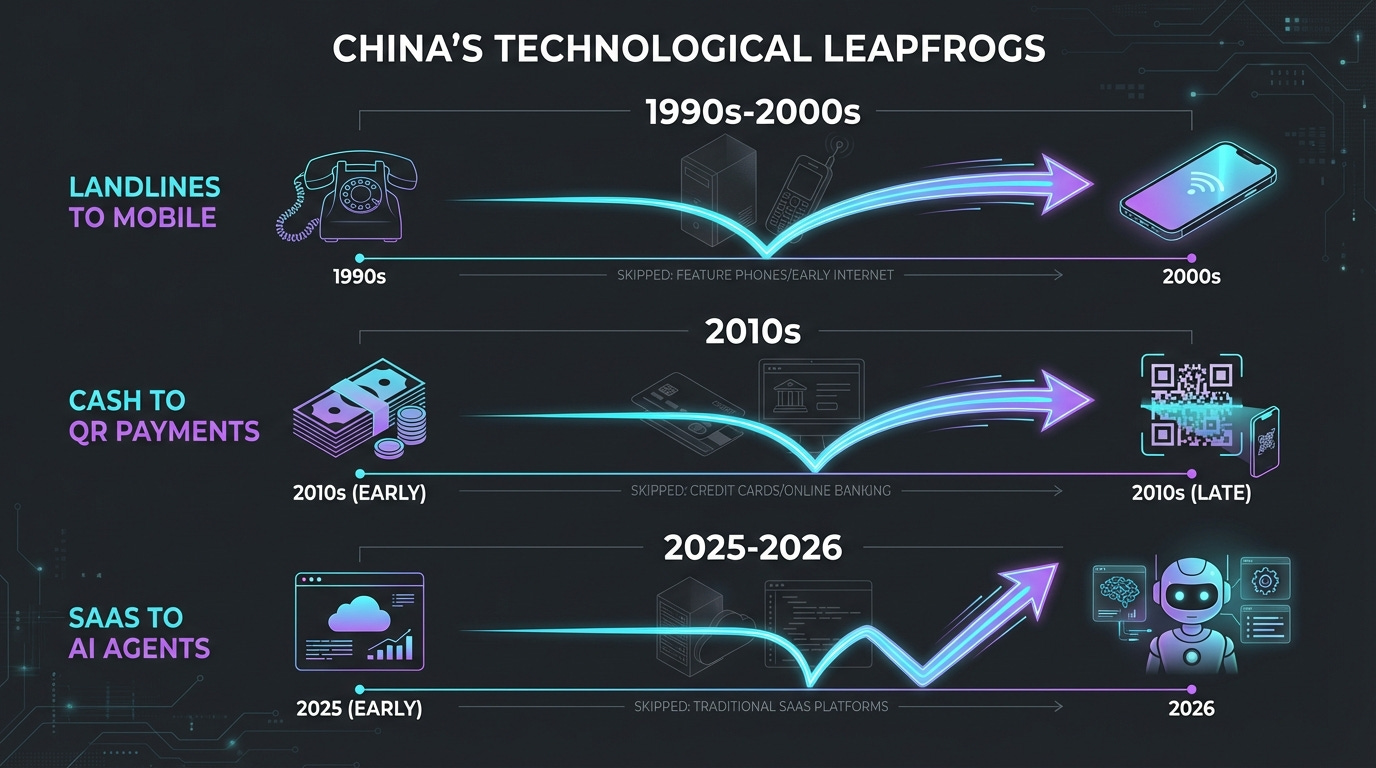
Leapfrogging requires three conditions: absence of entrenched infrastructure, timing alignment with new technology, and coordinated adoption pressure. China has all three. Every time.
The countries that adopt new technology fastest aren’t the most advanced. They’re the ones with the least to protect.
In The Convergence, I wrote about OpenClaw’s heartbeat as the same pattern as Karpathy’s AutoResearch: wake up, check state, decide, act, go back to sleep. I was describing the technology. What I missed was the distribution. The technology is universal. The adoption isn’t.
Meanwhile, in San Francisco
While OpenClaw was going viral through group chats, Anthropic was doing something quieter. They were building the same thing, piece by piece, through a pipeline most people haven’t noticed.
The pattern: features debut in Claude Code (the terminal CLI for developers). Developers battle-test them. The features that survive get polished and pushed into Claude Co-Work (the desktop GUI for everyone). Co-Work launched in January 2026 as a research preview. By February, it had enterprise plugins, private marketplaces, and scheduled tasks.
Here’s the timeline:
Jan 2025: Claude Code launches. Terminal only. Developers only.
Jan 2026: Co-Work launches. GUI. Everyone with a paid plan.
Feb 2026: Remote Control. Scan a QR code, control your laptop from your phone. Your local environment stays local. Only conversation flows through the cloud.
Feb 2026: Channels. Telegram and Discord integration for Claude Code. Send it a message, it picks up the task, acts on your local machine, replies through the same channel.
Feb 2026: Enterprise expansion. Private plugin marketplaces, domain-specific templates, scheduled recurring tasks.
Mar 2026: /loop command. Session-level task scheduling in plain English. “Check the deploy every 5 minutes.” “Run tests hourly and post results to GitHub.”
Mar 2026: Voice mode. 1M token context window.
Now line that up against what OpenClaw does:
Feature by feature, Claude has replicated OpenClaw’s core capabilities. The difference is the wrapper. OpenClaw is open, flexible, and model-agnostic. Claude is closed, enterprise-safe, Anthropic-only, and backed by a company valued at $380 billion.
Anthropic isn’t building an OpenClaw competitor. They’re building what OpenClaw would look like if it had $10 billion in funding, enterprise security requirements, and a legal team.
In January, I wrote that Co-Work was the iPhone moment. The technical capabilities existed. Power users had figured out the workflows. The interface unlocked mass adoption. Two months later, the Channels feature proved the thesis: the interface for agents isn’t a terminal. It’s the messaging apps you already use.
Jensen Saw It Coming
GTC 2026. March 18. The day before I started writing this.
Jensen Huang announces NemoClaw: a reference stack making OpenClaw “enterprise ready.” Policy enforcement, network guardrails, privacy routing, all deployed through NVIDIA’s OpenShell runtime.
His line: “Every single company in the world today has to have an OpenClaw strategy.”
This is the CUDA playbook, running for the fourth decade:
Open-source captures grassroots adoption (OpenClaw)
Enterprise wrapper captures corporate adoption (NemoClaw)
Infrastructure layer captures margin (NVIDIA GPUs)
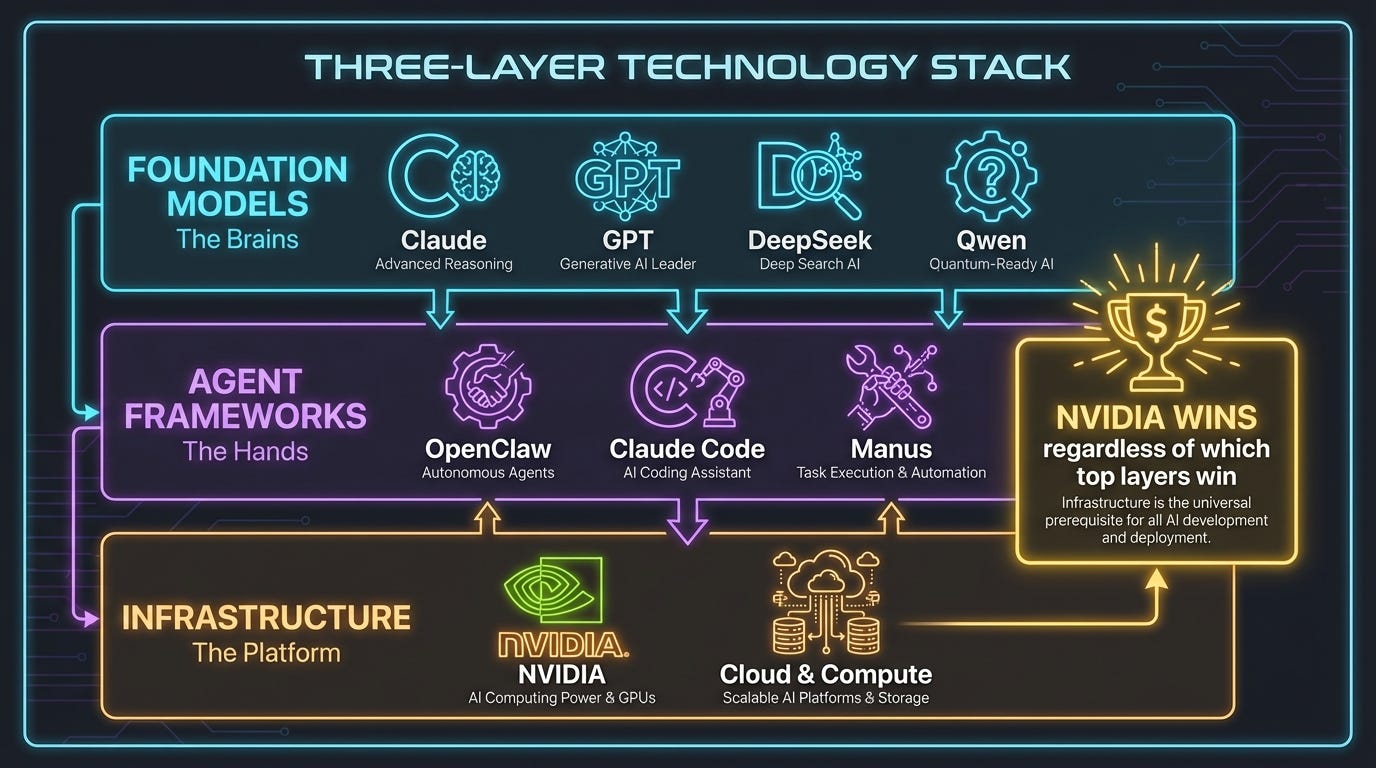
Jensen doesn’t care whether you use Claude or OpenClaw. He cares that you need GPUs to run either one. The three-layer stack is crystallizing:
Foundation models: Claude, GPT, DeepSeek, Qwen (the brains)
Agent frameworks: OpenClaw, Claude Code/Co-Work, Manus (the hands)
Infrastructure: NVIDIA, cloud providers (the platform)
Jensen is positioning NVIDIA to own layer 3 regardless of who wins layers 1 and 2. Same play as CUDA. Own the reference implementation, own the infrastructure demand.
The smartest move in the agent war wasn’t building an agent. It was building the platform every agent runs on.
The Year of the Personal Agent
2025 proved capability. Claude Code, GPT-5, Opus 4.5. For the first time, a single model could plan multi-step tasks, execute across domains, and iterate without human intervention. The question that year was simple: how smart can we make one model?
2026 changed the question. Not “how smart is the model?” but “how well does the agent know you?”
The evidence landed all in the same month. March 2026:
OpenClaw: 250,000 GitHub stars. Acquired by OpenAI.
Claude Co-Work: Enterprise plugins. Scheduled tasks. Private marketplaces.
Claude Code: Channels, Remote Control, /loop, voice mode.
NemoClaw: NVIDIA’s enterprise OpenClaw wrapper.
Perplexity Personal Computer (Mar 11): Always-on agent running on a Mac Mini.
Meta Manus My Computer (Mar 16): Desktop app for Windows and macOS.
All five major AI companies pivoted to local or hybrid personal agents in the same month. That’s not coincidence. That’s a market signal. Gartner predicts 40% of enterprise apps will feature task-specific AI agents by end of 2026, up from less than 5% in 2025.
The threads from my previous posts converge here:
In The Overnight Loop, I wrote that the loop itself is infrastructure. Try, measure, learn, repeat. The pattern works on GPUs, landing pages, molecular design. Anywhere you have something to change and a number to check. Personal agents are that loop, running on your machine, with your data, optimizing for your priorities.
In The Convergence, I wrote about small, proven components composing into systems that compound. A cron job plus a language model plus markdown files equals a personal agent that never sleeps. The composition is the breakthrough, not any individual component.
In Every AI Agent Is Missing Its Dopamine, I argued the next frontier isn’t more tools or faster models. It’s judgment. The continuous, adaptive sense of what matters right now, given everything else going on.
Personalized agents are where all three converge. Your agent runs your loops. On your machine. With your judgment about what matters.
2025 asked “how smart is the model?”
2026 asks “how well does the agent know you?”
The Leapfrog
Back to the hotel lobby. The woman with the coffee.
She didn’t evaluate Claude vs. OpenClaw vs. Manus. She didn’t read comparison articles on DataCamp. She opened WeChat, saw that her friend had set up an agent, and did the same thing. The distribution channel was a group chat. The onboarding was a QR code. The result was a personal agent running on a Mac Mini she bought used.
That’s the leapfrog. Not better technology. Better distribution.
China’s relationship with new technology is fundamentally different from the West’s. Techno-optimism isn’t a subculture here. It’s mainstream. There’s no “are AI agents going to take my job?” discourse in the coffee shop. There’s “which agent setup are you running?” The energy is practical, not anxious. The adoption is social, not institutional. One person sets it up, shows three friends, and by next week the whole office has agents running through their messaging apps.
Anthropic is building the most capable, most secure agent platform in the world. It’s genuinely impressive engineering. But they’re distributing through enterprise sales cycles, SOC 2 compliance reviews, and private plugin marketplaces. That’s the credit card play: technically superior infrastructure, gated by process.
OpenClaw is distributing through WeChat group chats and Telegram communities. That’s the QR code play: good enough technology, zero friction distribution.
The lesson from China’s last two leapfrogs: the technology that wins isn’t the one that’s most capable or most secure. It’s the one that matches the distribution architecture people already use.
America built the best credit card infrastructure in the world. China skipped it.
America is building the best enterprise AI agent infrastructure in the world.
I’m watching what comes next from a hotel lobby in China.
The future of AI agents isn’t being decided in boardrooms or keynotes. It’s being decided in group chats.