


At 02:14 this morning, the agent that writes my overnight AI brief filed this line: "Stanford 2026 AI Index - Stanford HAI's annual report is out."
So I did the usual. I made coffee, opened a blog folder, pulled the PDF and started reading. I'd written the first heading before I thought to check the release date. April 13. The brief was six months late and entirely sure of itself.
I'll admit the next part stung a bit. The report my agent announced as news spends pages measuring how reliable agents are. Nobody at Stanford asked for a live demo.
There was no new report to write about. But six months is a useful gap. It's long enough for a forecast to meet reality and short enough that everyone still quotes it. So instead of a summary nobody needs, here's a check: what the Index said in April, what's happened since, and which claims held. I've also weighted it toward biopharma, because that's where the frontier labs spent the summer.
Why the mistake is on topic
The 2026 AI Index has good news on agents. On OSWorld, a test where an AI has to operate a real computer to finish a task, the best systems went from about 12% to 66.3% in a year. Humans score 72.35%. That's close, and it still means the agent fails about one task in three.
My agent's failure was the plausible kind. It had a real link to a real report, and the only wrong thing was the date. The item resurfaced in an AI newsletter months later with no publish date, the Stanford page has no date metadata, and my pipeline only ever asked "have I seen this link before", never "how old is this". A model reading chatter can't tell "people are talking about it" from "it just came out". To be fair to the model, plenty of people can't either.
The Index has its own version of this problem. It reports invalid-question rates on popular benchmarks of up to 42% on GSM8K, a widely used grade-school math test. Read the paper behind it and that 42% is the share of questions a detector flagged that experts confirmed were flawed, not the share of the whole test. That's plenty to blur a leaderboard, and it's a tidy example of a number losing its denominator. Keep that in mind for the next section, because some of April's rulers have already been retired.
A number that loses its denominator looks exactly like a bigger number.
The scorecard
I pulled twelve claims from the report and checked each against what's been published since. Nearly every number below traces back to a primary source, a few needed correcting on the way, and everything is as of this week.
What held
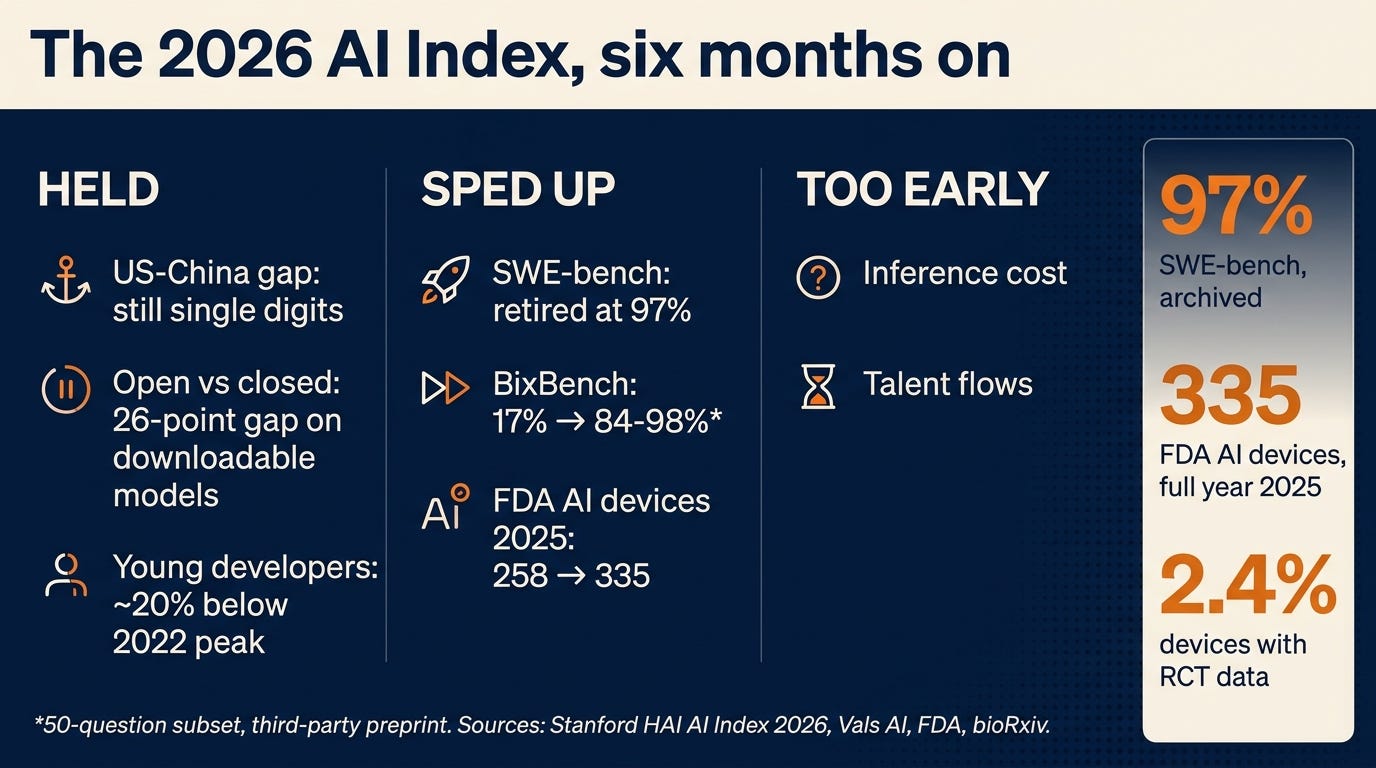
The US-China gap stayed closed. In March the top US model led the top Chinese model by 2.7% on Arena, a public head-to-head leaderboard where people vote on which answer is better. In October, a Bloomberg Intelligence note put the gap at about 3% on LiveBench after DeepSeek's latest release. Different scoreboard, same story: the gap is in single digits.
The open-versus-closed gap reopened, and it's stayed open. "Open weights" means you can download the model and run it yourself. The Index said the best closed models led the best open ones by about 3% in March, up from 0.5% in August 2024. On Artificial Analysis's revised index, which uses a different scale, the best open model you can actually download today trails the leader by 26 points. Kimi K3.1 Pro would roughly halve that, but its weights aren't out yet. A promised release isn't a downloadable one. Different instruments, so read it as direction, not a trend line.
Entry-level software jobs kept shrinking. The Index cited Stanford research showing employment for software developers aged 22 to 25 was close to 20% below its 2022 peak. HAI's labor dashboards this month show jobs in AI-exposed roles down more than 4% this year, and young workers in those roles down over 3% a year since ChatGPT launched. Different baseline, same direction.
What sped up
The benchmarks are dying faster than the report could print them. April's chart had the best models near 77% on SWE-bench Verified, a test of whether a model can fix real bugs in real code. By Vals AI's last run on September 1 the top model hit 97%, and Vals now lists it as an archived benchmark because performance has saturated. The ruler April used to show progress is now in a drawer.
Bioinformatics went the same way. The Index said frontier models scored roughly 17% on BixBench, a test of real-world biological data analysis. A third-party preprint in May reported 84% to 98% on a verified 50-question subset when the models had scientific skills and tools. Part of that jump is a cleaner exam, since the curation removed ambiguous questions, but the 17% is already a historical figure.
The money got bigger, and so did the accounting. The Index counted $285.9 billion of US private AI investment in 2025. Crunchbase puts global venture funding at $679 billion for just the first three quarters of 2026, the highest on record. AI took $102 billion of the $159 billion raised in Q3. Everyone else split the change.
Then Anthropic filed to go public. The S-1 shows unaudited first-half revenue of $16.3 billion, up from $1.2 billion a year earlier, and a net loss of $80.7 billion. That loss is on the books and mostly beside the point: $72.4 billion of it is a non-cash revaluation, mostly of convertible notes, which went up because Anthropic's own valuation went up. The operating loss was $693 million. It's the most expensive-looking way I've seen to report that things are going well.
The FDA count moved, and it's the same bug as my brief. The Index says 258 AI-enabled medical devices were authorized in 2025. The FDA's own list now shows 335 for the year. Neither is wrong. The report's body says its count runs through September 2025, and the highlight dropped the date range. Count the FDA list by decision date and January to September gives 259, while the full year gives 335, up 43% on 2024's 235. A correct number with its date stripped off is exactly what my agent served me at 02:14. I'm finding that oddly comforting.
What the labs did with biology
I care most about this part of the report, and it's moved the most since April. The Index's science chapter made two points. AI can propose, but the wet lab still has to confirm. And in biology, small specialist models often beat big general ones: a 111-million-parameter model tops ProteinGym, a protein-function benchmark, and a 200-million-parameter genomics model beats a 40-billion-parameter one on several tasks.
Then both frontier labs walked straight into biology.
Anthropic went into the lab. In September roughly 950 Claude agent sessions mined more than 200,000 reverse transcriptases, a single enzyme family, and one run flagged a new genetic system in a phage. The lab has confirmed the region is transcribed, and nobody yet knows what it does. I wrote up how they found it, including the uncomfortable bit that ten identical reruns missed it. Anthropic also reports protein binder designs hitting nearly 50% across 12 targets, tested by two outside organizations, against the 10% to 15% it calls typical. That's self-reported, but it's a general model producing lab-confirmed output. Awesome, and a little humbling for those of us who spent years fighting for every point of hit rate.
On Tuesday it published early results from six drug-development partners and said it has acquired Mithril Medicine. Read past the antibody counts and the line that matters is Anthropic's own: "so far it is mostly preclinical." The earliest it expects a drug to be ready for human trials is late 2028, and only if that candidate keeps holding up. The part of this I like most is that the company with the most reason to leave that line out wrote it anyway.
OpenAI built a specialist. Rather than lean on its mainline model, OpenAI shipped GPT-Rosalind, a purpose-built life sciences model, available only to vetted organizations. At its April launch OpenAI said it beat its then-current general model on 6 of 11 lab-research tasks, a vendor benchmark that's now six months old. Then this month OpenAI bought Orchestra Bio, whose platform coordinates the operations side of drug development. That's a model vendor turning into a platform.
So did small beat big? It depends on the job, and the answer is more useful than a yes or no. On predicting what a protein mutation does, the specialists still win at the top. A July preprint from the Marks and Church labs, built from ProteinGym assays, found the best general model scored about level with a 650-million-parameter protein model, ahead of roughly half of 95 published predictors and well behind the best specialist. Giving it more thinking time narrowed the gap and didn't close it.
On running the analysis, the general models have overtaken April's numbers. They're increasingly the thing that drives the specialist tools: Anthropic's binder results came from Claude operating open-source protein design models, not replacing them. I made a version of this argument in April in The Specialists Are Coming for the Generalists, and six months on I'd sharpen it.
The generalist is the operator. The specialist is still the instrument.
The cost has moved too. When Claude designed 318,000 antivenom proteins in 64 hours, 17 of the 211 that were tested passed the lab's binding bar, and the wet-lab work took two months and cost about three times the compute. Design got cheap. Nothing after it did.
The clinic hasn't moved yet. Insilico's rentosertib, with an AI-picked target and AI-designed chemistry, started Phase III in pulmonary fibrosis in September. It's the first real clinical test of April's caveat, and the registry's primary completion estimate is October 2029. Meanwhile the Index's sharpest medical number stands untouched: of AI devices with clinical studies, only 2.4% had randomized controlled trial data. I found no clinical outcome data in either frontier lab's announcements from the past six months.
If you run an R&D team, that's where I'd put the money. The model is the cheap part now. Assay data, wet-lab throughput and validation design are what decide whether any of this reaches a patient.
Too early to call
Inference cost is falling, and I couldn't find a clean, well-sourced number for how fast, so I'll leave it at that. Talent flows were one of the Index's starkest charts, with AI researchers moving to the US down 89% since 2017. A Stanford follow-up exists behind a paywall, and I haven't read it. Given the theme of this post, I'm not quoting a study I haven't opened.
What I changed in my agent
Back to 02:14. I didn't fix the brief by telling the model to be more careful. I fixed it by checking the thing it linked to.
There's now an age check in code that runs before the model sees anything. It looks for a date in the link itself, then in the page's metadata, then at the first time the story showed up in my earlier feeds. Anything older than 14 days gets dropped.
I re-ran it against last night's 110 items. It dropped seven. One was the AI Index, which first appeared in my feeds on June 16. The others were a 2025 METR paper, two Microsoft Research papers from last year, an April survey and a software release note that was 17 days old. Plus a blog post from 2011, which I can only assume was having a moment. The fresh stories from the same night still got through.
I'd only noticed one of the seven. The other six would have read as news, and I'd probably have believed them.
I'm not mad at the agent. It did exactly what I built it to do, which turns out to be the problem with most of the agents I build. It read the room, and the room was six months behind. The fix wasn't a smarter model. It was one boring question, asked in code, before the smart part ran: how old is this?
That question runs through the whole scorecard. The retired benchmark, the FDA count, the S-1 loss that's mostly paperwork. Most of the numbers April printed were true when it printed them. What goes stale is the when, and a number with its date stripped off looks exactly like a new one.
The next Index lands around April 2027. My agent will tell me it's out, and this time it'll be right.
I'll check the date anyway. We're working on trust.