

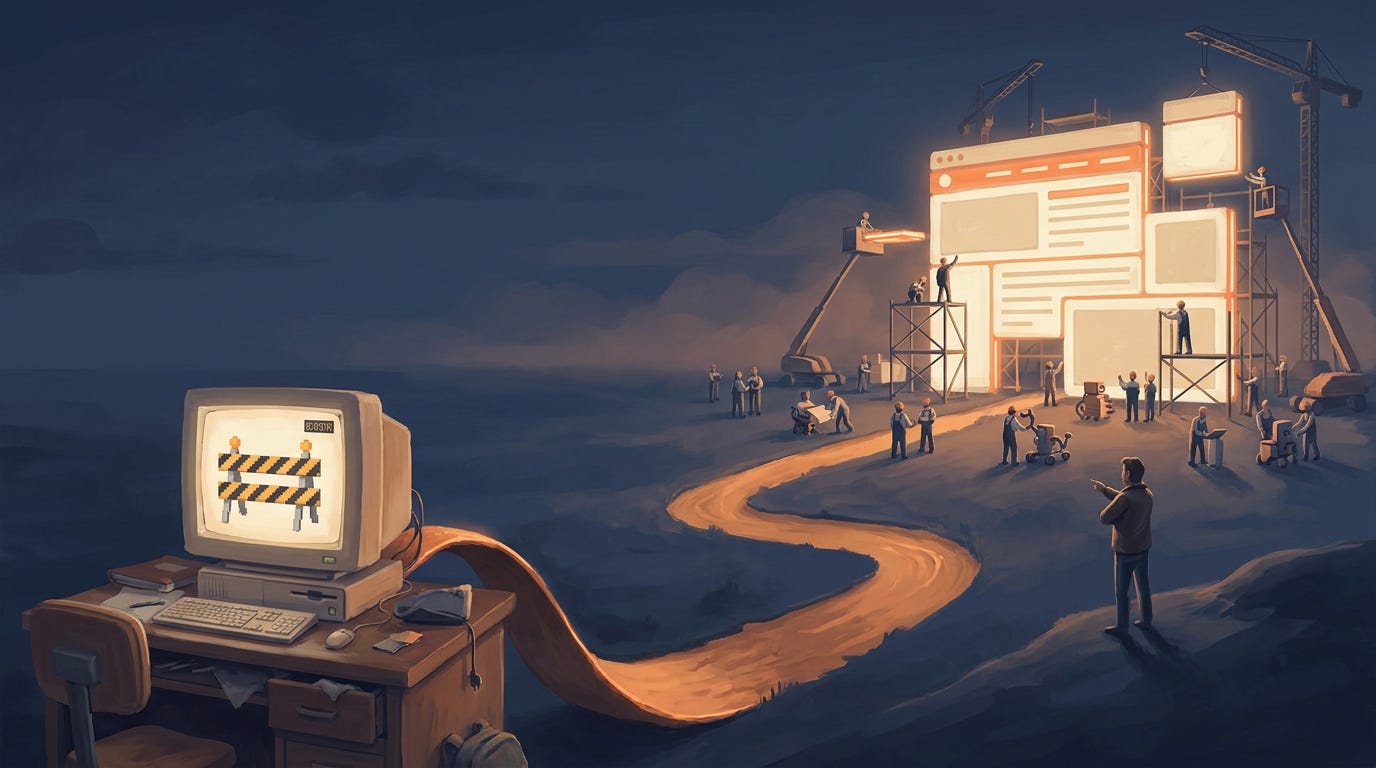
My first website had an under-construction sign on it.
Junior high. GeoCities. An animated GIF and a hit counter I started at a thousand so it would look like somebody had visited. I wrote every line by hand, badly, and nobody could have told me how to do it better, because nobody knew yet.
This week I relaunched justinhjohnson.com. It came together in about a day, and I didn't write a line of it.
Those two websites sit roughly thirty years apart. Almost everything I've learned about building with AI lives in the gap between them. So does the work I'm proudest of.
A year ago, purple gradients
Design is where the jump shows most.
A year ago, if you asked a model to design a personal site, you got a purple gradient, three cards with icons in them and a headline about the future. Competent. Forgettable. You could swap the name at the top for anyone's and nobody would notice.
This time I asked for five designs before anyone built anything, and what came back were five points of view. Each had its own type, its own colour and its own theory of who I am. One drew my whole career as a genome browser. It was gorgeous, and I killed it, because nobody outside genomics would know what they were looking at.
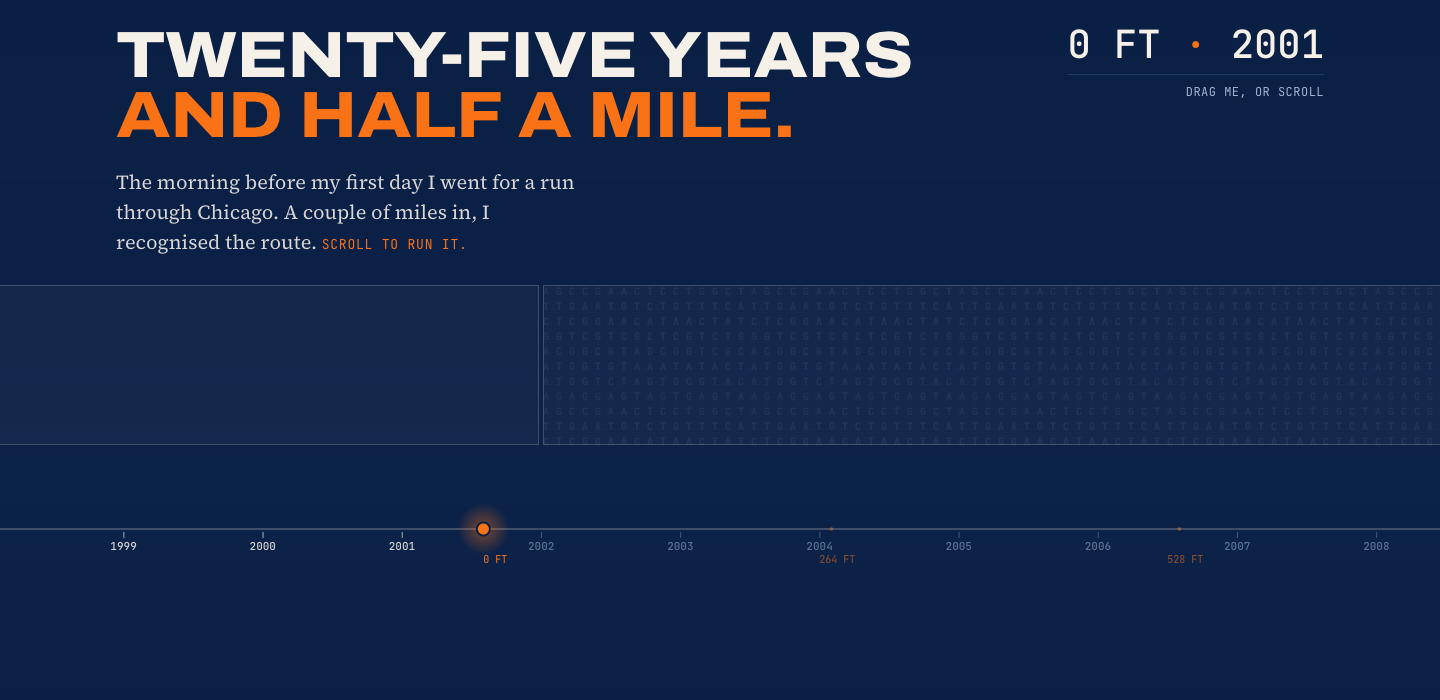
What I kept was a mix. Loud editorial type from one design. The running story from another, because Run Data Run is named for running and Twenty-five years and half a mile started on a run, so the homepage now opens on a route. And the builder thread from I Build Things.
Then a long list of no. No to the clever metaphor. The all-dark neon look I'd worn for a year went too. So did every image with numbers baked into it, because numbers change and pictures don't. The first version of the story got sent back, because it read like a resume. It came back as a story. And one big yes: every project links to the things it touches, so the work reads as one system instead of fifty tiles.
The models have range now. My job is taste, and taste mostly sounds like no.
The patterns that stack
The day was fast because the patterns underneath it took two years. Each one sits on top of the last.
Pick the instrument. Different models are good at different things. Opus designs and builds. Fable sets creative direction and writes the long stories. Sonnet digs through two years of notes to find every project I shipped. Haiku runs the small, fast chores. Gemini draws. Free models from other labs read drafts as second opinions and argue with each other for nothing. I started doing this with the trading bots, where three models from three labs had to agree before a trade went through.
Swarm the parallel work. When five pieces don't depend on each other, five agents build them at once. For the homepage, five agents each built a different idea for the opening piece, side by side. I picked one. Five years ago that would have been the most expensive indecision in the building. Now it costs a coffee.
Put the critic on a different model. A model grading its own work is looking in a mirror. ARIA taught me that, and the same move now checks most of what I publish, including this site.
Write the method down once. Every time I correct the system, the correction lands in a skill or a rule, so I never explain it twice. There are more than a hundred skills now. They know my sources, my house style for images and what I'm not allowed to say in public.
Remember everything. A vault of notes, indexed so any machine I own can search it by meaning. The stories on the new site were written from those sources instead of from my memory. That turns out to matter. More on it in a second.
None of these were built for a website. They were built for trading bots, research engines, a book and two blogs. Then they all turned up for the same job, which is how compounding feels from the inside. I wrote more about why the setup matters more than any one model in The Harness Is the Moat.
None of these patterns were built for a website. Then they all turned up for the same job.
My most cautious colleague
Every model I work with now shares one personality trait. It will not let me do anything that might be unsafe or untrue.
It cut "I sleep eight hours a night" from my bio because it couldn't find a source. Fair. It wouldn't let me say I built the first version of Navari myself, because I didn't. An engineering lead built it in about six weeks. I'd claimed otherwise in a blog post in August. The page says so now, and so does this one. It flagged the newest Navari number as second-hand and made me say that too. And it asks permission before anything goes public. Every time. Including the website whose entire purpose is to be public.
I've worked with a lot of careful people. None of them ever asked me for a citation on my sleep.
It's annoying for about a minute. Then you notice it's the only colleague you've ever had with no reason to flatter you. I spent years telling teams that safe is the fast way. Now I work with something that takes me at my word.
It's the only colleague I've ever had with no reason to flatter me.
The work I'm proudest of
All of this was built during thirteen years at AstraZeneca and handed off when I left in June. I joined Tempus in August.
Most companies trying agentic AI start with the agent. Pick a model, build a chatbot, go looking for a problem. That's backwards, and it's the thing almost everyone misses. We don't understand our own business processes well enough to automate them. Nobody wrote down how the work actually flows, where the time goes or what a better outcome is worth. You can't hand a process to an agent when you can't describe it to a person.
Agentis was my answer, and it's the work I'm proudest of. Before it, every function built its own agents, the data team served whoever asked loudest, and three groups ran three roadmaps that were never going to meet. Agentis is a framework, and it builds nothing itself. Start from the strategic question. Map the process underneath it and measure it. Decide which steps deserve an agent, what success looks like and the smallest version worth building. By late 2025 it had 14 use cases running in parallel.
Then the data has to be right. AIthena made clinical trial data AI-ready at the source, with an owner and a release gate for each study, so nobody had to clean it up after the fact. The first proof was a ctDNA atlas across 24 trials and 4 vendors, concept to working version in two months, with a program lead running it day to day. This is the boring 80 percent, and it's where agents win or lose.
Last, the platform. Navari is where the agents got built and used. It launched to a pilot group in spring 2025 and passed 1,000 users while I ran it, with no mandate and no rollout plan. Someone finished a week of work in an afternoon, a colleague asked how, and the colleague was on it the next day. It's reported at about 10,000 users now. That number is second-hand, which is awesome in its own way. It kept growing without me.
The Navari story pulls more search traffic than any other page on my site, and people find it by typing "navari ai". My most popular work is the thing I gave away, which is what a platform is for.
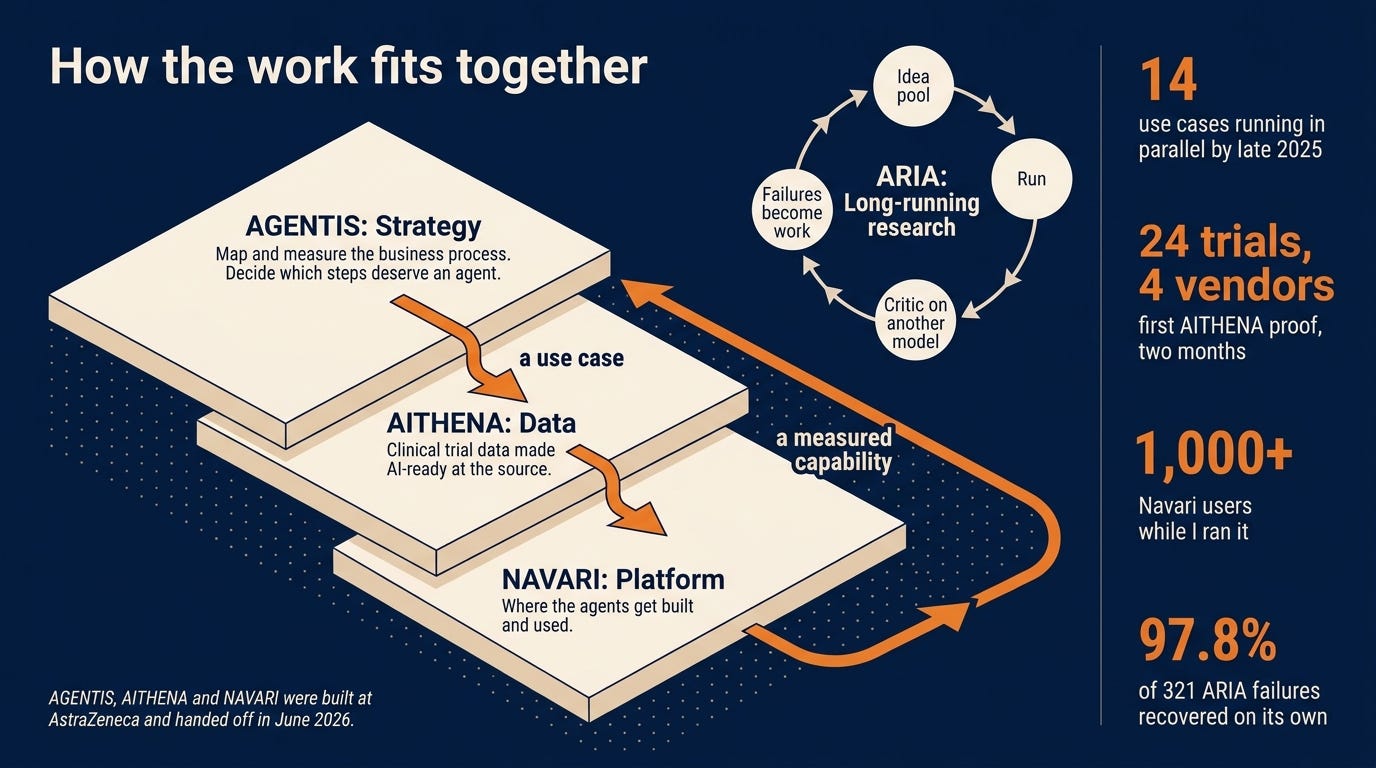
Put the three together and you get the whole idea. Agentis picks the destination. AIthena supplies the data. Navari builds the agent. A use case goes down through all three and comes back up as something you can measure. Take out any layer and you get the usual pile: agents nobody uses, data nobody trusts and a strategy deck nobody builds.
We don't understand our own business processes well enough to automate them. Almost nobody starts there.
ARIA, where it compounds
ARIA is where the last two years of learning ended up.
It's a research engine built to run for months instead of minutes. A pool of ideas competes for the next slot. The winner runs, a critic on a different model family gives its verdict, and failures classify themselves and go back into the pool as recovery work. Self-improvement is a loop you can point at.
Across 7 instances and 4 domains it made 19,364 commits and recovered on its own from 97.8% of 321 failures, on $86.92 of cloud compute. The paper published in July. Its successor ran more than 8,700 sessions on borrowed hardware.
Every pattern that built this site in a day, ARIA learned first. The critic on another model. Failures that turn into work. Memory that outlives a session. The website is what those habits look like when you point them at something small.
Teaching it
Writing is how I find out what I think. Run Data Run has 175 posts since 2024, and many of you reading it. If you're new, start here:
Twenty-five years and half a mile, my favourite to write. It includes the organism carrying my initials in its chromosome.
I'm Justin Johnson. I Build Things., the one you click through to most.
Claude Science and the boring 80 percent, the one search engines like best, and the plain account of where AI time actually goes.
Three Days, One Petaflop, and an AI Partner, if you want the weekend the home lab started.
AIXplore is the practitioner side, 116 technical write-ups for people who build.
And the whole method, written down, is the book. Builder-Leader: The AI Exoskeleton came out in July, and I wrote it with the harness it describes.
Still under construction
The new site has plenty to poke at. Every project connects to the things it touches. There's a ten-chapter story you can click through, and a chat that answers questions about my work.
My first website had an under-construction sign. This one should have one too, because everything on it is still being built.
The tools changed. I still build things.