


My AI coding setup is two years old. It is not a model. It is a system: rules for how the assistant should behave, skills it knows how to use, specialized agents for different kinds of work, guardrails that stop it deleting things it should not. I built it up the way you build anything that carries real weight, one piece at a time, and I assumed it was welded to the expensive model it ran on.
Over the weekend I moved the whole thing onto a model that costs 40 cents. Every rule, every skill, every agent, and most of the guardrails. The port took an afternoon. It cost under forty cents, measured on the model's own usage dashboard. It was fast enough that nothing sat waiting. And for the work I actually do, I could not tell the difference.
You are reading the result. This post was drafted on that 40-cent model, running my rules, my skills, and my voice checks.
Under 40 cents. Nobody noticed the difference.
What a two-year harness actually is
Vendors sell you "the agent" as if it were a single thing, inseparable from the model underneath. Here is the model that thinks, here is the tool it lives in, they come as a pair. That framing is comfortable because it is simple. It is also wrong.
What I actually depend on is the layer above the model. A set of written rules that encode judgment: what to let the assistant do on its own, what to check before believing an answer, how to recover when something breaks. A library of skills, each one a procedure the assistant can follow, from drafting a blog post to running a security review. A few specialized agents for jobs that need a particular temperament or toolset, which I have come to think of as a squad rather than a toolbox. And guardrails, the ones that refuse a destructive command and tell you to back up first. I broke the pieces down component by component if you want the inventory.
Two years of that is an asset. It is the accumulated discipline of deciding, over and over, what you want an assistant to be allowed to do. The model underneath is just the executor. I had never tested whether the executor mattered as much as I assumed.
The provocation
DeepSeek shipped an endpoint whose only purpose is to let a rival company's coding tool talk to its model. Not a community wrapper, not a shim someone reverse-engineered: an official endpoint, so a competitor's agent points at DeepSeek and works.
It is not the first to do this. Kimi and MiniMax already run the same kind of passthrough, which is what makes it a signal rather than a stunt. When three model makers independently build an on-ramp into someone else's tool, they are all betting the same way. They are betting that the user's investment sits in the harness, and that the model underneath is what swaps out. I decided to test the bet on my own setup.
I had already compared these tools from inside one back in May, which tells you where they differ on paper. That is a different question from what happens when you pick a working setup up and put it down somewhere else.
The number that matters
Here is what the port actually cost.
The expensive model I was on charges $5 per million input tokens and $25 per million output. DeepSeek V4 Flash charges $0.14 and $0.28. The July build, the one Artificial Analysis actually put a score against, is cheaper still at $0.09 and $0.18. Call it 35x cheaper on input and 90x on output, and hold in mind that those are the conservative numbers.
The whole migration, every piece of the harness moved over, came to under forty cents on the model's API key.
The expensive model was never the asset. The discipline was.
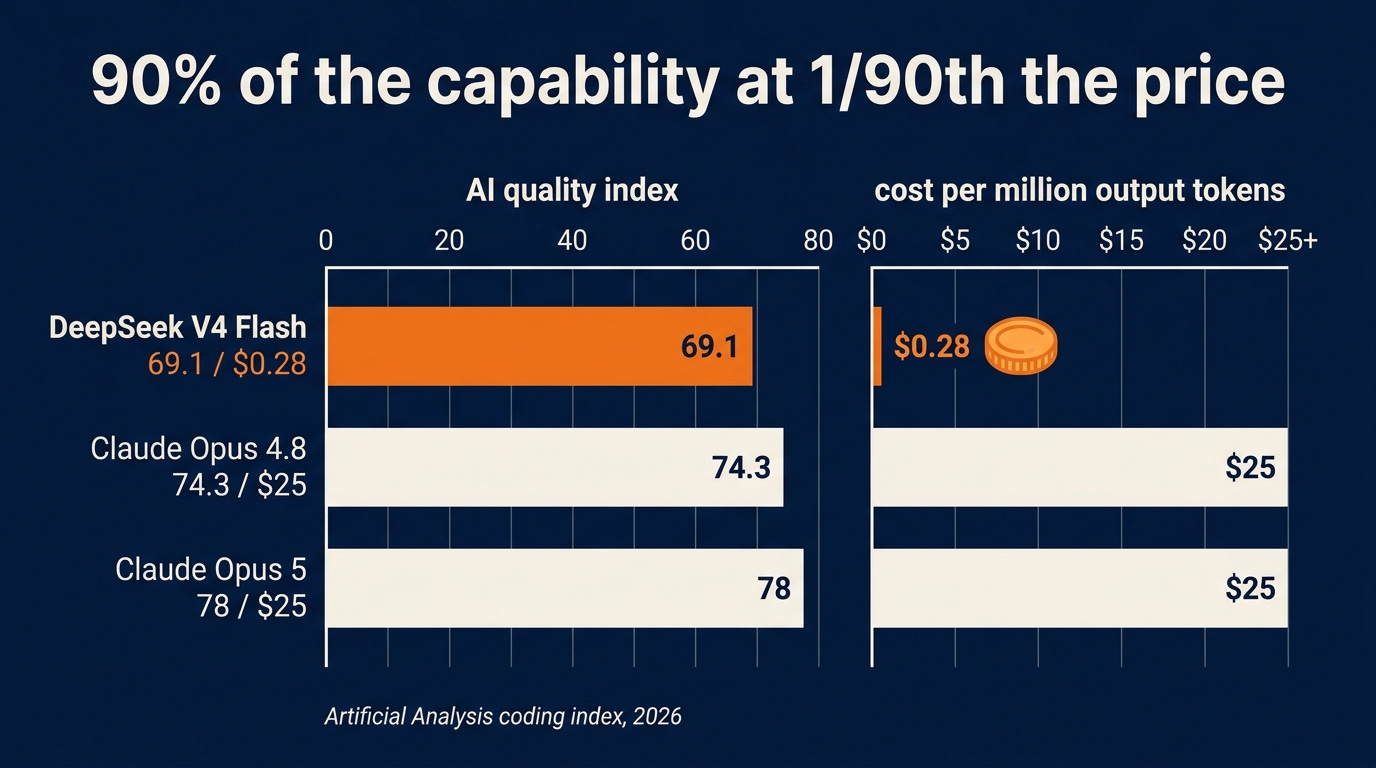
And the cheap model is not a toy. On Artificial Analysis, the independent scoring benchmark I trust, DeepSeek V4 Flash scores 69.1 on the coding index. Claude Opus 4.8 scores 74.3. Claude Opus 5, the current flagship and the one I actually came off, scores 78. So the cheap model sits about nine points behind the best model money can buy, at one-ninetieth the output price.
I am not telling you cheap models are as good as expensive ones. They are not. Measured against Opus 5 on coding, DeepSeek lands just under ninety percent. On the broader intelligence index it falls to about eighty-two. The gap is real and it is wider than the excitement suggests. For one specific kind of work it is also invisible, and the port was that kind of work.
What transferring taught me
Four things, and none of them were what I expected.
The written parts moved without a fight. Rules, skills, agents. They are all just instructions, and instructions do not care which model reads them. The expensive model was never doing the thinking my setup does. It was following thinking I had already written down.
Judgment travels. Enforcement stays behind. One of my guardrails is a plain paragraph telling the assistant to back up before it deletes anything, check the backup worked, and only then delete. The cheap model read that paragraph, refused a delete it had been asked to make, and walked the sequence. My two mechanical blocks, the code that physically stops a dangerous command before it runs, never made the trip. The new tool keeps a fingerprint of your safety file and quietly ignores anything it does not recognize, so both blocks are sitting there written, tested and switched off. I would rather say that than let "every guardrail moved" stand.
A whole phase of the work was unnecessary. My plan said the new tool could see two of my skills against the eighty-eight I have. So I wrote a converter and moved them all. Then I hid a uniquely named skill in each location and asked the tool what it could see. It saw both. It had been reading my original library the entire time.
Underneath that was a difference only the hidden-file test would have found. My usual tool hands the model a skill's full instructions the moment it needs them. The new one shows a one-line summary and leaves the rest on disk, read only if the model goes looking. That economy is why skills work at all, and the new tool pushes it further than I would have chosen. Same files, very different odds of the thing running.
The dial that does nothing. The model has a low-to-high effort setting. On the connection my setup uses it is inert: I told it to think briefly, then told it to think hard, and got the same work at the same cost either way.
Then I went looking, and the public picture is a mess. teortaxesTex read a benchmark chart as low matching high at twice the price. Morgan Linton, who ran that benchmark, found close to the opposite: DeepSeek won on medium effort, not high. Same model, same week, two readings. I did not settle it. The claim I can stand behind is smaller, that on my connection the setting does nothing, and no documentation would have told me.
A control you cannot verify is a control you should not build assumptions on.
The comparison
The cheap model is having a moment. opencode, a coding tool, tracked 8 trillion tokens of DeepSeek Flash traffic on August 1st alone, 5 trillion of that free usage. DeepSeek's own launch numbers put V4 Flash at 82.7 on Terminal Bench 2.1, ahead of its larger sibling, and that is a vendor number, so weigh it the way you weigh vendor numbers. The independent read is Morgan Linton's VulcanBench run, where it took the top spot outright and pushed two much better-known models out of the top five.
The objection that deserves airtime is cost per task rather than cost per token. cline raised it: a cheaper token still loses if the model burns more turns reaching the same answer. It then answered its own objection in the same post, citing Artificial Analysis clearing the same benchmark tasks at 105x lower cost. My experience splits along that line. For harness plumbing, moving rules and skills and agents around, the cheap model held without extra turns. For the hardest reasoning it is still a step down. The judgment call is knowing which of the two you are doing before you start.
This is uncomfortable for the premium tier. At roughly ninety percent of the capability and one-ninetieth of the cost, the premium has to buy a workload you can name and point at. Not "it is the best model." A task. If you cannot produce one, you are paying for the brand.
The meta turn
Which brings me back to where this started. This post was researched, structured and drafted on the 40-cent model. The same rules, the same skill that formats a Substack essay, the same voice checks that stop me sounding like a language model, all running on something that costs less than a vending machine snack.
Be precise about what that proves, because there are two separate tests here and only one of them wrote this. The first is the model swap: my everyday tool, my harness, a different and far cheaper model underneath. This post is the output of that one. The second is the framework port: the same harness rebuilt inside a rival vendor's tool, which is where the guardrail finding came from and which I ran on its own. Neither test alone would have told me much. Together they say the harness survived a change of model and a change of tool.
This is also not the first long thing it has produced. Earlier this year the same setup drafted a 33,000-word book in eight days, Builder-Leader: The AI Exoskeleton That Crosses the Gap, whose argument is the one I have just spent an essay stress-testing against a model that costs 40 cents. I did not set the port up as a sequel to the book. It became one, and it could have gone the other way.
You are reading this because a 40-cent model ran my harness well enough to write it.
A two-year-old pile of written instructions, pointed at a nearly-free model, then asked to hold a style, route research and stay disciplined across a full essay. It did. The model did not need to be the smartest one available. It needed the instructions to be good.
Close
I did not downgrade my setup this weekend. I found out how much of it never depended on the expensive model at all.
The moat was never the model. It was the accumulated discipline: what to let an assistant do, what to check before believing it, how to recover when it breaks. Written down, tested, and enforced wherever the tool let me enforce it. That followed me for 40 cents and it is still doing the work.
Every setup has a number here and it costs an afternoon to find: swap the model underneath and count what still runs. Whatever survives is the asset. Whatever breaks was rented. I have argued before that you should choose your harness every six months rather than let it choose you, and this is the cheapest test I have found for whether you own one.
I did not downgrade my setup. I found out how much of it never depended on the expensive model at all.
Sources: Artificial Analysis model indices for DeepSeek V4 Flash, Claude Opus 4.8 and Claude Opus 5 · opencode on DeepSeek usage · rohanpaul_ai relaying DeepSeek's Terminal Bench numbers · morganlinton on VulcanBench · teortaxesTex on effort scaling · cline on cost per task.