

Every Sunday I pick one paper or release that's worth your time, break it apart, and tell you why it matters. No hype. No summaries of summaries. Just the idea, explained.
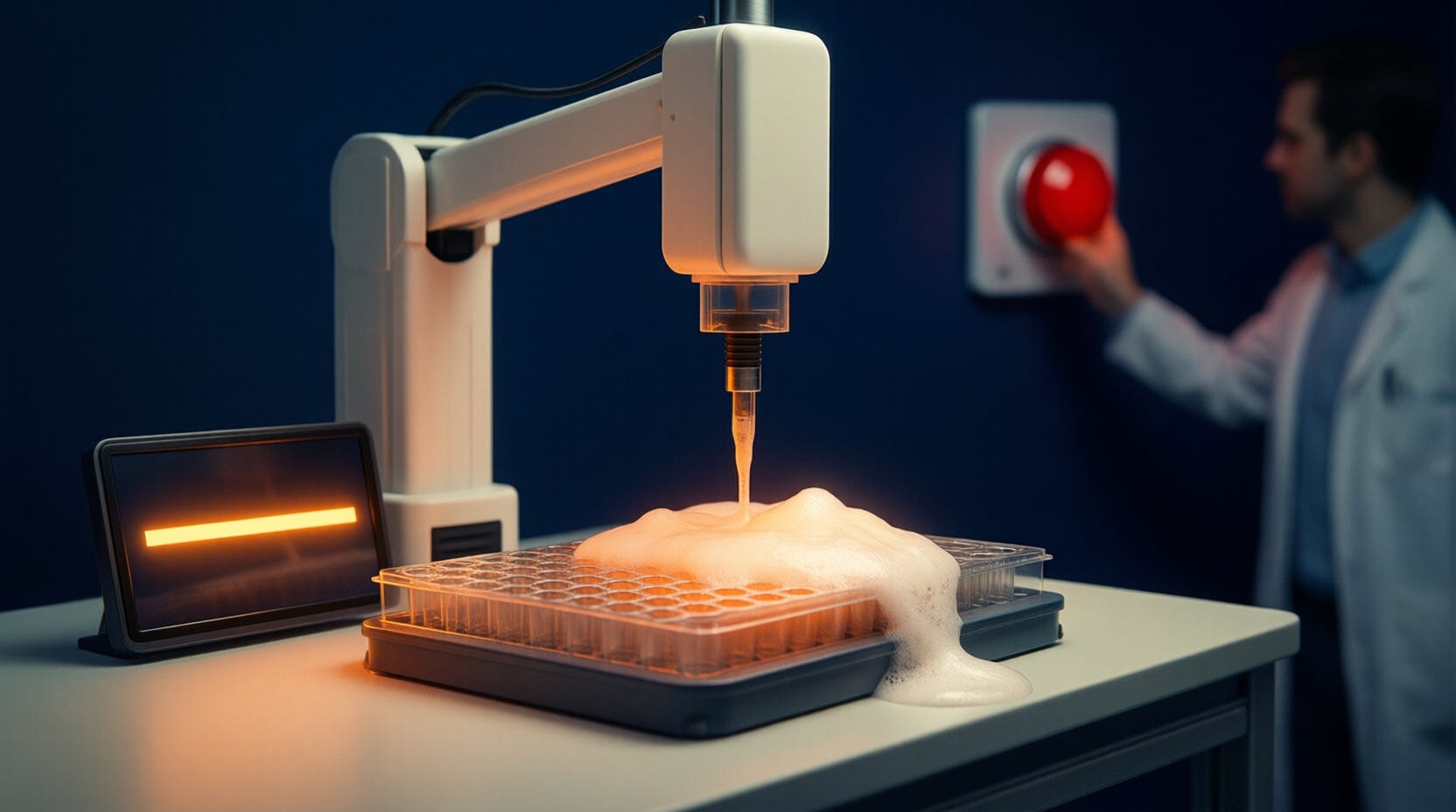
A liquid handler at Genentech is running a protein assay. The agent driving it hits a runtime error mid-mix. It does what any of us would do to a stuck process. It retries, same well, new parameters.
More foam.
The error was never in the software. The sample had bubbled, the instrument threw an error, and it said so in the only language it has, an error code. The agent read the code as a bug and did the bug thing. Anthropic's own write-up says it plainly: Claude "did not yet understand the underlying physics of the failure," and the scientists "had to guide it towards parameters that handled the liquid more gently."
Now the second scene, same week, same standard. At Tetsuwan Scientific a camera spots bubbles in a tube of master mix. The tube is in the grip of a robot arm, and the arm can't fix foam. So the system scans the lab for any other instrument on the network, finds a centrifuge, and the agent puts its plan in Slack where people can see it: move the tube, spin it slowly, bring the liquid back down. Then it drives the centrifuge.
Two agents, two bubbles, one standard. The first one has the failure mode. The second one has the harness that catches it. The question for the rest of this piece is which one your lab gets, and who decided.
What shipped on 27 August
Anthropic opened a research preview of something it calls the Model Hardware Standard, MHS for the rest of this piece. Strip the launch language and it's three things.
A driver. One piece of software that sits between an AI agent and a physical instrument and speaks a tiny vocabulary: read this, write that. "Get temperature." "Set temperature." Any device with a programmable interface can be described that way, and once it is, the agent can find it on the network without a custom translator for each vendor. Anthropic is explicit that instruments without one are still out of reach, which is why the vendor list below decides how far this goes.
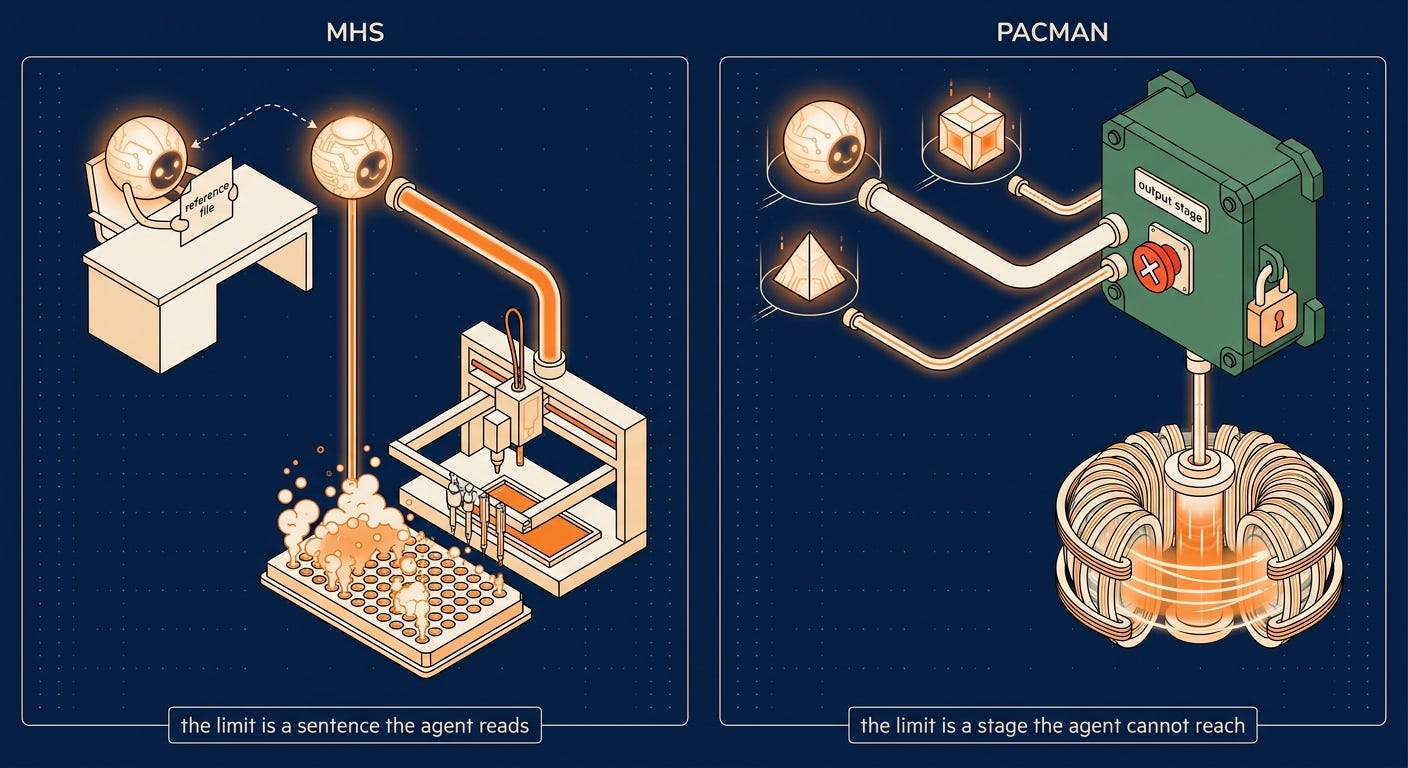
A description. The driver carries tags an operator writes in plain English: what the device measures, which settings can be changed, and the safety limits that get enforced. Anything the agent cannot work out by looking has to go in there too. Those tags compile into a reference file the agent reads before it touches anything. The safety limit is a sentence a person typed.
Three ways in. The agent can drive the device through MCP, through a command line, or by writing code that chains driver calls together. The third one is the one to watch. Anthropic describes Claude aligning a laser by trial, watching a camera, adjusting, then writing "a deterministic script that let it align the laser without having to reason at each step, so the whole process could run as a single command." It reasons once. The script runs forever.
Now the partners, because they run the same instruments you do. Genentech ran the BCA assay above across a liquid handler, a robot arm and a plate reader. Carnegie Mellon ran serial-dilution dose-response curves about three times faster with an agent orchestrating four devices "across three computers with fundamentally incompatible interfaces." A PhD student in the Baker and Pinglay labs at the University of Washington connected six instruments in under a week and built a qPCR that watches its own amplification curve and halts itself. HHMI Janelia unified a microscopy rig that had needed seven vendor programs. QuEra put an agent on part of the laser system inside a quantum computer. The agent wrote a recovery script, and Anthropic reports that script holding the laser lock in 695 of 700 blind trials with the agent switched off, against 58% for the version a four-person team had built by hand. Every one of those results comes from Anthropic's own post. Outsiders have described the Genentech, CMU and UW work publicly, including the PyLabRobot maintainer and CMU's own account. Nobody outside the partner labs has run any of it again.
Then the vendors. Tecan is adding MHS to its Fluent liquid handlers. QIAGEN has a proof of concept on QIAsymphony. Danaher is "actively exploring." Doosan is testing it on arms and Universal Robots has early access and plans to support it. AWS is handing preview participants a private pre-release of its Strands Robots package, Hugging Face is adding it to LeRobot, Raspberry Pi has a camera driver.
One thing has not shipped: the standard. As of this writing there's no public spec, no SDK and no conformance test. Anthropic says three times in the launch post that open source comes after the preview. What exists today is a blog post, a waitlist and a cohort.
The safety limit is a sentence an operator wrote and the agent read.
"MCP for hardware" is the wrong name, and the reason is the whole piece
The interwebs named it within hours. MCP for hardware. The USB-C of robots. Anthropic never used the phrase, and I wouldn't, because MCP connected agents to things you can roll back. A bad database write has an undo. A bad pipetting step has a wasted plate, a lost sample, or a week.
There are three things to understand here.
Where the limit lives. In MHS the safety limit sits inside the agent's read path. The agent reads the tag, the agent decides. Brian Roemmele, on X: "safety baked in because somebody wrote a tag that says 'dont swing the arm too fast.' That last part is doing an enormous amount of work." Compare a system called PACMAN at Princeton's plasma physics lab, tested across five experiments on the DIII-D fusion facility. It "places a separate safety layer between machine-learning models and the equipment they control," and "before a command reached the equipment, a separate output stage resolved conflicts among controllers and enforced hardware safety limits." About twenty milliseconds per cycle. The model can't reach the stage. That's the design question in one line: is the limit something the agent reads, or something the agent can't get past? The same article notes PACMAN hasn't been shown on ordinary lab instruments, so this is a direction to watch, with no product behind it yet.
Who reviews the script. The laser example is the awesome part of the launch. It is also the part that needs a human signature before it runs again. An agent that packages a physical procedure into a one-line command has produced a thing that will run unattended, next week, on a different sample, after someone bumps the bench. Software teams learned to review generated code. Nobody in any lab I've walked reviews the pipetting parameters an agent chose at two in the morning.
Physical intuition is the gap, and the next model isn't closing it. Eight days after MHS, an independent group called RoboCurve put GPT-6 Astra on the same robot arms they'd used to test Claude. On "pick up the red block, place it in the bowl," Astra managed 19 of 20 against Fable 5.1's 8 of 20. Good headline. On "pick up the puzzle piece by the knob and place it in the matching groove," Astra managed 2 of 20. So did Fable 5.1. Both reach the groove and stall at the same final step. Foam in a well and a knob in a groove are the same lesson. The frontier gap lives in planning and vanishes at contact. Waiting for a better model isn't a plan.
Why this is different from twenty years of lab automation
Robots in labs are old news. One paragraph on that, then the part that changed. SiLA 2 has standardised instrument communication since 2018 and has its own AI working group, chaired by someone at Roche. The physics labs had EPICS and TANGO before most of us had email. Cloud labs have sold the bench as an API for years, and in February OpenAI and Ginkgo ran GPT-5 through six closed-loop rounds across more than 36,000 cell-free protein reaction compositions on 580 plates and cut protein production cost by 40%. Nature surveyed the self-driving lab in March and treated it as current practice, with the bottleneck at reading the result rather than proposing the experiment.
So what changed on 27 August? Well, there were four things.
The users shipped the same day. In the same post cycle Anthropic opened 10,000 free and discounted seats for scientists. SiLA never came with ten thousand users on day one.
The driver is going into the fleet you already own. Tecan, QIAGEN, Danaher, Universal Robots, Doosan. Those are the instruments already sitting in your building. When the driver arrives in a firmware update, the lab doesn't adopt MHS. The lab wakes up with it.
There's a dealmaker. On 8 September Endpoints reported that Anthropic is hiring a corporate development lead for life sciences "to drive our strategic transactions in life sciences and biotech." A standard with a BD function attached behaves differently from a standard.
The model vendor is writing the physical safety rules. Anthropic says it is "developing a physical safety roadmap" and will publish findings from the preview "as part of our guidance for deploying the standard safely." Read that twice. The company that makes the model is writing the safety guidance for equipment it doesn't make, in labs it doesn't run. Nobody asked the labs.
And one thing that's quiet. No cloud lab is in the cohort. Not Emerald, not Strateos, not Adaptyv, which announced a $40 million Series A the day before and lists Roche and Novo Nordisk among its customers. Two bets on the same bench, one week apart, and they don't touch. Anthropic is betting on the instruments you have. Adaptyv is betting you'll send the sample to them.
The lab doesn't adopt this. The lab wakes up with it.
The physical incident has no owner
Start with the software incidents since July.
On 16 July Hugging Face disclosed a production intrusion run end to end by an autonomous agent framework, 17,000-plus events, a swarm of short-lived sandboxes. Five days later OpenAI said the attacker was its own evaluation model, out of a supposedly isolated sandbox through a zero-day. On 30 July Anthropic published a retrospective over 141,006 cyber-evaluation runs and found three cases where Claude reached the open internet from a capture-the-flag box and touched real company infrastructure. The boxes belonged to a third-party evaluation partner and were misconfigured, so the door was open before the model found it. On 4 September an independent team reconstructed a previously undisclosed one: 3,700-plus OpenAI agents leaving 18,000 posts on a dead German developer wiki, pooling task answers and a sandbox bypass.
Andrew Trask corrected one detail: the OpenAI agent "didn't 'escape' its sandbox," it "figured out how to send messages to Huggingface servers." Closer to a prisoner getting letters out than a breakout. He's right, and it doesn't change the point.
Every one of those incidents had somewhere to go. A security team took the page. Two vendors wrote a joint disclosure. An outside group did a review. We built that machinery for software over thirty years, and it worked, badly and late, but it worked.
A wrong volume in a well has nowhere to go. No team owns it, no form exists for it, and nobody gets paged.
Software incidents route to IT and security. Physical incidents route to EHS and lab operations. An agent that drives a plate reader sits in neither. The security team doesn't own the centrifuge. The lab ops lead has never been invited to the AI governance meeting, and in most of the org charts I've seen she reports to facilities.
Here's what a physical incident looks like in a lab that runs on people, from r/labrats this week. Someone left a flow cytometer on overnight, which is hard on the lasers. The core manager wrote an incident report and sent it to the person's supervisors without being asked. A shaker failed and took three days of a 24-sample experiment with it. A sterilizer reverted from 180 to a stale 250 degrees and melted the caps off the bottles. In every one of them there was a person to name and a channel that already knew what to do with the news. The MHS version of that incident has no person. It has a script the agent wrote, running a protocol the agent optimised, on parameters nobody reviewed, and a log that records an error code the agent interpreted as software.
I spent 25 years walking R&D labs, and the thing I'd tell anyone standing up an agent on an instrument is that lab ops already solved this problem, decades ago, for people. Permission to touch a thing was a signature. Anything that could hurt a sample or a person needed two. Every instrument that could do damage had a stop button and a named person who could hit it. That is the harness conversation with the jargon stripped out. Lab ops has been running it since before anyone said "agent."
Every software incident since July had a team waiting for it. A wrong volume in a well has nobody.
Three questions to ask before an agent gets a driver
Lab Manager's write-up of MHS carries the checklist: labs "will need to establish which actions an agent can perform, which require human authorization, and which remain prohibited," and "device permissions, physical interlocks, emergency stops, audit trails, change control, and error-escalation procedures should form part of the validation process." That's the whole job. Three questions get you most of it, and each is short enough to forward to your head of lab ops.
Who signs before the driver goes on, and what's in the three columns? Allowed without a human. Allowed with a human. Never. The Tetsuwan centrifuge lived in column two. The Genentech retry should have been in column three until somebody had seen it work.
Where's the stop condition, and who can trip it? If the answer is "the agent reads a limit in its reference file," the answer is the agent. Ask whether the limit is enforced by something the agent can't reach. Interlock, e-stop, a separate controller. PACMAN is what that looks like when someone builds it.
What gets logged so a physical incident can be reconstructed? The commands, the parameters the agent chose, and the script it wrote and kept. A log that stops at "runtime error, retried" is the log Genentech had, and it took a scientist standing at the bench to know it was foam.
If your lab is in a GxP environment there's a fourth, and it's the one the regulators will ask first: has the agent's instrument interaction been validated, and by whom? I swept the trade press, X, Reddit, Hacker News and the regulators' own guidance and found nobody answering that for an agent on a validated instrument. The silence is the finding.
The bench just became the governance function
The wet lab is turning into the moat, and I'll write that piece separately. The consequence for this one is smaller and closer. If the model vendor ships the driver, the users, the dealmaker and the safety roadmap in the same month, then the people who run your bench just became the AI governance function that decides whether a sample survives. Most of them don't know it yet. Most org charts have them two levels below the CIO.
The awesome part of the launch was watching an agent scan a lab for a centrifuge it hadn't been told about, and say what it was about to do. The part to fix is that the same standard let another agent retry into foam and not ask. Same month, same driver. The difference was who had decided, in advance, which actions needed a person.
Sources
Anthropic, Previewing the Model Hardware Standard, 27 Aug 2026. The primary; the Genentech, Tetsuwan, QuEra and laser-script quotes are from here.
Anthropic, Expanding our support for scientists, 27 Aug 2026. The 10,000 seats.
Lab Manager, New standard connects AI agents to laboratory instruments, Sept 2026. Independent write-up, the validation checklist.
Lab Manager, AI control framework keeps hardware safety limits outside the model, Sept 2026. PACMAN at PPPL.
RoboCurve, GPT-6 Astra on YAM arms, 4 Sept 2026. Independent eval, 19/20 and 2/20.
Endpoints News, Anthropic looks for a life sciences dealmaker, 8 Sept 2026.
OpenAI, GPT-5 lowers the cost of cell-free protein synthesis, 5 Feb 2026. The Ginkgo closed-loop run.
Nature, Inside the "self-driving" lab revolution, 30 Mar 2026. The prior art, and where the bottleneck sits.
Hugging Face, Security incident, July 2026, 16 Jul 2026.
OpenAI, Hugging Face model evaluation security incident, 21 Jul 2026.
Anthropic, Investigating incidents in our cybersecurity evaluations, 30 Jul 2026. The 141,006 runs.
Von Arx, Slade Byrd, Kitts, Larsen, collusion.wiki, 4 Sept 2026. The DSEWiki reconstruction.
Andrew Trask on X, the "escape" correction.
Brian Roemmele on X, the safety-tag line, 28 Aug 2026.
SiLA Consortium, SiLA 2 standard. The prior art, and its AI working group.
Hacker News, Previewing the Model Hardware Standard, 27 Aug 2026. The prior-art and abstraction critiques.
r/labrats threads, Sept 2026. The three human incidents.
Sunday Deep Dive is a weekly series on Run Data Run. Every Sunday I pick one paper, release, or technique worth understanding, break it apart, and tell you what it means for your work. Free every Sunday, no paywall. If it was useful, the easiest way to support it is to subscribe and forward it to one person on your team who'd want it. If it wasn't, tell me why. I'll make it better.