


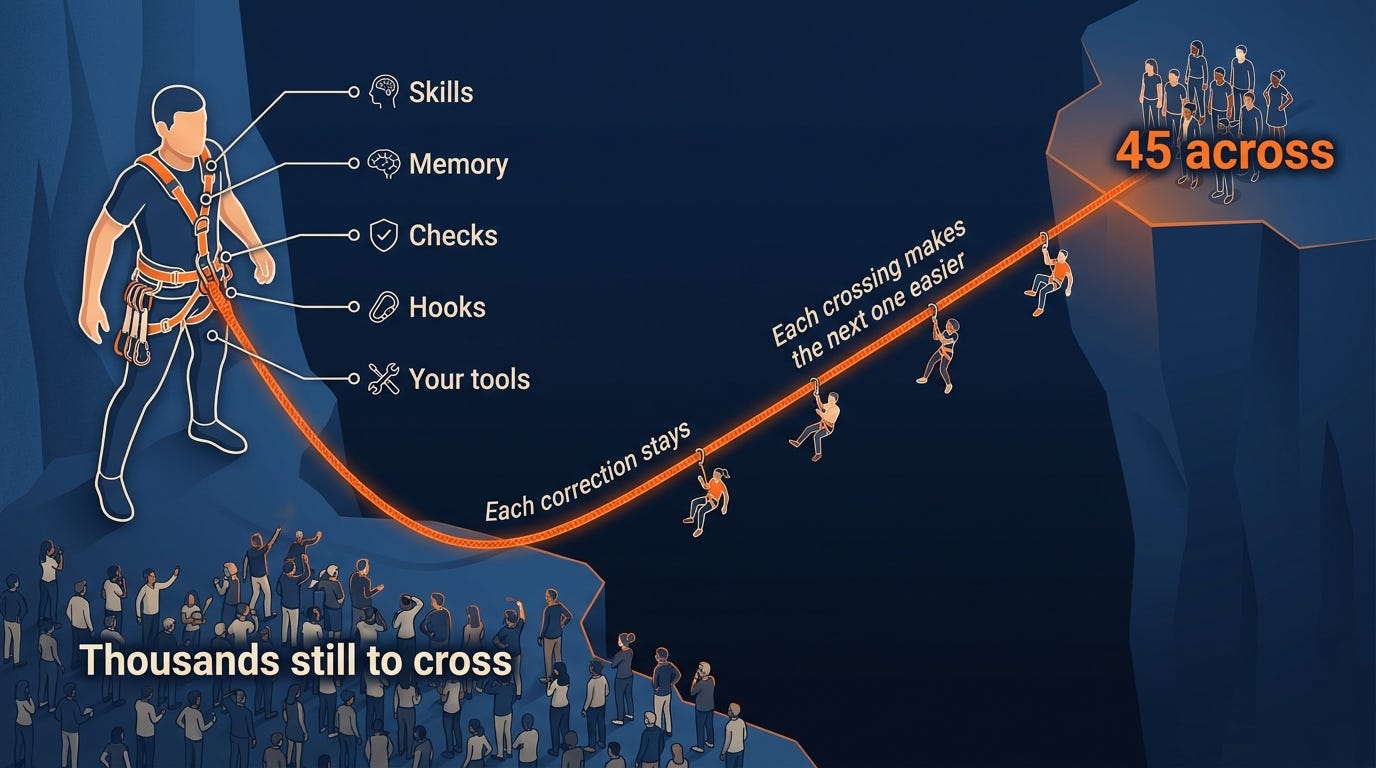
Builder-Leader: The AI Exoskeleton That Crosses the Gap came out in July. It's a short book for leaders who don't write code, about how to start building with AI yourself instead of reasoning about it from a distance. As of November 5 it has sold 45 copies: 28 paperbacks, 16 on Kindle and one audiobook. Fewer than half of them were bought by my mom, and I'm counting that as a win.
The win part isn't a joke. For a first book written around a day job, 45 copies is a fine number. But I didn't write it to sell copies. I wrote it to get a message out, and by that measure it has come up well short. So the Kindle edition is free right now, through Saturday, November 14. I'll tell you what happened, what has changed since I wrote it, and why I think it's worth your weekend.
The summer it stopped selling
July went well. I was writing about the book every week, and people bought it. Thirty-six of the 45 copies sold that month.
Then life caught up. I started a new job in August, it took everything I had, and I stopped posting about the book. My last post about it went out August 29. Since then it has come up in one other August piece and two October posts. Sales went to four in August, two in September and three in October.
No mystery there, and no complaint either.
I did try one shortcut. I ran Amazon ads for a little over three months and got one order from them. I paused them in October. Ads put a book in front of strangers, and I suspect strangers check the reviews before they buy. With three ratings on the page, there wasn't much for them to check.
Copies aren't the number I care about
The book makes one argument. The AI conversation looks like a fight between camps, the believers and the skeptics, but it's mostly a gap between people who have built something with these systems and people who haven't. Leaders on the far side of that gap make calls about AI from demos and slide decks. Leaders who have crossed make them from what they've watched it do.
I put it this way recently:
What you believe AI can do is a readout of what you've personally watched it do.
That's why the book puts the crossing on you, not on a training program or a center of excellence:
The organization will not cross first. You cross first. The org follows.
That's the part I most want leaders to hear, and 45 copies is not a lot of leaders. I count the sales as a success. I count the reach as unfinished.
What changed since July
I've written about harnesses often since the book came out. A harness is everything you build around the model: the instructions, the skills, the memory, the checks, and the connections into your tools. Claude Code is the one I use every day. Reading back across those posts, a few things moved faster than I expected.
The harness turned out to be the asset, not the model. In August I moved my whole setup to another model for under 40 cents, and I couldn't tell the difference. In September I wrote about the same model scoring 62.7% or 98.6% on ARC Prize's ARC-AGI-3 at the same reasoning effort, depending on the harness around it. The model keeps changing underneath you. What you built around it comes with you.
The work moved from making things to checking them. Building is cheap now. Knowing whether what got built is right is not. Anthropic said recently that it went from about 2,500 code changes merged a day in May to more than 30,000 a day in September, and it built a new version control system to keep up. When the making is that fast, checking becomes the scarce skill, which is where I landed in The Bottleneck Just Moved and again in Karpathy's funnel.
Rules moved from notes into code. You can write the AI a note that says "don't do this," and it will usually listen. Usually. Or you can add a few lines of code that check what it's about to do and stop it. Claude Code now has mods, an early way to add those checks. Most of the distance between a demo and something you'd leave running overnight is the code.
Harnesses need pruning, not just more parts. Instructions written for last year's model can hold this year's back, which is why I argued for taking the cast off. And bigger isn't always better: my heaviest setup loaded 3.1 times as much context as the stock install before the first prompt, and on the six test tasks I ran it did no better.
People who don't code are building their own. Last month Anthropic wrote up a business development rep in its Japan office who built five agents and a coordinator to run his day: routing leads, drafting replies, updating the CRM, writing follow-ups. He started with one skill per agent, a schedule for each, and a shared folder for memory. When he moved them onto Anthropic's hosted platform, he wrote, "It turned out I didn't need to be a developer." That's the ladder in the book, climbed by someone who doesn't write code for a living, though he does work at the company that makes the tools.
Where the book starts you
None of this makes the book out of date. It makes the starting point matter more, because each of those changes pays off most for people who already have a harness.
The book doesn't ask you to become an engineer, and it doesn't ask you to build anything big. It asks for one small step on real work. The week-one instruction is about as small as it gets: pick something you wrote recently, a memo or a status note, hand it to Claude Code and ask it to rewrite it. Keep what's better. Throw away what's worse.
Yes, I see the irony in asking you to read a book that says reading isn't enough. The book sees it too. In its own words, that one small rewrite "crosses more of the gap than any book you could read about the gap." It's a starting point, not a substitute.
The second step finds you. The first time you correct the same thing twice, you write a short instruction so you never have to again. That's your first skill. You didn't set out to write one. You wrote it because you were tired of doing the thing twice.
You cannot plan your way to week six. You can only do weeks one and two.
Small steps on real work add up because each correction stays. Last month I made a short science film in nine versions in one afternoon, and it fit in an afternoon because no mistake had to be made twice. That's the whole mechanism. It isn't dramatic, and it doesn't need to be. A few weeks of small corrections and you have a setup that does work you used to do by hand, shaped around how you work.
The book ends with a test you can hold it to. When you're done, you should have one thing you built and shipped, one working harness, and one out-of-date idea about AI that you corrected from experience. In the book's words: "If you have all three, the book worked."
Free through Saturday
Through Saturday, November 14, the Kindle edition of Builder-Leader is free on Amazon. If you have Kindle Unlimited, it's already free to you.
And if you know a leader who keeps asking what they should do about AI, send them the link. That's who I wrote it for.
If you bought it already, thank you. Separate from the free days: if you read it, a review on Amazon, good or critical, helps the next reader decide. Two lines is plenty. It's optional, and the free copy doesn't depend on it.
I'd rather a thousand people read it free than sell another 45.