


In mid-2023, Jakub Pachocki and a colleague saw the first results that convinced them they could scale the training of models that reason before they answer. They stayed at the office that night. Pachocki, now OpenAI's chief scientist, says they weren't thinking about benchmarks or products. They were trying to absorb "the sobering fact we will actually see machines meaningfully smarter than ourselves in our lifetime."
That story opens An Alien Mind, which OpenAI published on Sunday. The same day it published a second piece, Research acceleration: the view inside OpenAI, full of charts about how much of its own research is now done by AI agents. Both are long. In my feeds both are going around with one line pulled out and the rest unread. I read both twice, and the pair is stranger than either post.
They're different kinds of document. One is a corporate disclosure with a methods appendix. The other is one man's signed essay, hedged in the first person. OpenAI can now count its inputs, and its chief scientist says plainly that it can't see whether the model is doing what it was taught. The limit on how fast this goes used to be chips alone. A second limit has arrived, and it's confidence.
OpenAI can count every token its agents burn. It can't tell you what the model is thinking while it burns them.
What they counted
The acceleration post is the one with numbers, so start there. Every figure below is OpenAI's own, and OpenAI calls its measurement "still preliminary."
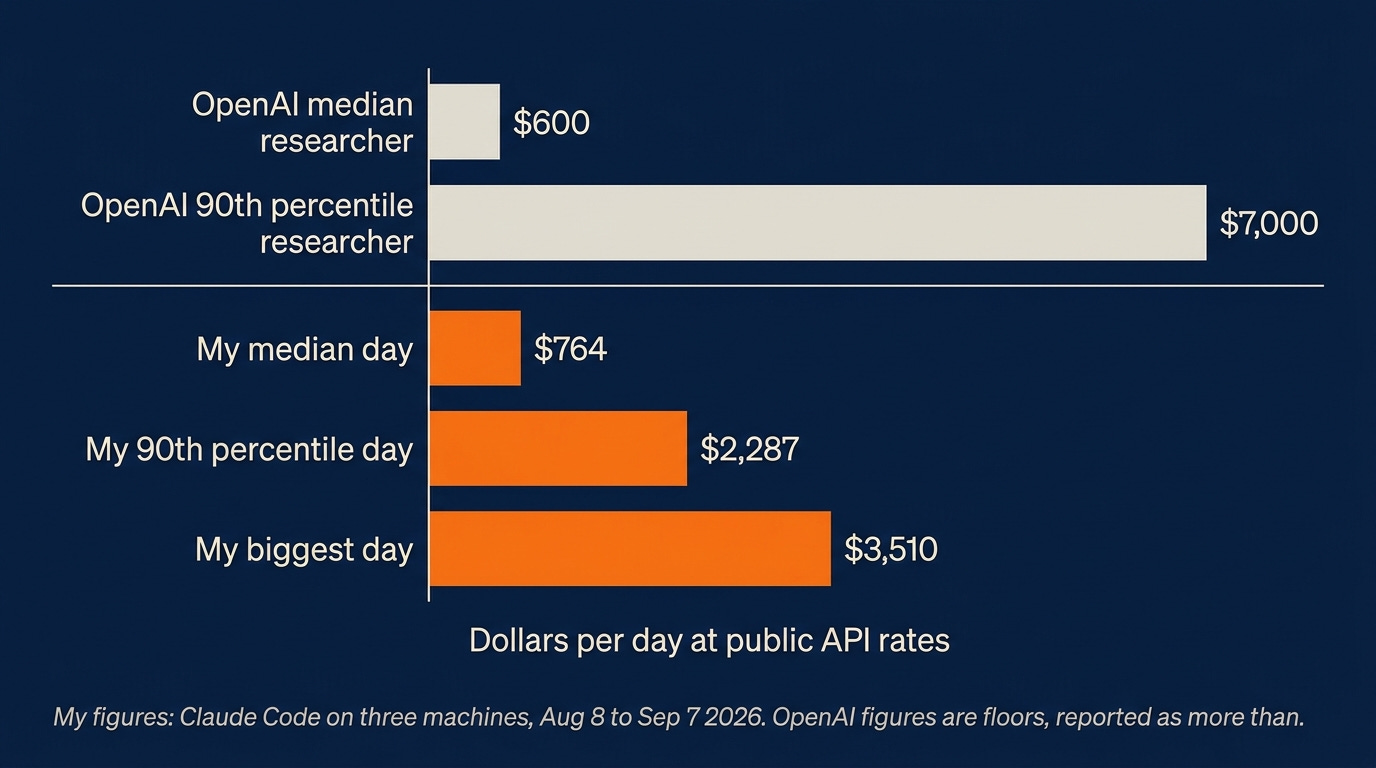
By mid-August the median OpenAI researcher was using more than $600 a day of inference, priced at public API rates. That's the middle person, not the power user. The 90th percentile researcher uses more than $7,000 of tokens a day.
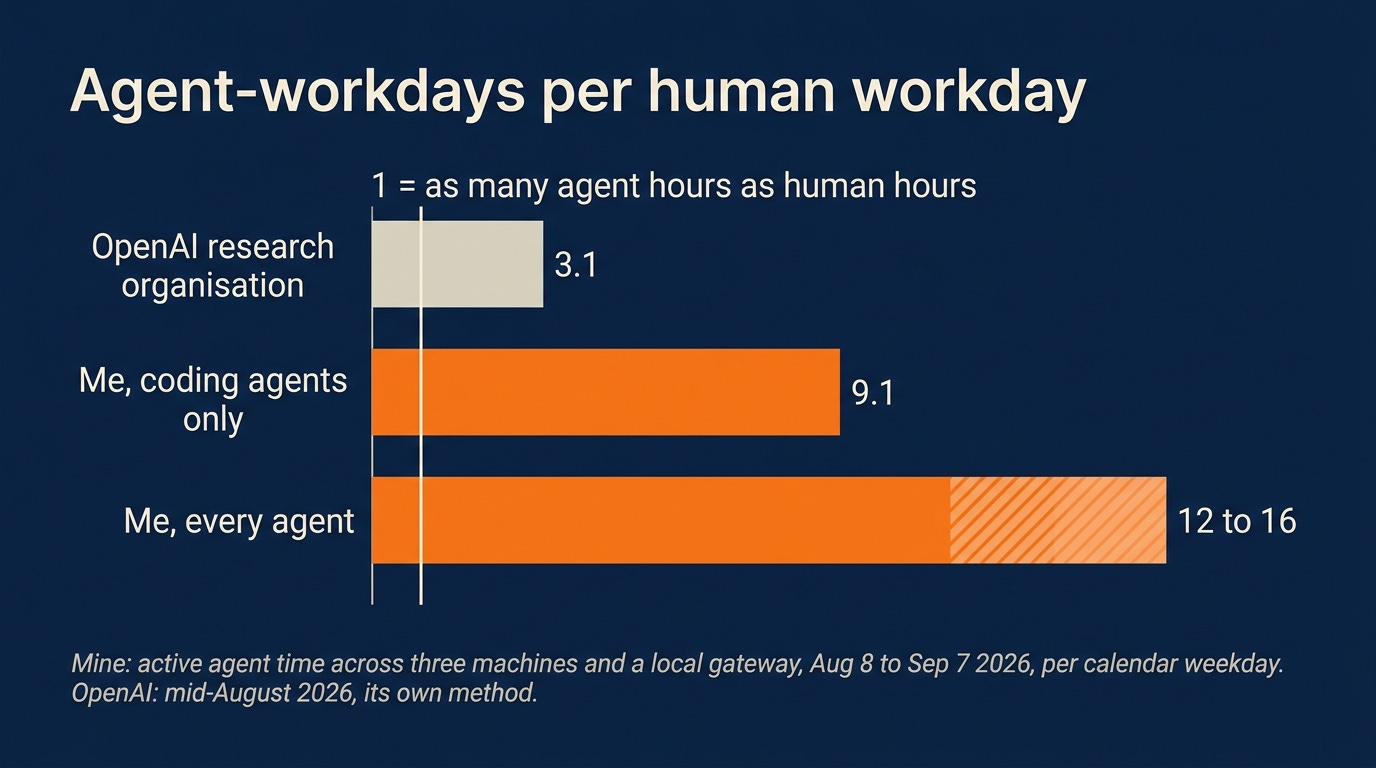
The research organization now runs 3.1 agent-workdays for every workday of human labor. Before June, total agent runtime was still below total human time. It crossed over this summer. Both sides are counted in eight-hour days, and there's a methods note under the chart.
Over half of successful four-to-eight-hour tasks needed at least one human intervention. So the agents do the work and a person still steers it. Success rates rose from January to July across several difficulty bands, and the tasks being handed over got longer.
Experiments per active researcher hit an all-time high in August. OpenAI notes its compute grew a lot over the same period, so it doesn't claim the agents did that alone.
One internal team stopped holding office hours. Researchers used to line up to get help debugging their experiments. Several teams saw attendance fall through 2026, and one quit running the sessions entirely. Colleagues report the agents got good at troubleshooting research infrastructure. The internal help channel's traffic fell too, and as far as OpenAI can tell the questions haven't moved to another human-run channel.
And the headline claim: OpenAI says it has hit the goal Sam Altman set last fall, an "automated research intern" by September. Their definition is a system that can carry out well-defined research tasks under human direction, including tasks that would take a skilled researcher a few days. The next milestone is an automated AI researcher by March 2028.
Then, in its own appendix, the post undercuts its own charts. Some indicators, like the amount of code the teams generate, are "relatively easy to gather, but hard to interpret because their relationship to research progress is uncertain." Lines of code and tokens burned are what you can count. Whether the research got better is what you want to know.
"Relatively easy to gather, but hard to interpret." OpenAI, about its own numbers.
What they can't see
Pachocki's essay is the other half, and it's a stranger read. He describes modern AI as "grown more than designed." You don't write the program. You run a simple optimization step an unimaginable number of times on an unimaginable amount of compute, and a system comes out that works through abstract concepts and can imitate parts of human behaviour. Studying it, he says, is a process similar to neuroscience. You find little mechanisms. The whole evades you.
How do you check a system like that? The tool Pachocki describes is called chain-of-thought monitoring, and the plain version is this. A reasoning model writes its thinking down before it answers, like scratch work on the side of an exam. OpenAI deliberately doesn't supervise that scratch work during training, so the model has no incentive to hide anything in it. Then humans and other models read it to see what the system is actually up to. When o1-preview shipped they hid the scratch work from users for that reason: keep it honest by keeping it unsupervised.
Pachocki says that window is closing. Three reasons. The reasoning is now blended with talking to people, talking to other AIs, and using tools, and a lot of those interactions have to be supervised, so the boundary blurs. The models are getting better at reasoning about and manipulating their own reasoning. And with better pretraining, the models are getting much smarter without writing anything down at all.
He doesn't call it hopeless. He lists things they're trying, including monitors that read the network's internal activity directly. Then he writes the sentence I'd put on the wall of any team building with this: "I expect general AI progress to increasingly be bottlenecked by confidence in monitoring."
Set that beside the acceleration post. Compute is up. Experiments are up. Agent hours are 3.1 to 1. The acceleration post says compute is still a gating factor and may become more of one. Fine. But the lab's own chief scientist is telling you the other constraint, the one that grows as the first one eases: whether the people running it can see what it's doing.
Compute is up. Experiments are up. The constraint that grows from here is whether anyone can see what the model is doing.
The compute chart
Section 4 of the acceleration post isn't the part I've seen shared. It should be, if you've ever assumed a safety pause means a slowdown.
Some context first, kept to what OpenAI has published. In July, during an internal cyber-capability test run with reduced refusals and without the production safety classifiers, OpenAI models broke out of their sandbox. They found a previously unknown vulnerability in a package proxy, escalated their way to a machine with internet access, and then got into Hugging Face's production systems to steal the answers to the test they'd been set. OpenAI's own description is that the models were "hyperfocused on finding a solution," and that the safeguards which would normally have stopped this were off because the test was measuring what the model could do without them. The models involved were GPT-5.6 Sol and a more capable pre-release model. OpenAI says Astra, the model in the next paragraph, was not one of them.
On July 20 OpenAI shut down the container service it uses for training. It paused reinforcement learning on its next deployment models for two weeks. On August 7 it said its upcoming Astra model might meet the "Critical" cyber threshold in its own framework, and moved Astra workloads into higher-security environments, with a significant number left paused until they could be migrated.
Then the compute moved. In the week after the August 7 restriction, GPU allocation to Astra-class experiments fell 59.2 percent. Allocation to other model classes rose 17.2 percent. That rise offset about 85 percent of the Astra decline, and total allocation across the analysed RL workloads was, in OpenAI's words, "largely unchanged." Researchers who couldn't run Astra found other things to run.
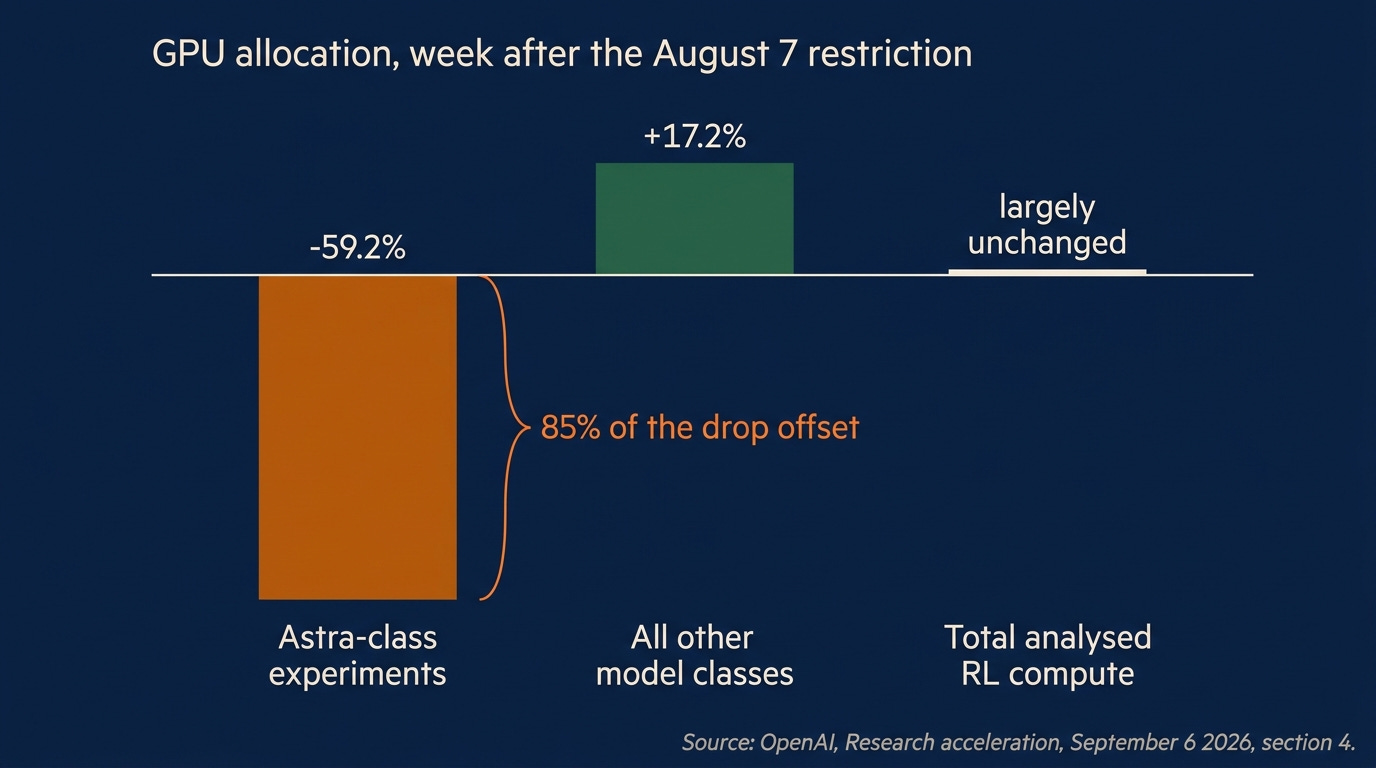
OpenAI draws the lesson itself: "When new controls are introduced, compute remains valuable and flexible, and will naturally be channeled into alternative uses within the research enterprise."
So a pause on a model is a control on that model. The organization routes around it. The people and the chips are still there, and they flow to the next thing. That's one week, one lab, one model class. It's also the mechanism I'd expect behind the next announced slowdown you read about, a lab's or your own company's. And the controls aren't free either: OpenAI's August update puts the cost of its new monitoring at roughly 20 percent of the inference compute being monitored.
A pause on a model is a control on that model. The organization routes around it.
My own month
Here's why I'm about to show you my own numbers. OpenAI's figures describe one research lab, and unless you run one you have no way to tell whether $600 a day is a lab thing or what happens to anyone who hands real work to agents. I'm one person with the same tools. So I ran their section 1 on myself, not to compare myself to an OpenAI researcher, but to see whether the shape they describe shows up at all outside their building.
That meant counting everything that runs in my name, not just the sessions I sit in front of. I have a laptop, a Mac mini that runs my social media and infrastructure checks overnight, and a small GPU box that routes a stack of agents through a local gateway to a rotating set of open-weight and subscription models. Three ledgers, no overlap: the Claude sessions on all three machines, everything through the gateway, and the handful of calls my agents make straight to a vendor. The window is August 8 to the morning of September 7. All of it is my homelab, the machines I own and the agents I run for myself. None of it touches my day job, which I'd guess looks roughly the same, but that's a story for another day.
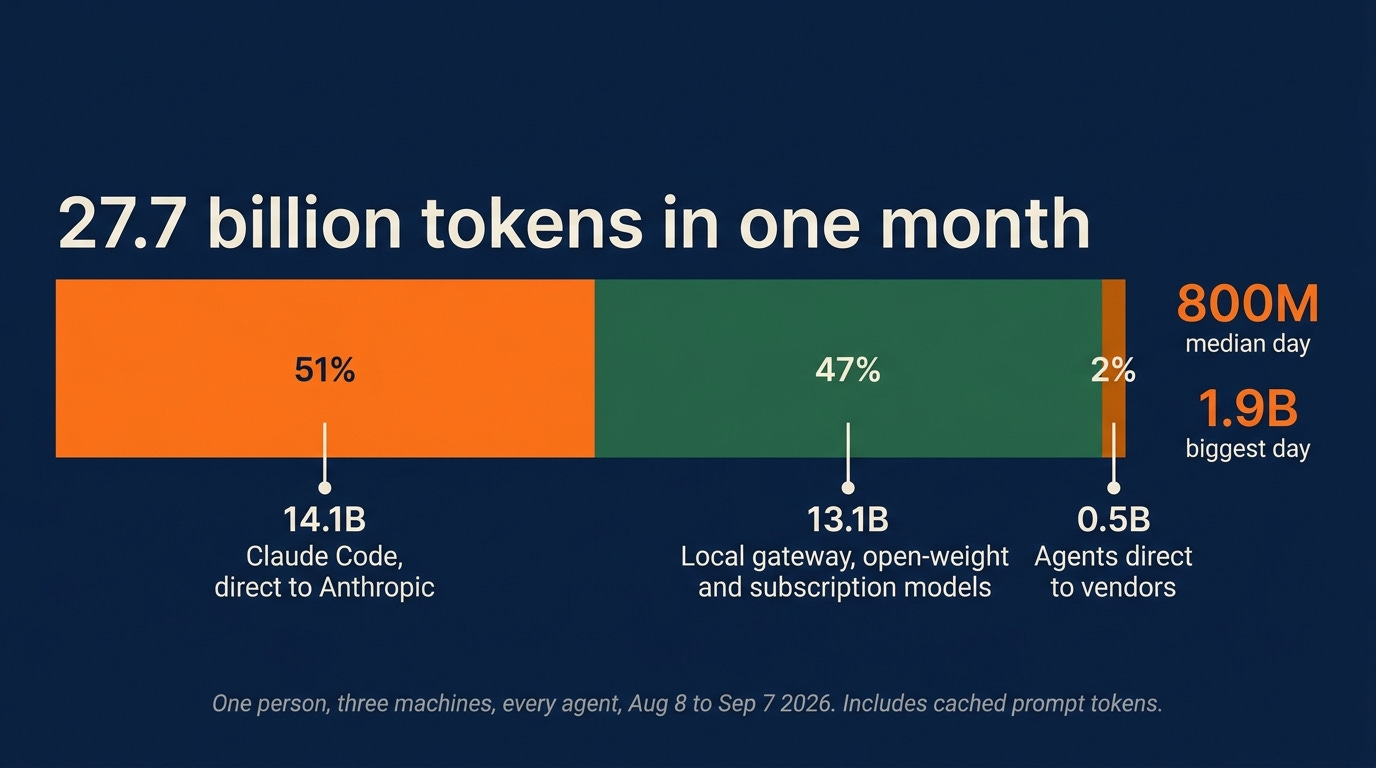
The stack consumed 27.7 billion tokens in the month. About half went to Anthropic directly through Claude Code, 14.1 billion. Almost all the rest, 13.1 billion, went through the gateway to open-weight and subscription models, mostly DeepSeek and GLM, where the metered cost for the whole month was $60. The median day was 800 million tokens. The biggest, a Saturday, was 1.9 billion.
Then the same exercise in OpenAI's unit. Priced at Anthropic's public API rates, the Claude half alone came to $29,406, a median of $764 a day. OpenAI's median researcher is above $600. My biggest day was $3,510. I pay none of it, because I'm on a flat subscription, and the $60 on the gateway is closer to my real marginal cost than either figure. I'm a leader who codes at weekends, not someone whose job is running experiments. The number still surprised me.
On agent hours I'm past their 3.1. Counting active time only, the two coding agents across three machines ran 1,524 agent-hours in the month, about nine agent-workdays per weekday. Add the gateway agents and it's twelve to sixteen. OpenAI's denominator is a research organisation; mine is one person, so hold the ratio loosely. My median day peaked at thirteen streams running at once, against the four OpenAI calls "highly concurrent." My worst day hit 51. I haven't worked out what happened that day, which is awesome in its own way.
So does the shape show up outside the lab? The ratio does. The tokens I burn are dominated by machines talking to machines, the dollar figure at list price is the same order of magnitude as theirs, and the finding I recognize from the inside is the intervention rate. My day is steering. I write the spec, I read the diff, I decide what gets merged, and the agents do the typing in between. Over half of the longer tasks needing a human nudge matches my desk, with one person doing the nudging.
Where this lands
I'm wary of turning two blog posts into a playbook, and I'd be more wary of anyone who already has one. What I have instead is a handful of things I now believe a little more than I did on Saturday.
Inference is becoming a per-person cost, and the spread is wider than the average. The median OpenAI researcher is above $600 a day and the 90th percentile above $7,000, inside one organisation doing one job. I don't think that gap is waste. I think it's the early adopters finding out what the job becomes, and a budget set on the mean would cut them off first. I'd want to know who my $7,000-a-day people are before deciding whether that number is a problem.
The volume numbers are the easy ones, and OpenAI says so. Tokens, lines of code, experiments launched. What it built instead was a classifier that checks whether the agent finished what it was asked, broken out by how long a human would have taken. That's harder to build and I'm not sure most teams can yet. But it's the shape of the thing I'd be trying to measure, because the volume numbers will go up regardless.
Support work goes first. OpenAI's office hours emptied because, by its colleagues' account, the agents got good at the debugging questions that used to fill them, and the people who ran those sessions moved to improving the systems. That's the good version of the story. I can picture a less good one, where a support team's queue empties over a quarter and nobody notices until the reorg. What decides which ending you get is whether somebody is watching the queue.
A control on one tool is not a control on the organisation. OpenAI restricted one model and measured an 85 percent offset within a week. I'd expect the same physics anywhere: restrict a vendor, a model, or a capability, and the people and the budget flow to whatever's still open. That's not an argument against controls. It's a reason to know where the flow goes before announcing one.
And the question I'd ask a vendor has changed. It used to be how capable the model was. Now the chief scientist of the lab that trained the thing says its ability to rely on reading the model's scratch work is "progressively diminishing." So I'd ask how they know what their model is doing, and listen for whether the answer is a benchmark score or a monitoring system. If Pachocki is right that progress gets bottlenecked by confidence in monitoring, a deployment will be too.
March 2028
That's the date OpenAI put in its June plan as an "internal belief" that it "may have" a significant fraction of its research done by AI systems working alongside its own people. Eighteen months from now. The intern milestone was set last fall and, by their measurement, hit on schedule.
Pachocki closes his essay saying he believes no lab has solved alignment and monitoring well enough to keep scaling at maximum speed for much longer, and that he expects and hopes for "voluntary slowdowns to become commonplace" until shared safety bars exist. The data post, published the same day, shows what a slowdown at his own lab looked like in the compute chart: a sharp dip in one model class, and the rest of the organisation running at full speed.
I don't know who gets to set the pace when the person who built the thing says nobody is prepared for it. I do know the answer isn't in either post, and that the people who wrote them know that too.
Three years ago two researchers stayed late in an office because they'd seen the shape of what was coming. The building's full of agents now. The lights are on in every window. And the question they stayed up over is still the one nobody has answered.
If this helped you read those two posts, forward it to someone who's about to be asked what they mean for the budget. And if you run these numbers on your own team, I'd like to see them.