


I have a personal finance app I built for myself. It took two nights. It reads my real bank accounts and it has done its job without complaint ever since. It works. It would help other people who want the same thing it gives me.
It was never going to leave my laptop.
Some context on the curve before the story. Months ago I built EmberPlan, the FIRE-planning app this one feeds, and I run it for the financial-independence community today. I built that one on Sonnet 4 and felt every mile of it: call it ten times the effort, every feature a negotiation, every refactor a fight I had to referee. Kindling, its daily-money sibling, took two nights on the current Opus line (4.6 through 4.8). And yesterday Anthropic shipped Fable 5, their first public model in a new tier, which today compressed the one step left over: the distance between a tool that works for me and a tool anyone can run. I pointed it at the app and watched that distance close in a single working session.
Three data points, a few months apart, same builder.
This is what that looked like, and why the afternoon matters more than the model.
The gap between a private tool that works and a public one anyone can run used to be a weekend nobody takes. That is why good private tools die private.
The work nobody schedules
Picture the thing you built for yourself that you've thought about sharing. A script, a dashboard, a little app. It does exactly what you need. Every time you consider putting it out, you run the same mental tally and decide not to.
Here is the tally for my finance app.
The code had my real brokerage positions sitting inside a test script, the kind of file you write once to load some sample data and never open again. My net worth ran through the project's saved history, commit after commit, like a watermark. The whole thing was named after somebody else's trademark and wired into my home network. The "brand" was a working title I'd typed in once. There was no front page explaining what it is or how to run it.
Every one of those is small. None of them is hard. Together they are a full weekend of careful, joyless work where a single missed line publishes your account numbers to the internet forever.
**The tax that kills personal tools isn't difficulty. It's that the work is tedious and dangerous at the same time.**
Tedious means you put it off. Dangerous means putting it off is the correct decision. So you put it off correctly, indefinitely, and the tool stays yours alone. This is not a character flaw. It's the rational response to a job with no upside until the last line is right.
One session
Today I handed the whole project to Fable 5 and described where I wanted to end up: a clean public version anyone could run, with nothing of mine left in it.
It swept the entire project history looking for anything sensitive. It found the brokerage positions in that forgotten test script. That's the part I keep coming back to.
I would not have found those by eye. I'd built the file, I'd forgotten the file, and on a Saturday-afternoon scrub I would have shipped it. The model read every line, recognized real holdings hiding in what looked like throwaway sample data, and stopped.
Then it made a harder call than I'd have made myself. The history was too contaminated to clean line by line, so instead of scrubbing it the model gave the public version a fresh, verified starting point with none of the old baggage carried forward. That's the right answer, and it's the one I'd have talked myself out of because it sounds drastic.
From there it kept going. It generalized the code so nothing pointed back at me. It renamed the app Kindling (a sibling to EmberPlan, since kindling is what you tend so the ember catches). It did a full redesign around that idea, a warm fire-lit theme in light and dark. It generated the logo and the visual identity. It seeded the app with believable fake data so the screenshots show real-looking money that is entirely invented. It wrote a proper front page. And it open-sourced the result under a permissive license, deployment scripts renamed and all.
The model did the tedious part and caught the dangerous part, the leak I'd have shipped. That's what flips the math.
One session. The thing I'd been putting off since the day the app first worked, because it was a weekend I'd never take.
The demo below came out of the same conversation. The screenshots already existed (it had seeded a Plaid sandbox with invented money, so the app shows realistic accounts that are entirely fake). I asked for a video; Fable 5 wrote a Remotion composition in the app's brand and rendered it. About five minutes, ask to mp4.
What an afternoon changes
The difference here isn't the speed by itself.
When the path from private to public was a careful weekend, the default for anything you built for yourself was it stays on your machine. That default was correct. The payoff of a publishing weekend, weighed against the small but real chance of leaking something that ends a career, came out negative for almost everything. So almost everything stayed private. Good tools and half-finished ones, all of them on individual laptops, helping exactly one person each.
Move that cost to an afternoon and supervise the dangerous step instead of doing it by hand, and the sign flips. Now the question for a useful private thing isn't is it worth a weekend. It's is it worth an afternoon I was going to spend anyway. The answer is yes far more often.
When shipping a private tool costs an afternoon instead of a weekend, the default moves from "dies on my machine" to "someone else can run this."
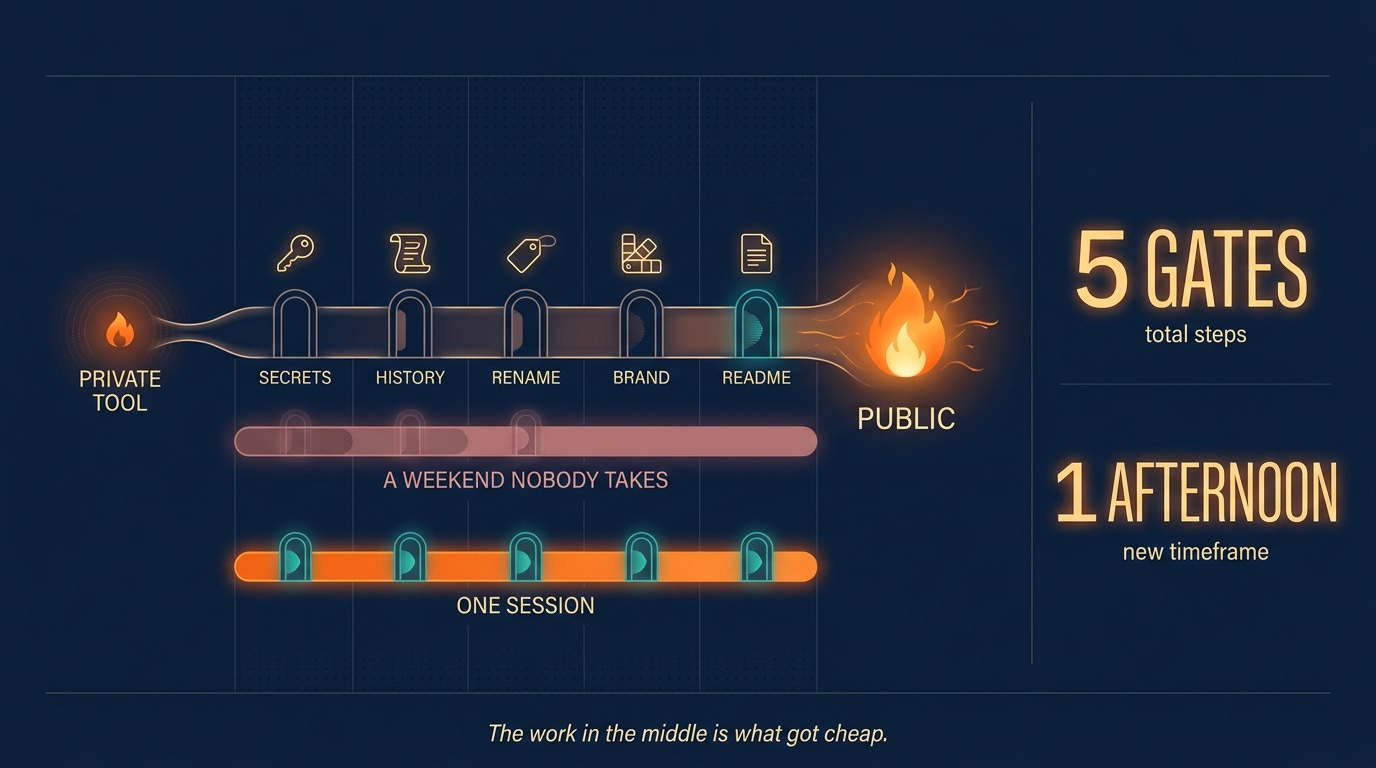
Small shift in cost, large shift in behavior. A lot of tools that solve one person's problem also solve a thousand other people's, and the only thing that kept them from those people was the tax in the middle. The tax is what got cheap today.
I've written before about delegation over automation: the move isn't handing a task to a machine and walking away, it's handing it the careful work and staying close enough to check the one judgment that matters. This was that. I didn't watch it rename files. I did look hard at the leak it caught and the call it made to start the history clean. The mechanics went to the model; the judgment stayed with me. That's the shape worth getting used to.
You can have what I have
The same shift works on the receiving end. The repo has a quickstart, but the truer install path now is a paragraph of English. Paste this into Claude Code (or Cowork) and let it drive:
Install Kindling, the self-hosted personal finance app, from
https://github.com/BioInfo/kindling. Clone it, check my Node version
(node:sqlite needs Node 22.5+), install dependencies, and read README.md and
PLAN.md before changing anything. Then walk me through Plaid credentials:
help me create a free account at dashboard.plaid.com, find my client_id and
Sandbox secret, and store them the way I prefer (pass entries
api-keys/plaid-client-id and api-keys/plaid-secret-sandbox, or exported env
vars). Generate an APP_ENC_KEY for me with openssl rand -hex 32. Start the
app with ./run.sh dev, confirm http://localhost:3408 responds, and walk me
through connecting Plaid's sandbox bank (user_good / pass_good, any OTP).
LLM features are optional: if I have an OpenAI-compatible endpoint (Ollama
counts), wire it up via local.env using local.env.example; otherwise skip,
everything degrades cleanly. When I'm ready for real accounts, walk me
through Plaid Production access and PLAID_ENV=production, and remind me to
keep the app private-network-only. Ask before anything irreversible.
It clones the repo, checks your machine, walks you through the one account signup a human has to do, generates your encryption key, starts the server, and connects a fake bank so you can see it working before any real money touches it.
If you're on a paid Claude plan, Fable 5 is free until June 22. The experiment costs you a paragraph.
Sharing used to mean writing install docs for every OS and fielding issues when step 4 failed on somebody's laptop. Now the README's job is to brief an agent. I ship one prompt; your agent handles your machine and its quirks. The distance closed on both ends today: cheap for me to publish, cheap for you to run.
The spark
The app didn't get better today. It worked last month and it works now. What changed is that the spark can leave my workbench.
For years the reason most personal tools never go public wasn't pride or secrecy. It was a weekend of dull, high-stakes scrubbing that no sane person does on a side project. Take that weekend away, replace it with an afternoon spent watching one model do the dull part and catch the dangerous part, and a different question shows up on the table.
Not can I build it. You could already build it. The question is whether the thing you built for yourself is about to start helping people you'll never meet. For the first time, the work standing in the way is small enough to actually do.
Mine is up now. It started as something I tend every day so my own ember catches. Turns out a spark spreads more easily than I thought.
Sources
Claude Fable 5: Anthropic's first public model in the new tier, shipped 2026-06-09.
Kindling: the open-sourced app, MIT-licensed.
EmberPlan: the FIRE-planning sibling, built months earlier on Sonnet 4.
Delegation, Not Automation: the judgment-stays-with-you frame this session ran on.