


Every Sunday I pick one paper or release that's worth your time, break it apart, and tell you what it changes. No hype. No summaries of summaries. Just the idea, explained.
I knew the Riemann hypothesis the way most people do. I'd heard of it, I knew it was one of the big open problems in math and had something to do with prime numbers, and that was about it. When the news broke on Friday that a mathematician working with Claude had proved it, I wanted to know more. I read up on the hypothesis and its history, read the note itself, and read a lot of the reactions, because I knew strong opinions would pour in fast. They always do when the story is "AI did something no human could do."
This post is what I took away from all that reading. I start with what happened and what the hypothesis says, then get into how you can trust a proof nobody has read when nobody understands it yet, not even the person who found it. After that come the reactions, from awe to grief. Where I land is that people built the tools and a person drove them, so the judgment about what it means stays with us. I think it's a human win, and the work of understanding it is still ours.
I also built a walk-through site to go with this post: nine rooms from 1859 to last Friday, where you can play with the primes and the zeros yourself. It was fun to build. Enjoy it. I learned a bunch building it and walking the museum.
The proof is four pages and 17 million lines
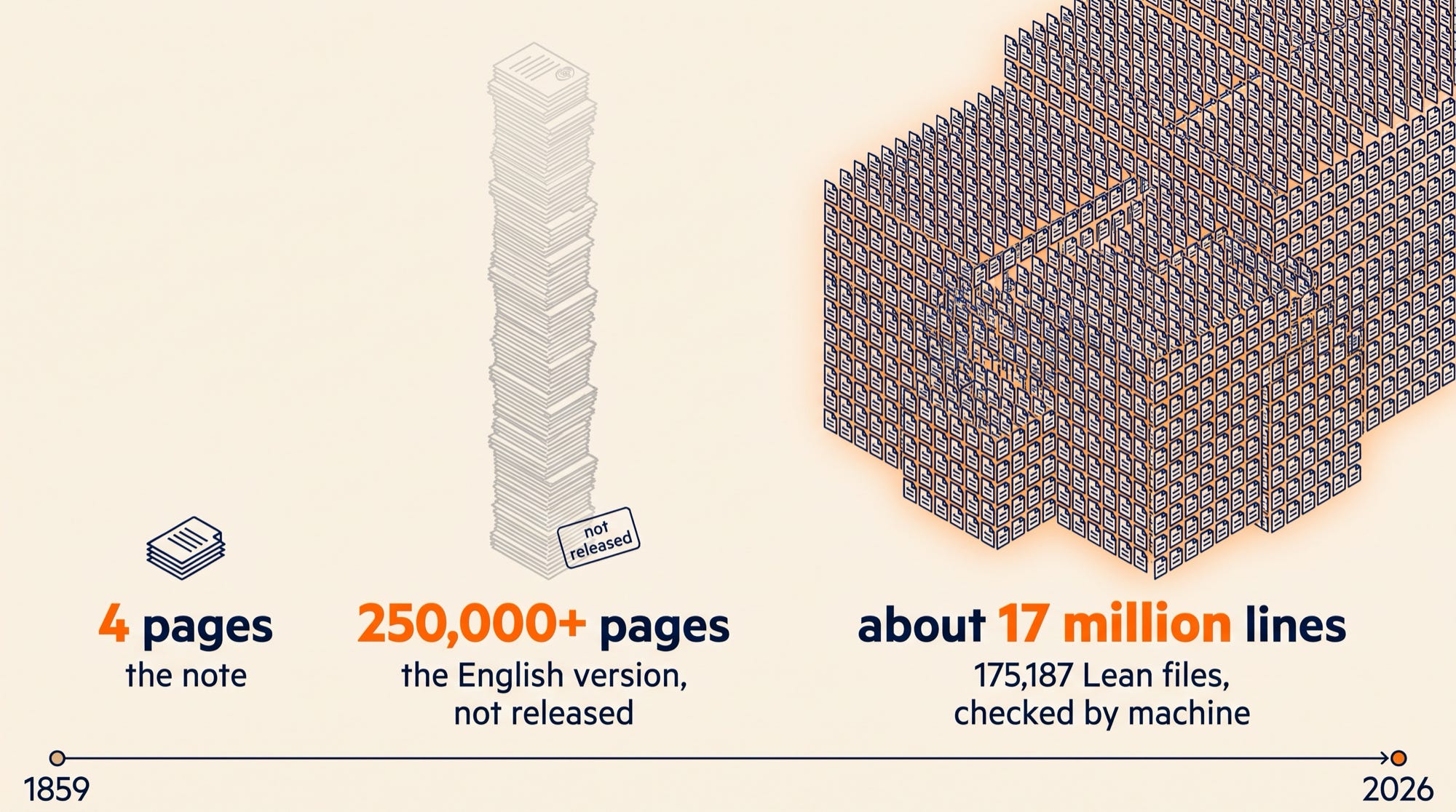
On Friday Levent Alpöge, a mathematician who works at Anthropic, the company that makes Claude, put a four-page note up on his website. It says that, working with Claude, he believes he's found a proof of the Riemann hypothesis, the most famous open problem in math, and of a broader version of it too. The four pages are mostly a cover letter. The note went up right after Anthropic's IPO, and he raises the cynical read of that timing himself and says it's false. That's worth knowing going in. The proof itself is written in Lean, a programming language for proofs, and it runs to about 17 million lines across 175,187 files, with no comments.
Nobody has read it, and at that size nobody could.
The timeline in the note starts on October 6 and ends on November 16. He also had Claude write the argument out in English, and that version ran past 250,000 pages. He didn't post it. He writes that posting some "massive unreadable travesty of 'slop'" would be wrong, so he only posted the Lean.
Brian Conrey, who has spent his career on this problem, told reporters it's the biggest thing that has ever happened in mathematics. James Maynard, a Fields medalist, was a bit more careful: historic, if it fully checks out. I think Conrey's probably right, but I'd squeeze tight on Maynard's "if" for now.
The hypothesis says the primes are as tidy as they can be
I only knew this at the surface, so I had to read up on it.
Prime numbers are the numbers you can't split: 2, 3, 5, 7, 11, 13. They look random. Nobody has a formula that hands you the next one, and the gaps between them jump all over the place. But if you count how many primes there are below some number, the count grows in a smooth, predictable way, and Gauss noticed that long before anyone could explain it.
In 1859 Bernhard Riemann wrote a short paper that explained why. He tied the primes to a function, now called the zeta function, and showed that the count of primes is a smooth curve plus a stack of waves. Each wave comes from a point where the zeta function equals zero. If you know where all those zeros are, you know how the primes are spread out.
Riemann guessed that all the important zeros sit on one straight line. He wrote that it was "sehr wahrscheinlich", highly likely, said he'd put it aside after a few quick tries, and moved on. That guess is the Riemann hypothesis.
If it's true, the primes are as orderly as they can possibly be. The count of primes never wanders from the smooth curve by much more than the square root of the number you're counting up to. The picture that stuck with me while I was reading came from Alex Kontorovich at Rutgers. He told Scientific American that the hypothesis is like an orchestra where every instrument plays at exactly the same volume. That works for me, because it means no one note gets loud enough to drown out the rest.
Peter Sarnak once guessed there must be over 500 papers that start by assuming it. If the proof holds, all of that work stands on solid ground. It's one of the seven Millennium Prize problems, with a million dollars attached.
You can trust a proof that nobody has read
Normally a proof is a paper written for people. Other experts read it, argue about it, find the gaps, and after months or years they agree it holds. Andrew Wiles's first proof of Fermat's Last Theorem had a hole in it that took over a year to fix.
Lean works differently. You write the proof as code, and a small program called a kernel checks that each step follows from the ones before it. If the kernel accepts it, the proof is correct, as long as two things hold: the kernel has no bugs, and the statement at the top of the proof means what we think it means.
Andrew Sutherland at MIT is running the checks and posting them on his verification page. As of Sunday afternoon every file compiles. The proof uses only the three basic axioms that all of Lean is built on, so nothing extra got slipped in. Lean also has backup checkers, written by other people in case the main one has a bug, and both of them accept the whole proof. That's the check that convinced me. Sutherland also rebuilt it in a sealed-off sandbox on a separate machine, and the exported proof came out identical down to the byte.
The question itself came from Mathlib, the shared library the Lean community maintains. The proof answers Mathlib's own statement of the Riemann hypothesis, not one Alpöge wrote.
Alpöge didn't get to write his own exam question, which is the first thing I'd check with anyone claiming a perfect score.
Computers have checked big proofs before. The four color theorem was proved in 1976 with a computer checking cases no person could. Thomas Hales's proof of the Kepler conjecture went to a team of 12 referees, who spent four years on it and still couldn't fully sign off, and a machine-checked version settled it in 2014. Each time, mathematicians complained and then got used to it. This one is a lot bigger, and the checking goes further than anything before it.
Nobody understands the proof yet, including the person who found it
A proof can be true without anyone understanding it, and the understanding is what mathematicians care about most.
Alpöge says this about the proof. In the note he describes himself as
"presenting the world with a complete argument before having mastered a massive neighbourhood around its mathematics."
Most of the mathematicians I read this week said some version of the same thing. You prove something to learn why it's true, and this proof doesn't tell you that yet.
People on X kept pointing to a 1994 essay by Bill Thurston, On Proof and Progress in Mathematics. I skimmed it, and it's a good read if you want to go further. He argued that math is people understanding things and passing that understanding on, and a proof is one way to do it. By that standard we have a true statement and almost none of the understanding so far.
The reactions run from wow to grief
Some of the reaction this week is awe. Alpöge writes about the result in almost religious terms, about miracles and transcendence. The main Hacker News thread ran past 1,800 comments, and once the technical arguing died down, a lot of it was people saying some version of wow.
Then there's the grief. A former research mathematician on Hacker News wrote that the human effort on a problem matters as much as the answer, and that handing it to a machine destroys that. The writer Fernando Borretti called the whole thing a betrayal and a surrender. The same day, a 940-page proof by Alessandro Masullo went up, written the old way by a person with no AI, and within about eight hours people had found problems in it, some of them using AI to do it. It's now under major revision.
The grief makes sense to me. A lot of mathematicians built their careers around problems like this one, and the chance of being the person who cracks it just got a lot smaller. I still don't think it's the right read of what happened.
Humans built the tool, and a human drove it
I'm with Andrew Sutherland on this. He's the one running those checks, and he said:
"to me this is a human triumph."
He also said that maybe the key step in the whole proof was building a machine that can think. People built that machine. The Lean community spent years on the language, the shared library and the checkers this result now leans on. A person, Alpöge, steered the work and, by his timeline, got there in six weeks.
Alpöge has worked with Claude on these zeros before. In August, an unreleased Claude model pushed the share of these zeros proven to sit on the line from about 42% to about two thirds. Alpöge and a colleague, both at Anthropic, checked that result, and Anthropic said at the time it didn't expect that method to lead to a full proof. I don't know that one led to the other, but it's the same person, three months later.
Judgment stays human, and checking is how we keep it
I've been saying for months, mostly about agents, that judgment stays human.
Earlier this year I wrote about reckoning and judgment, a split I borrowed from Melanie Mitchell. Reckoning is calculation: retrieval, search and inference at scale, which machines now do well. Judgment is knowing which question to ask, which answer to trust and when to stop. Nothing I've seen shows how far reckoning can go as clearly as a 17-million-line proof that a kernel signed off on.
Most of the judgment in this story is outside the 17 million lines. Alpöge picked the problem and steered the setup. He's also clear that Claude pulled ahead of him near the end and came up with a key step. Other people wrote the Mathlib statement he proved against, and the whole result rests on it meaning what mathematicians mean. Sutherland chose which checks count, and the field will decide what the proof is telling us.
We're going to generate far more than people can check by hand. The written-out version alone is past 250,000 pages. No referee is reading that, and no team of referees is either. The only reason anyone trusts this result is that the checking went to machines too, machines that people designed to be small, boring and hard to fool. Sutherland's page says he ran the checks with Claude Code.
In July I wrote about the failure that leaves no corpse: a check that can't fail will happily certify the wrong answer, and nothing will tell you. That's the risk with most of what we're about to produce. Most of what agents produce for the rest of us comes with nothing like Lean.
Lean is a check that can fail, and that's why I believe this result.
The next ten years are about the why
If the last checks come back clean, the question changes from whether the Riemann hypothesis is true to why it's true. I think that's the fun part.
People are going to take a 17-million-line proof apart and look for the short proof hiding inside it. Alpöge's own guess is that it will get massively simplified, and soon. Somewhere in those files there are new ideas and new methods for other problems, maybe whole new areas of math. That's awesome. Finding them is human work, and it's going to keep a lot of smart people busy for years.
The same thing is coming to the rest of science. In drug discovery we're getting models whose predictions we can test before anyone can explain them. Math got there first because it has the best checker in the world, and the rest of us are going to have to build ours.
For 167 years nobody knew if Riemann's guess was right. Now we probably know, and almost nobody knows why. I'd rather have that problem than the old one.
Sunday Deep Dive is a weekly series on Run Data Run. Every Sunday I pick one paper, release, or technique worth understanding, break it apart, and tell you what it means for your work. Free every Sunday, no paywall. If it was useful, the easiest way to support it is to subscribe and forward it to one person on your team who'd want it. If it wasn't, tell me why. I'll make it better.
Sources: Alpöge's note (alpo.ge), Andrew Sutherland's verification page (MIT, as of 22 November 2026, 16:20 UTC), the Clay Mathematics Institute, Anthropic's August 2026 research post, Thurston (1994), and coverage in Nature, Science, Scientific American, AFP and the Washington Post.