


Seven weeks ago, the day Opus 4.8 and Dynamic Workflows shipped, I wrote that the unit of agentic work had moved from one model call to dozens of verified ones, and that the open question was no longer whether the model is good enough. It was who is verifying.
I have been running fan-out as a daily default since. The field taught me things the launch-day post could not.
The economics held
The price math was the argument in May, and it played out the way the arithmetic said it would. Fifty parallel subagents on Fast at $10 in and $50 out stopped being a budget event. A review pass that spawns a skeptic per finding, a discovery sweep that runs five finders with different lenses and takes the union, a batch edit split across ten agents that each own a file. None of those feel like a stunt now. They feel like a Tuesday.
My own standing rule shifted to match. For anything that is a build, I hand the file-level work to subagents by default and keep the main context for the plan, the spec, and the diff review.
I do not decide to fan out. I decide not to, and only when there is a reason.
So the call on cost was right, and it was the easy call. The arithmetic was visible at launch.
The dispatch problem is still in my head
The harder prediction was the one I was least sure of. I said the question of when a workflow is the right shape, and when a single careful pass is, was unsolved and lived in your head. Seven weeks later it still lives there.
ultracode, the setting that makes Claude reach for a workflow on every task without being asked, still ships off. There is still no governance layer that says do not orchestrate this one. So the judgment of when to spend forty agents and when to spend one is mine, made fresh each task, and I get it wrong in both directions. I have fanned out a rename that a single pass would have finished cleaner and faster, and I have run one careful pass on a discovery job that wanted five blind finders and missed a third of the surface. Neither mistake announces itself. The over-orchestrated one costs more; the under-orchestrated one returns a confident, incomplete answer.
The tooling got cheaper. The taste did not.
The footnote became the fight
The part I could not see in May is the one that has cost me the most.
I called the verifier the priced skill and warned the tooling for one was thin. What I did not know is that the harness puts a hard ceiling on the verifier's ability to do its job. Every subagent is capped at 8,000 output tokens per response, and the model's own thinking counts against that budget. Set effort to xhigh, which is the Claude Code default, and an adversarial verifier asked to reason hard about whether a finding is genuine will think its way past the ceiling and die before it emits a single word of verdict. The tool call comes back with zero output. No finding, no error, no crash. Silence that reads exactly like a clean pass.
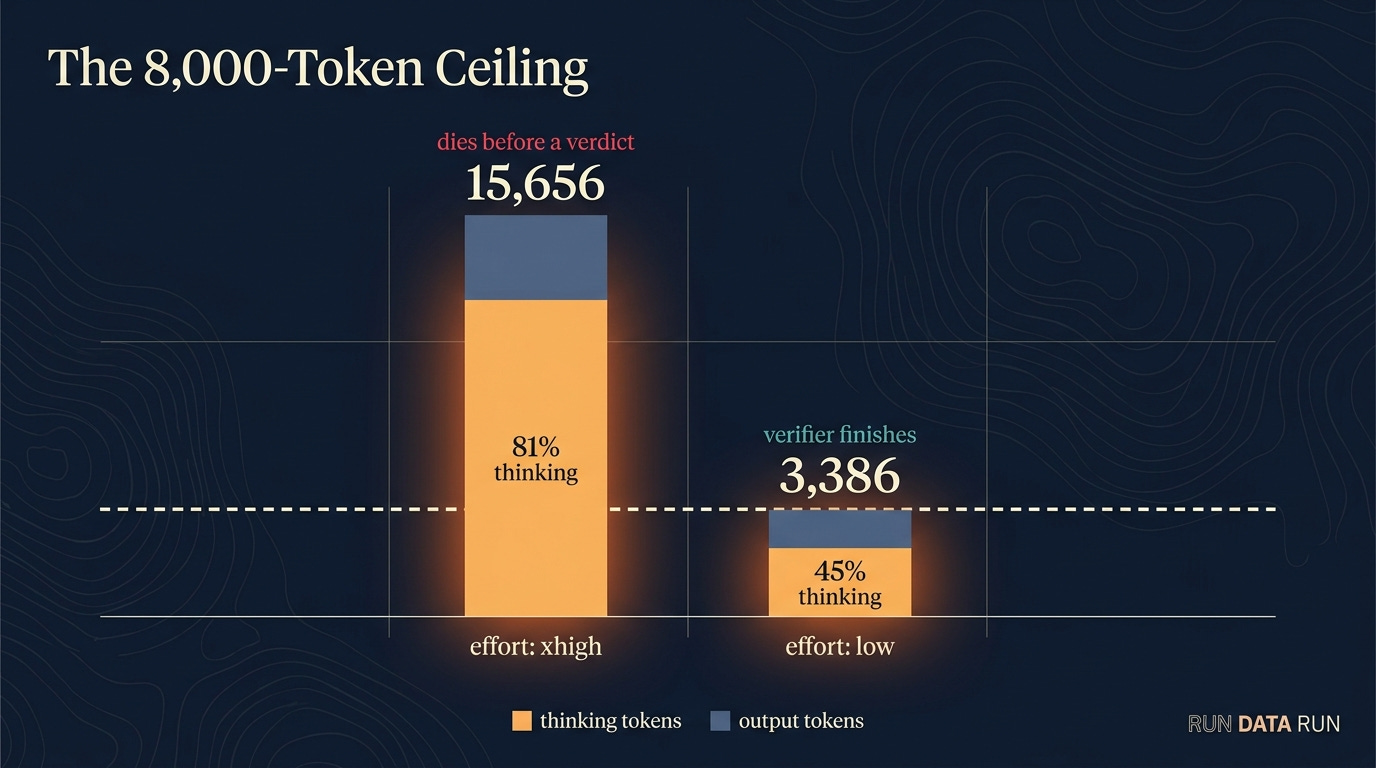
A verifier panel that looks like it ran and returns nothing is worse than no panel, because you trust the green. This is the failure I warned about in May, arriving through a door I did not know was there. The launch post said a fan-out that forwards fifty unverified findings is worse than the single pass it replaced.
A fan-out whose verifiers silently no-op forwards zero findings and tells you everything is fine.
The fix is mechanical once you know the ceiling exists. Bound what each agent writes, chunk large outputs across several small responses, and dial effort down for the producers so the verifiers have budget left to reason. But you have to know it is there. Most builders reaching for their first verifier panel do not, and the default settings hide it from them.
What I run now
Effort is not one dial for the whole job. The producers, the agents writing code and editing files, run low, because their work is mechanical and the reasoning tax buys nothing. The judges and verifiers keep the high effort, and I split their task so each verdict fits inside one response instead of one giant pass that overflows. The verifier gets a real design, not a one-line prompt bolted onto the end of the workflow.
In May the verifier was a line item. Now it is the thing I spend design time on.
The verifier is the only part of the pipeline that fails without telling you.
The frame still holds
The bridge between one model call and an agentic system is now a tool the model writes for itself, and the frameworks that were charging for that bridge have a lower ceiling on what they can charge. The vendor who ships the verifier primitive first still sets the pattern everyone copies.
I would add one clause to the closing line I wrote then. If the price of careful goes down, the price of casual goes up, and the default question stops being is the model good enough yet. It becomes who is verifying, and can your verifier afford to think.
Around the Corner: short reviews of ideas worth watching. Opt-in section, not part of the weekly Run Data Run email. [Subscribe to the main list](https://rundatarun.io/subscribe) for longer essays.Subscribe to the main list for longer essays.*