

I took a trip to New York with the fam in October and I was standing on Ellis Island when I started wondering whether anyone in my family had come through it. Grandma Holland, my mom's mom, could trace her family back to the Mayflower, and she said so with pride her whole life. I love solving problems with AI agents, and this looked like a fun one. That weekend I handed Claude my DNA, what the family already had and what everybody remembered, and set the agents loose.
The next morning an agent filled my cart with an AncestryDNA kit and a trial membership, then stopped at the payment page and waited for me. I clicked buy. By that night 48 agents had been out in the archives. Nobody in my family has ever been that interested in us.
About 500 agent runs later, I can tell you that none of my ancestors came through Ellis Island. It opened in 1892. My family was already here: the Winslows by the 1630s, a German family of tanners around 1850, and two more German lines in the 1880s, one of them through Baltimore.
I'd been standing at the wrong door the whole time.
It's the first of a few holiday posts about things I've built with AI for the people I love.
Four grandparents each had a story
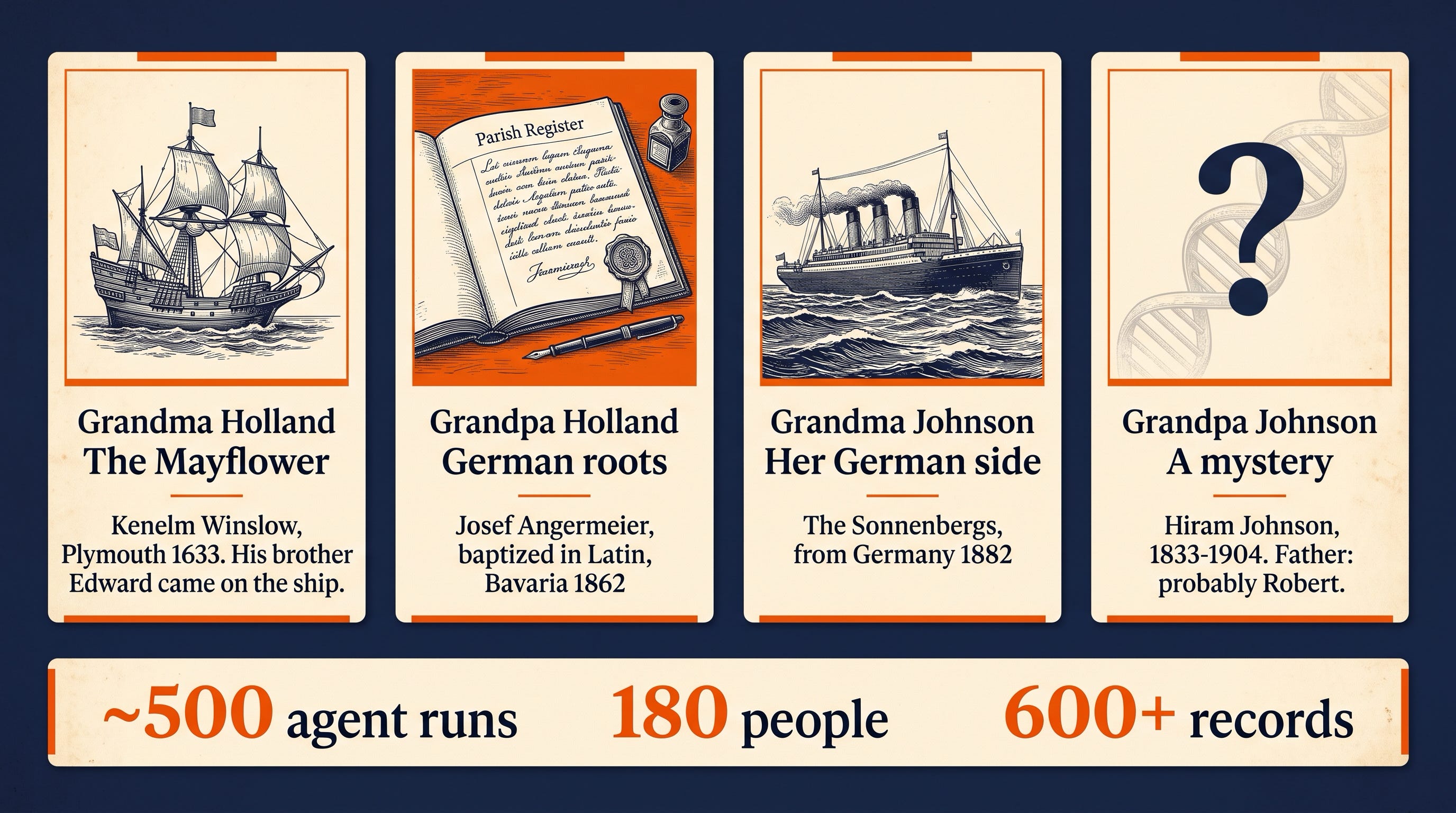
Every family has a few stories it tells about itself. Mine had one from each grandparent. Grandma Holland had the Mayflower. Grandpa Holland talked about Austrian and German roots. Grandma Johnson was proud of her German side. Grandpa Johnson was a mystery, and nobody knew much past his parents.
I wanted to know what the records would add to each story, and then tell it back to my family in a form they'd watch.
Small, cheap agents each took one person or one question and went looking: FamilySearch, Find a Grave, Ancestry, the old newspapers, and the German church books. A bigger model read what came back and put the pieces together. It works a lot like a research team, except nobody gets tired of reading obituaries. I trust what came out, because I built the system to be trustable.
The Mayflower came with a brother attached
Grandma Holland was born a Winslow, and her line had the best paper trail. Her grandfather's 1917 death certificate named his parents, and the census pages lined up behind it, back to a John Winslow born in 1825 in a lumber and coal county in western Pennsylvania.
Above 1825 the agents went to the family histories: a Winslow genealogy published in 1877 and the work of Winslow family historians since. The line runs up through Maine to Kenelm Winslow, a furniture joiner in Plymouth Colony by 1633.
Kenelm wasn't on the Mayflower. His older brother Edward was, and he was governor of the colony three times.
I think Grandma would have been fine with that. A Mayflower governor's brother at Plymouth is a pretty good family story. By Sunday evening the agents had turned the line into a three-minute narrated map film, Plymouth to Altoona, with the route drawing itself across the map by sea, river and rail. I sent it to my mom from New York. Her reply: "Wish Mom could have heard her history. She always said her ancestors came over on the Mayflower."
The German side was written in Latin and old script
Grandpa Holland's mother was an Angermeier, and that line took the agents to Bavaria. Josef Angermeier was baptized in 1862 in the parish of Roding, and the agents found the entry on Matricula, which puts Catholic parish books from across central Europe online for free. The entry is in Latin, in a priest's handwriting. The agents read it from the scan: born at seven in the morning, son of Michael, a cottager at Hochbrunn No. 1.
His marriage is in the same parish books, on May 2, 1888. Five weeks later Josef and his wife Franziska were on the dock at the Locust Point pier in Baltimore, where the railroad ran right to the ships, and from there they went on to German Altoona. I didn't find Austria anywhere, but Bavaria's right next door, so I'll give Grandpa that one.
Grandma Holland's side had Germans too, and they took the most work. The Elbels came from Tanna, a small town in Thuringia, and their records are in Lutheran church books scanned on Archion, in an old German script most Germans can't read today. The agents read three generations off the page images: a master brewer in the 1750s, then three generations of tanners. One entry has Eduard Elbel born at two in the afternoon on August 5, 1833. His gravestone in Pennsylvania has the same date. The online family trees had him born in the wrong town, and the church book settled it. Getting the hour a relative was born out of a 190-year-old church book is awesome.
The agents got one page's margin notes wrong the first time, and the fix came down to deciding that a looped squiggle was a 2 and not a 4. Fair enough. It's 230-year-old handwriting.
The Elbels got a film too. For that one I had a dozen agents build its 13 scenes in two waves. The narrator voice in the Winslow film had its own trouble with history: it couldn't say "hospital corpsman," which is what Grandpa Holland was in the Navy, and kept coming out with "coarseman." He's a Navy medic in the films.
Grandpa Johnson is the story I can't finish
Grandma Johnson's German side was the easy one. Her mother's family, the Sonnenbergs, came from Germany in 1882, and one of them was a tinner. She married Grandpa Johnson in Columbus on Christmas Eve 1947, and they ended up in Altoona. He became a life member of the Bavarian Aid Society there, a club that Bavarian railroad-shop workers founded in 1887, the year before the Angermeiers landed. For the family mystery, he spent a lot of time with my other grandfather's people.
The Johnson line is where the agents hit a wall. It runs back to a Hiram Johnson, born in 1833, who farmed in Union County, Ohio, and died in 1904, by his gravestone. Hiram's father was probably a Robert Johnson, born in Maryland around 1787. School records and an 1850 census household put them together. But one later census gives Hiram's father a different birthplace, and the agents haven't found a death record, a will or an obituary for Hiram.
This is also where I blew it. I had the agents scan 2,285 pages of handwritten census, and two different models disagreed on about one name in four. I shut it down.
Old handwriting still beats OCR.
The DNA made the mystery more interesting. The Y chromosome passes from father to son almost unchanged, so it usually travels with the surname. Mine is on a branch of J2a, a line that goes back to early farmers in Anatolia and is common today around the Mediterranean. The closest men on my branch share an ancestor who lived around 1345, give or take a couple of centuries, which is far too long ago to say anything about a surname, and they're all named something else. A Y-DNA test against other Johnson men would tell me whether the name has always traveled with this chromosome, or joined it later through a stepfather, an adoption or a new name in a new country. I haven't ordered one. I think I like having one story left open.
My mom had the best part
My mom sent the Winslow film on to my aunt and asked for the Angermeiers, the Shannons and the Hollands next. When the Elbel film went out three days later, she wrote back: "So amazing what AI can do. Just hope the world continues to use it for the good." She also decided my brains came from our ancestors, and I'm not going to argue with her. The next day she was listening to Viking music in case they turn up in the tree. So far, no Vikings.
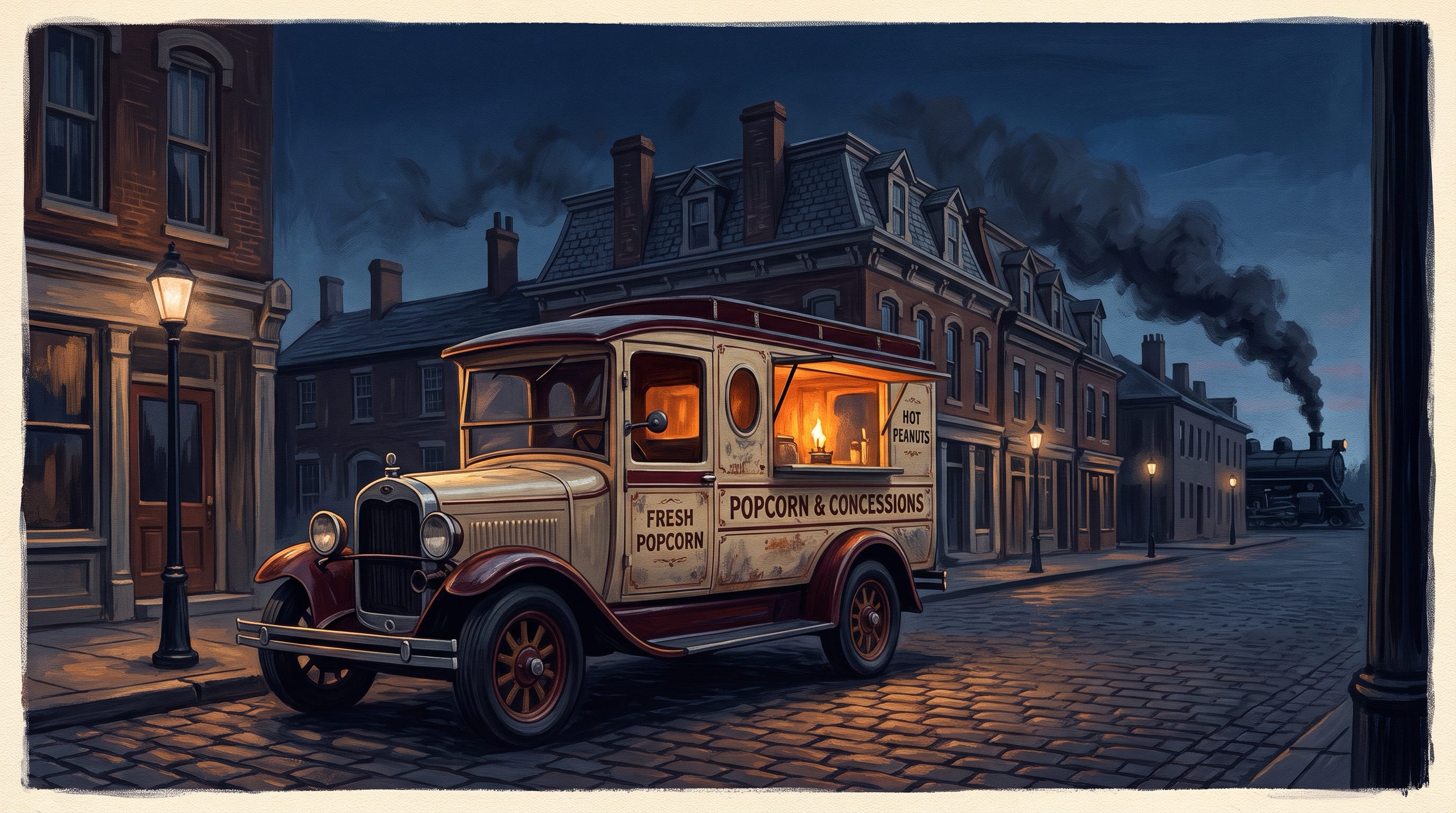
That night she texted me that my great-grandfather Holland had the first and only popcorn truck in Altoona, and his daughter Marie had the first ice cream truck. I had the agents put both into a storybook for her, a little book about where she comes from, with a page of questions at the end for her to circle so we'd know what to make next. Less than half an hour after her text, the popcorn truck was in the book and on its way to her phone.
Then she wrote about Saturdays. Her dad took her to visit his mother every week. His mother was Mary Catherine Angermeier, the daughter of Josef from the Latin baptism and Franziska from the Baltimore pier. My mom remembers her as the kindest woman, cooking for up to 15 people in a tiny kitchen: homemade pizza, pies, canned green peppers, and a homemade ketchup my grandfather loved. My mom still has the recipe.
The agents found Mary Catherine's parents in a Latin parish book in Bavaria.
They couldn't have found the ketchup.
Grandma Holland died at home in Altoona in 2024, at 92. She spent her life telling people her family came over on the Mayflower. What I got was her daughter on the other end of a text thread, telling me I was bringing her back to a lot of good memories. The next book is my mom's side of the family, and it goes to her for Christmas.
How I built it
The family tree lives in Gramps Web, an open-source genealogy app, running on a small always-on computer at home. I gave it a family-album look so it feels like something you'd pull off a shelf. On top of it sits an app I built and named Manifest, after the ship manifests at Ellis Island. It holds the research queue, every record the agents found, the DNA results and a list of open questions. The agents write their findings to Manifest, not straight into the tree. A finding moves into the tree only when it clears a bar I set.
About 500 agent runs, nearly all of them in the first ten days, with 48 on the busiest day. Small, cheap models each searched for one person or one question: FamilySearch, Find a Grave, Ancestry and its newspapers, Archion for the German Lutheran books and Matricula for the Bavarian Catholic ones. A bigger model read what came back and put the tree together. The tree is at 180 people and more than 600 records so far.
The agents also made things: three short narrated films, with a team of agents building the scenes in parallel, nine written family stories and a storybook.
Not everything paid off. They built a searchable copy of the Pennsylvania death index, all 173,909 pages of it, and it found one record.
The agents stopped at every payment page so I could click buy myself.
Total cost: my AI subscription, about $64 for Ancestry and the DNA kit, and about 20 euros for a month of German church books. The ketchup recipe was free.