

Some version of this question arrives most weeks. How do you keep up? You have a day job. The field moves every single day. What are you reading?
For a long time I answered it badly. I would say something about reading a lot, which is true and completely useless to the person asking. The real answer took me a while to say out loud, because it sounds like a dodge.
I stopped trying to keep up. I built something that keeps up for me.
Bookmarks are where links go to die
Nobody is reading this field. Not all of it, not close. Papers land overnight. A lab ships a model on a Tuesday and by Thursday other teams have published what breaks about it. The people who look like they are on top of it are not reading faster than you. They have narrowed, or they have automated, or they are bluffing.
Manual curation was my first answer, and it failed the way manual curation always fails. Open tabs became a graveyard. Saved links went unread and, worse, went stale.
A link I saved in March, about a model superseded in April, is not information anymore. It is clutter with a timestamp.
Newsletters helped until I was subscribed to a stack of them and reading none. The problem was never that I lacked sources. I had too many, arriving on their own schedules, with no shared memory between them.
One pipe
So I built a wire.
Several channels I already had running now point at one place. A scan that reads the day's news, releases, and research. The things I bookmark as I go. Findings from a small set of AI assistants I run, each pointed at its own beat. My own written breakdowns of the papers and tools and companies I sit down and work through by hand. Things I email myself at midnight and would otherwise never see again.
All of it lands in one store, scored and deduplicated. No single source has to be the right source, because none of them carries the day alone. And nothing gets read twice, because the store already knows it saw that story on three feeds this morning.
Two things come out the other end.
The first is private, and it is the part I use every day without thinking about it. The store is a knowledge base that refreshes itself, and my own AI tools read from it directly. When I sit down to write, or research something, or work a problem, the context they pull from is current. Not their training data. Not a stale snapshot I remembered to update. This morning's.
The second is public. A curated slice of the store becomes a website: a daily dispatch of the items that scored highest, written up rather than merely linked, so you know why something mattered before you decide to click it.
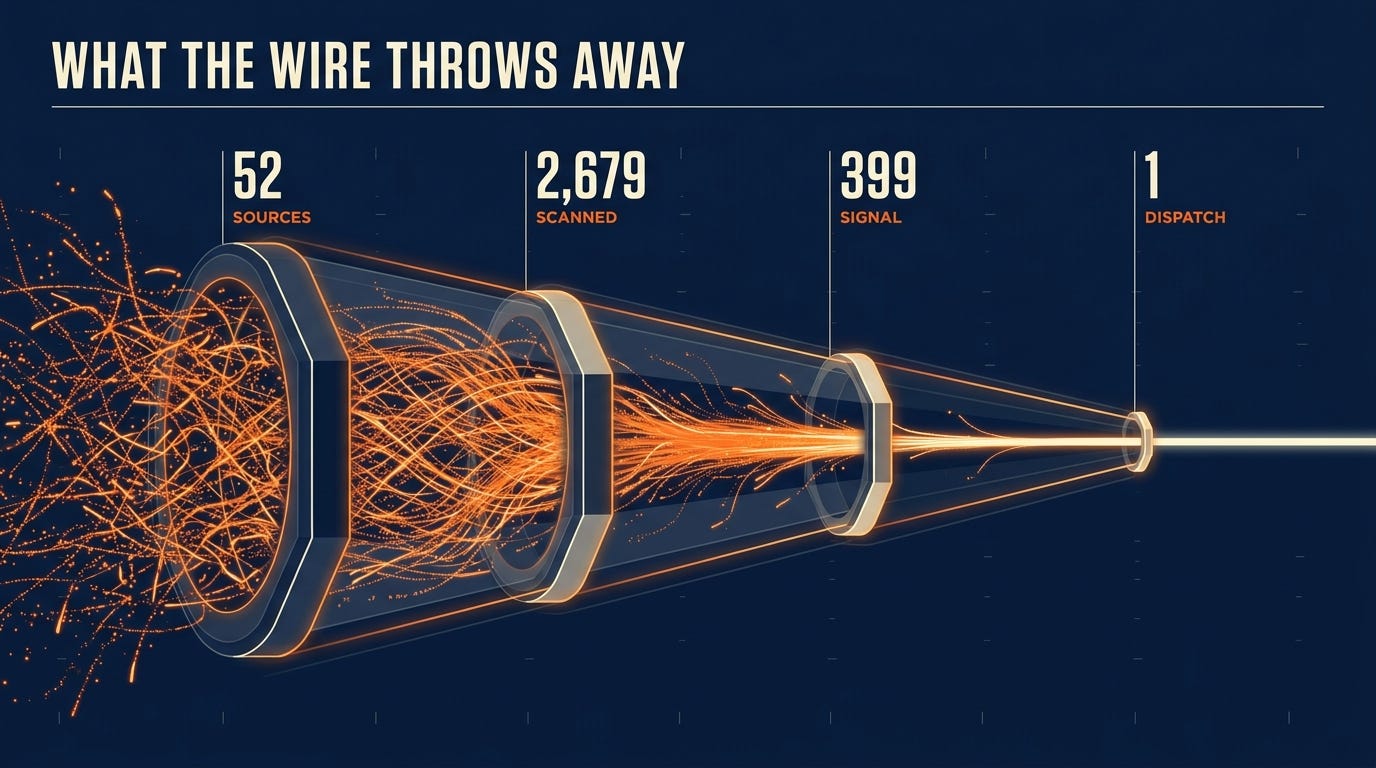
I like the arithmetic of it. The wire watches fifty-two sources. Over the last month it read and scored two thousand six hundred and seventy-nine items, and three hundred and ninety-nine of them cleared the bar. Yesterday's dispatch came out of a hundred and twenty-one signals. The site puts it more plainly than I would: it reads about seven things so you read one.
Fifty-two sources in. One page out.
What lands is a page I can get through with coffee.
The wire is the front door
This is not a side project I bolted on. It sits at the front of everything else I make.
What scores highest is usually what I end up writing about, because the things worth six hundred words announce themselves by refusing to go away. What I write becomes what I post. What I post brings back arguments and corrections from people who know more than I do about some corner of it, and those go back into the store as research. The loop closes. One pipe, several outlets, and the website is only the visible tip of it.
I did not design it that way at the start.
I built the scan because I was drowning. Then I noticed the thing that solved the drowning was also the thing deciding what I had to say.
Go look at it
The daily dispatch is free, it is public, and it lands every morning: wire.rundatarun.io/briefs. The day's signals, grouped by what they are, with a source link on every item so you can go argue with the original instead of taking my read on it.
Underneath it, the firehose shows you the machinery. The whole intake, the filter that thins it, and the last seven days in the raw.
What it does not show you is the store underneath. The complete searchable archive, the picks I would put in front of you myself with the reasoning attached, the decode and dossier library, the week ahead before it is news. That layer is not free, and it is not open yet. There is a waitlist at the bottom of the firehose page, and if the arithmetic up there sounded like your problem too, put your email in it.
Here is the whole thing, start to finish, in about forty-five seconds.